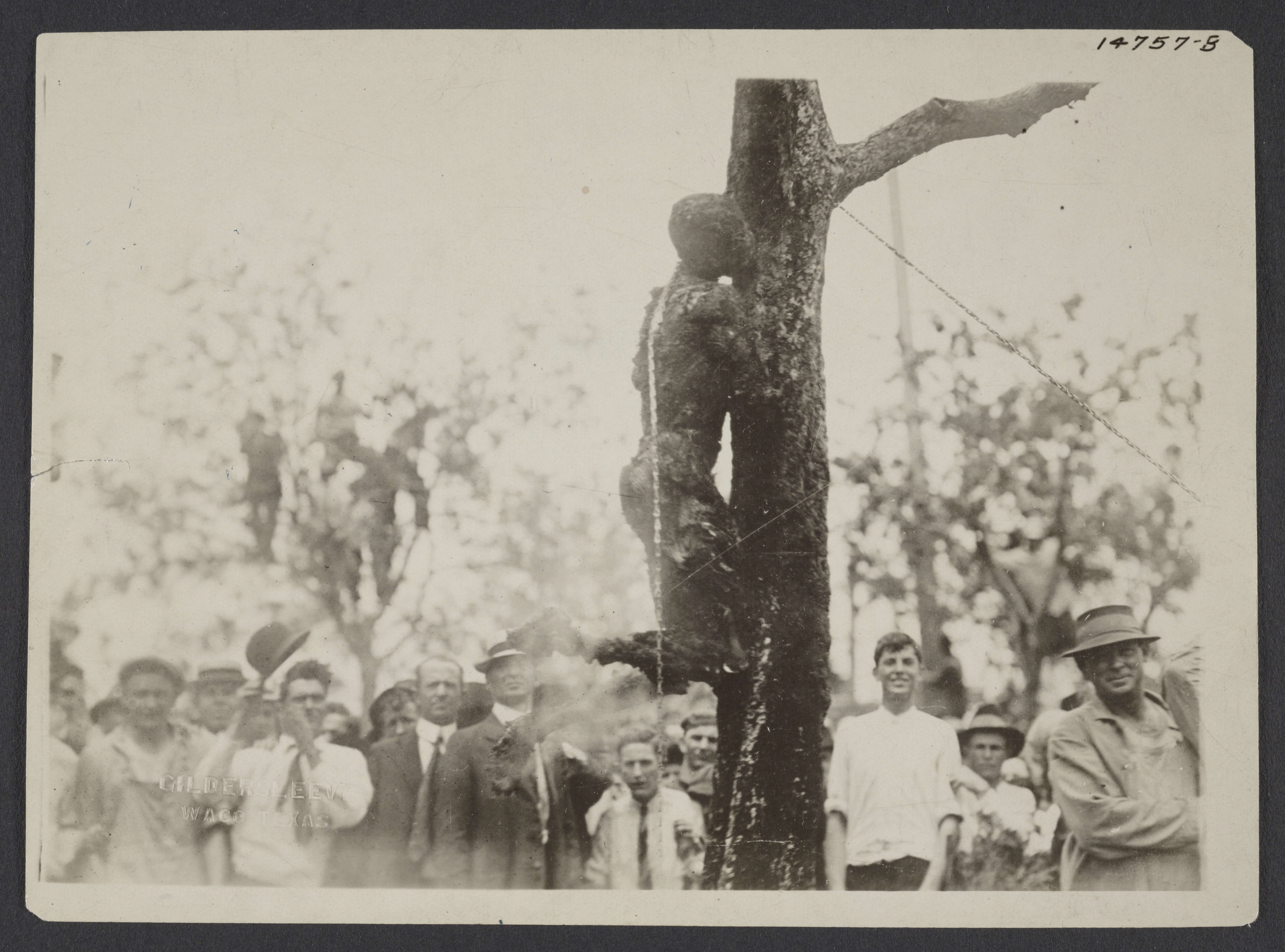
Lynching of Jesse Washington
The jury deliberated for four minutes. After a trial lasting roughly one hour in a Waco, Texas, courtroom packed beyond capacity, seventeen-year-old Jesse Washington was found guilty and sentenced to death for the murder of Lucy Fryer. Court officers moved to escort him away. They never reached the door. A surge of spectators seized Washington, chained him by the neck, and dragged him out of the courthouse. What followed -- in broad daylight, at midday, in front of Waco's city hall, with the mayor and chief of police looking on -- was one of the most thoroughly documented lynchings in American history. A professional photographer captured it frame by frame. The images were printed as postcards and sold in town. The date was May 15, 1916.
A City's Thin Veneer
Waco in 1916 was a prosperous city of more than 30,000 people that had spent years cultivating a pious, respectable image, sending promotional delegations across the country. A Black middle class had emerged, along with two historically Black colleges. But journalist Patricia Bernstein, in her 2006 study of the lynching, described the city as having a 'thin veneer' of peace. Racial tension ran beneath the surface: local newspapers emphasized crimes committed by African Americans, and in 1905, a Black man named Sank Majors had been lynched and hanged from a bridge near downtown. Several factors heightened racial hostility in 1916 -- among them the screening of The Birth of a Nation, a film glorifying the Ku Klux Klan, and the circulation of photographs from a recent lynching in nearby Temple, Texas. Between 1890 and 1920, approximately 3,000 African Americans were killed by lynch mobs across the South. Waco was no exception to the pattern.
The Fryer Farm
On May 8, 1916, in the small community of Robinson, Texas, Lucy Fryer was found clubbed to death in the doorway of her farm's seed shed. She and her husband George were English immigrants, well respected in the rural community. McLennan County Sheriff Samuel Fleming investigated and suspicion fell on Jesse Washington, a seventeen-year-old Black farmhand who had worked on the Fryers' property for five months. Deputies found Washington at his home wearing blood-stained overalls. He was interrogated without an attorney or his parents present. Washington initially denied involvement, but after being transferred between counties -- first to Hill County, then to Dallas -- he eventually confessed to the killing, describing the murder weapon and its location. Fleming confirmed finding a bloody hammer where Washington indicated. Washington was assigned several inexperienced lawyers who prepared no defense. His confession was published in Waco newspapers, which sensationalized the crime. A grand jury returned an indictment on May 11, and the trial was set for four days later.
The Waco Horror
The courtroom was standing room only on the morning of May 15. More than two thousand spectators surrounded the building. One man pointed a gun at Washington as he was led in. The trial proceeded quickly: the defense challenged none of the prosecution's jury selections. When asked about the offense, Washington replied, 'That's what I done,' and quietly apologized. After the four-minute deliberation and guilty verdict, the mob overtook the court officers. Washington was stripped, stabbed, and beaten as the crowd dragged him toward city hall, where a bonfire had been prepared. He was doused with oil, castrated, hanged from a tree by a chain, and lowered repeatedly into the flames over roughly two hours. Bystanders collected his bones as souvenirs. Children snapped teeth from his skull to sell. His charred remains were dragged behind a horse through town. An estimated 10,000 to 15,000 people watched. Schoolchildren attended during their lunch hour. No one was arrested. Sheriff Fleming had told his deputies not to intervene.
Elisabeth Freeman's Investigation
The NAACP dispatched Elisabeth Freeman, a women's suffrage activist already in Texas, to investigate. Posing as a journalist, Freeman found most Waco residents reluctant to speak. She obtained photographs of the lynching from Fred Gildersleeve, the professional photographer who had documented it -- possibly at the mayor's invitation. Freeman determined that white residents were generally supportive of the lynching but upset by the mutilation. She identified the mob's leaders as a bricklayer, a saloonkeeper, and several ice company employees. Freeman concluded that Washington had killed Fryer but that the rape accusations were false. She reported that a schoolteacher who knew Washington described him as illiterate and that all attempts to teach him to read had failed, suggesting limited intellectual capacity. W. E. B. Du Bois, NAACP co-founder and editor of The Crisis, published Freeman's findings with photographs in a special supplement titled 'The Waco Horror' -- the first time the organization's newsletter had published images of a lynching. The issue reached a circulation of 30,000, three times the NAACP's membership at the time.
Seeds of Collapse
Newspapers across the country condemned the lynching within days. The New York Times declared that 'in no other land even pretending to be civilized could a man be burned to death in the streets of a considerable city amid the savage exultation of its inhabitants.' Even southern papers that had previously defended lynching refused to justify what happened in Waco. The NAACP distributed its report to hundreds of newspapers and politicians, catalyzing what historian Amy Louise Wood calls 'a defining moment in the history of lynching.' Wood argues that with Washington's death, 'lynching began to sow the seeds of its own collapse.' The photographs that were meant to celebrate white power instead revolted the nation. By the late 1920s, Waco authorities had begun protecting Black residents from mob violence -- not from moral awakening, but from fear that negative publicity would drive away business investors. On May 15, 2016, one hundred years after the killing, the mayor of Waco formally apologized to Washington's relatives. A historical marker now stands near the site. In the 2018 film BlacKkKlansman, Harry Belafonte portrays a witness recounting the lynching to a civil rights rally -- ensuring that Jesse Washington's name endures in the national memory.
From the Air
Located at 31.558°N, 97.130°W in Waco, Texas. The lynching took place in front of the old Waco City Hall, near the McLennan County Courthouse in the downtown area along the Brazos River. A historical marker now stands at the site. Best viewed at 2,000-4,000 ft AGL. Nearest airports: KACT (Waco Regional Airport, 7 nm NW), KCNW (TSTC Waco Airport, 5 nm NE). Baylor University campus is visible to the northwest. The Brazos River curves through downtown, with the suspension bridge and courthouse area marking the approximate location.