Lyndon B. Johnson National Historical Park
Every day of his presidency, Lyndon Baines Johnson phoned his ranch foreman in the Texas Hill Country. He wanted the weather, the grazing conditions, and the medical status of every head of cattle on the property. Even from the Oval Office, with Vietnam escalating and civil rights legislation on his desk, LBJ kept one ear tuned to the land along the Pedernales River where he had been born, raised, and would ultimately be buried. That attachment to place defines Lyndon B. Johnson National Historical Park, a two-site unit of the National Park System that stretches from a white frame boyhood home in Johnson City to the sprawling ranch near Stonewall that the world came to know as the Texas White House.
Born on the Pedernales
Johnson entered the world in a small house down the riverbank from his aunt's home on the family ranch. The structure was built in the "dogtrot" style, named for the open breezeway running through its center to catch every breath of wind during the brutal Texas summers. The original house fell into disrepair and was demolished in the 1930s, but Johnson had it reconstructed during his first presidential term using historically accurate building techniques. He then landscaped the grounds in 1960s fashion -- expansive St. Augustine grass, squat shrubs, and towering oak and pecan trees -- a sharp contrast to the "swept" dirt yards his parents, Sam Ealy and Rebekah Baines Johnson, had maintained in the early 1900s. The National Park Service preserves this presidential-era landscaping to this day. When LBJ was four years old, in 1912, the Johnsons moved to a white frame house with large porches in Johnson City, a few blocks off Highway 290. It was from that front porch that the young man would later launch his congressional bid.
The Texas White House
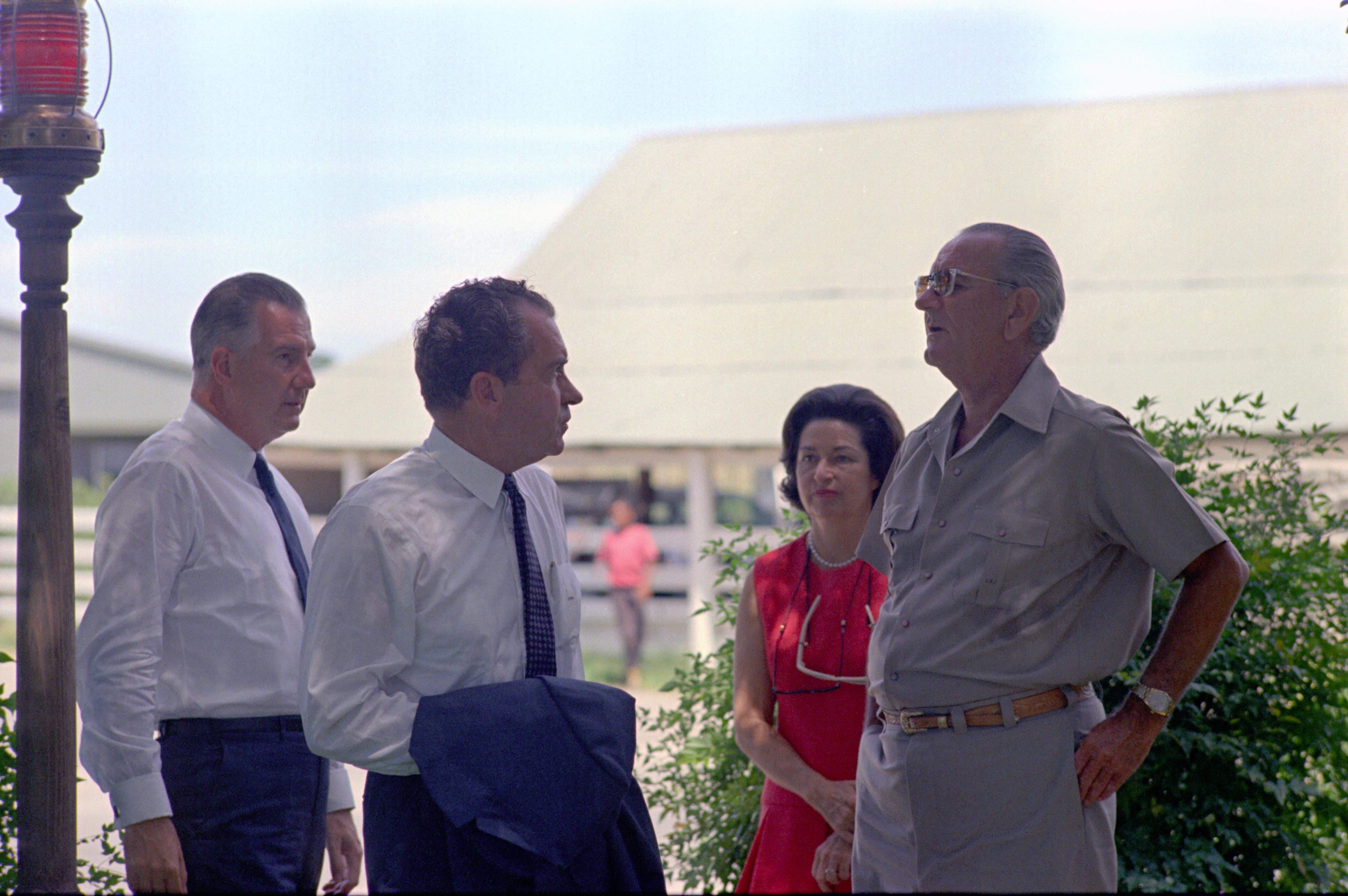
Johnson purchased the ranch from his aunt in the 1940s while serving as a U.S. Senator and spent the rest of his life accumulating land along the Pedernales, pronounced per-der-NAL-as by the locals. During his presidency, the ranch became a second seat of government -- foreign dignitaries flew in, cabinet members strategized in the living room, and press conferences unfolded on the lawn with Hereford cattle grazing in the background. President and Mrs. Johnson donated the ranch and the boyhood home to the American people in 1972, reserving the right to live there for the rest of their lives. After Johnson's death from a heart attack in January 1973, Lady Bird continued living in the Texas White House until her final hospitalization in July 2007. The Secret Service turned over the last portions of the property to the National Park Service after her passing. LBJ's office was opened to the public on August 27, 2008 -- what would have been his 100th birthday.
Wildflowers and Lady Bird's Legacy
Across the Pedernales from the federally owned ranch lies the Lyndon B. Johnson State Historical Park, managed by the State of Texas since 1970. Its rolling pastures blaze yellow with wildflowers in early summer, a living tribute to Lady Bird Johnson's tireless conservation work. She persuaded her husband to push the Highway Beautification Act of 1965 through Congress, planted the first tree funded by the project in Washington, D.C., fought to preserve the natural shoreline of Town Lake in Austin -- now renamed Lady Bird Lake in her honor -- and founded the National Wildflower Research Center. Friends and staff seldom saw her on the ranch without a pocket full of wildflower seeds. Over 25 species of conspicuous wildflowers bloom here in profusion each spring, among roughly 100 types of native grasses including little bluestem, switchgrass, and Canada wild rye.
A Working Ranch, Still
LBJ insisted, as a proviso of his donation, that the park maintain the ranch as a working operation. The National Park Service honors that condition today with approximately 100 to 125 head of white-faced, registered Hereford cattle and a small herd of Longhorn cattle and horses in the Johnson Settlement. The Pedernales River, fed by springs and holding a steady temperature in the 60 to 70 degree range, nurtures a rich ecosystem along its banks. Bald Eagles winter in the area. The endemic Guadalupe Bass and Texas Map Turtle inhabit the clear water. Eastern and western bird species mingle on the Edwards Plateau -- Painted Buntings, Scissor-tailed Flycatchers, and Black-chinned Hummingbirds nest among the live oak and mesquite grasslands each summer. Prairie grasses cover rolling hills dotted with mesquite and juniper, but near the river the landscape softens to lush green pastures beneath towering pecans -- the quintessential Texas Hill Country that a president carried in his heart from cradle to grave.
From the Air
Located at 30.24N, 98.62W in the Texas Hill Country between Austin and Fredericksburg. Elevation 1,000-2,500 feet. The ranch and Johnson City sites are separated by about 14 miles along US Highway 290, visible as green pastures along the Pedernales River corridor. Nearest airports include KAUS (Austin-Bergstrom International, 50 miles east) and T82 (Fredericksburg, 16 miles west). Clear conditions typical; hot summers with temperatures frequently exceeding 100F June through September.