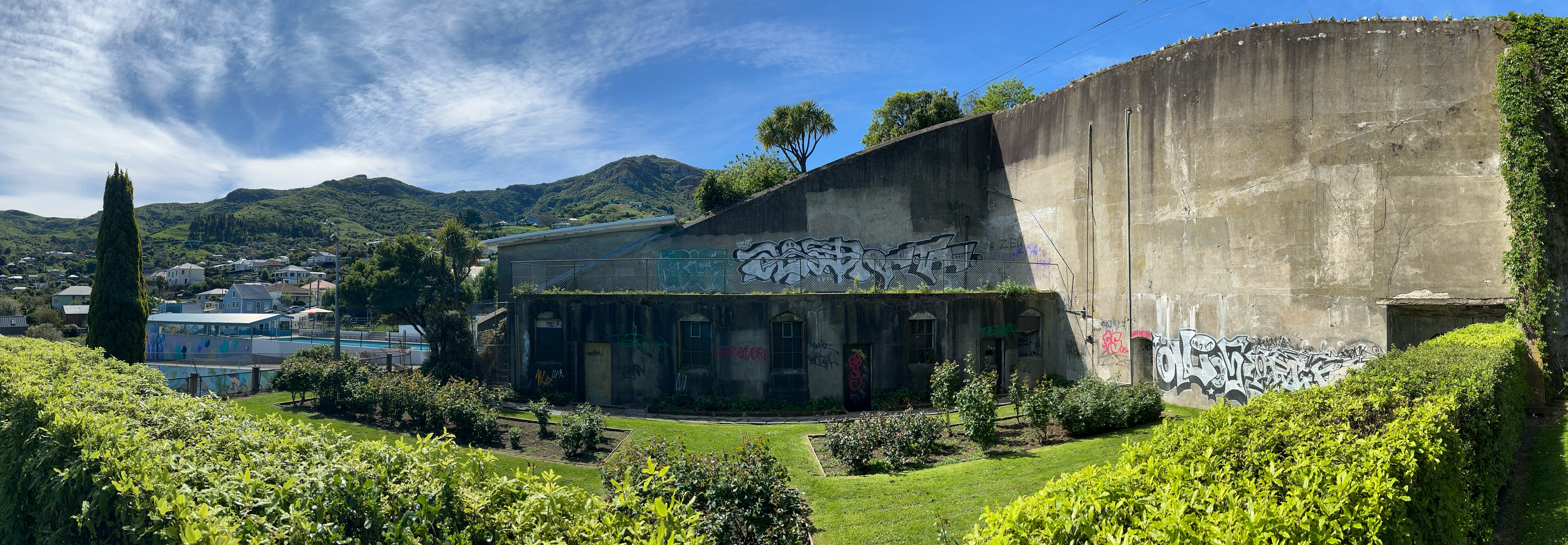
Lyttelton Gaol
The walls went up before the town was finished. In 1851, just a year after the first Canterbury settlers arrived on the First Four Ships, construction began on a gaol in Lyttelton - a prison for a colony that barely existed yet. Designed by Benjamin Mountfort, who would go on to shape much of Canterbury's Gothic Revival architecture, and built by contractor William Chaney, the Lyttelton Gaol was the region's first prison. Its stones came from Otamahua / Quail Island in the harbor, and its walls were crowned with broken glass and metal spikes. From the start, this was a place that meant business.
Convicts Who Built the Town
The gaol's inmates did not sit idle. Hard-labour gangs were sent out to do the public works that a young port town desperately needed: reclaiming land from the harbor, constructing wharves for the Port of Lyttelton, building roads, and laying retaining walls along the steep hillsides. The irony was sharp - men imprisoned by the colony were literally constructing the infrastructure that made the colony function. Many of those retaining walls and harbour works still stand today, embedded in the fabric of modern Lyttelton without any plaque to mark who built them. The convicts' labor was essential to the development of what would become Christchurch's gateway to the world, a port through which settlers, goods, and ambitions flowed for more than a century.
Stone, Glass, and the Gallows
The main gaol building was a substantial stone structure, its blocks quarried from Quail Island and ferried across the harbor. A high stone wall surrounded the compound, the top lined with embedded broken glass and metal spikes - a practical brutality common to colonial prisons. The gaol's rules and regulations were first published in 1857, and construction was largely complete by 1861. Between 1868 and 1918, seven men were hanged at Lyttelton Gaol for murder. William Donald served as the gaol's medical officer during the 1860s, tending to prisoners in a facility that offered little in the way of comfort or rehabilitation. By the 1870s, the colony had outgrown its first prison, and a newer, larger gaol was built in Addington to handle Canterbury's expanding population.
What the Concrete Remembers
After the Addington gaol took over as Canterbury's primary prison, Lyttelton's gaol faded from active use. But the structure did not disappear entirely. The high concrete walls at the rear and along one side of the former gaol compound survive to this day, and they carry a significance beyond their function. These walls represent one of the earliest known uses of concrete in New Zealand - an archaeological curiosity that speaks to the experimental nature of colonial construction. Heritage New Zealand has listed the site as a Category 1 historic place, recognizing both the physical remains and the stories they contain. The walls stand in a town that was reshaped by the 2010 and 2011 Canterbury earthquakes, which destroyed many of Lyttelton's historic buildings. That these gaol walls endured where so much else fell adds an unintended layer to their meaning.
A Colony's Mirror
Every settlement reveals itself through what it builds first. Lyttelton built a port, a path over the hills, and a prison - in roughly that order. The gaol tells a story about priorities, about a colonial society that arrived with English legal frameworks packed alongside its provisions and needed somewhere to enforce them almost immediately. It also tells a story about labor and power: who built the colony's infrastructure, and under what conditions. Walking through Lyttelton today, past the surviving gaol walls and along the harbour that convict hands helped shape, the layers of history compress. The Saturday farmers market fills a school ground a few minutes from where men once broke rocks. The cruise ships dock at a port whose earliest wharves were built by prisoners. The past does not announce itself, but it is there in the stonework if you know where to look.
From the Air
Located at 43.60°S, 172.72°E in Lyttelton, on the southern shore of Lyttelton Harbour within the caldera of an extinct volcano. The town sits below the Port Hills from Christchurch. The gaol site is in the hillside area above the commercial center. Nearest major airport: Christchurch International (NZCH), approximately 12 km northwest. The harbour and its volcanic caldera shape are clearly visible from altitude. Best viewed at 2,000-4,000 ft for detail of the town layout.