M-Wave: The Olympic Cathedral That Paid for Itself
Five world records fell here in twelve days. During February 1998, the world's fastest speed skaters converged on a brand-new arena in eastern Nagano City, its roof an enormous undulating wooden canopy designed to echo the mountain peaks visible through its windows. Marianne Timmer, Gianni Romme, Claudia Pechstein, and Adne Sondral each shattered world records on the M-Wave's 400-meter oval, the first ISU-standard indoor double-track in Japan. Then the Olympics ended, and the question that haunts every host city arrived: what do you do with an 18,000-seat speed skating arena when the world goes home?
Mountains Made of Wood and Steel
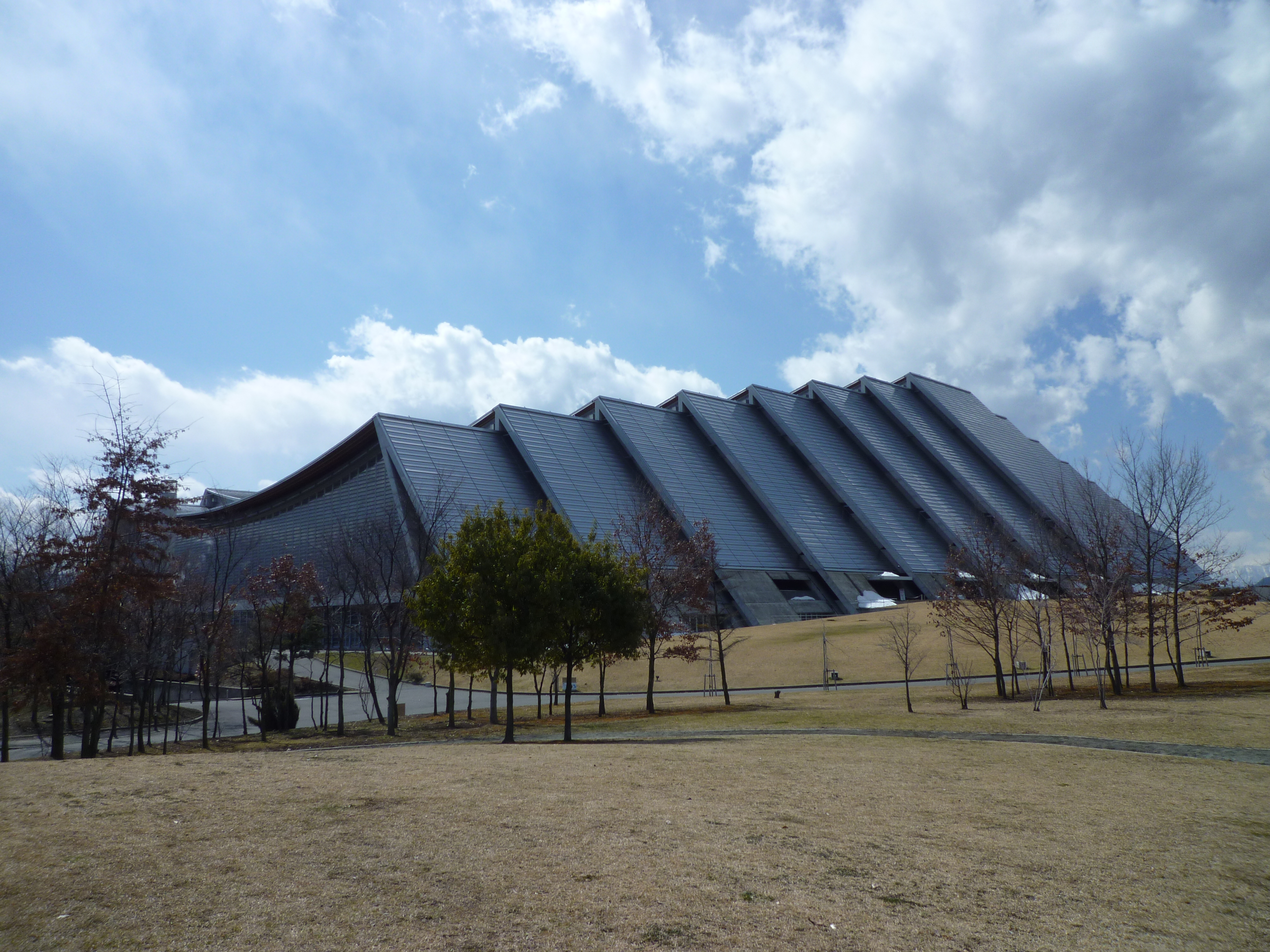
The building's name tells its story. M-Wave refers to the undulating profile of the roof, which was deliberately shaped to mirror the peaks of the Japanese Alps surrounding Nagano. Completed on November 21, 1996 -- the fourth Olympic venue finished for the 1998 games -- the arena earned a Special Award from the British Institution of Structural Engineers for its engineering. The roof is one of the largest hanging wooden structures in the world, a sweeping canopy of timber and cable that creates vast interior space without columns to obstruct sightlines. Inside, the 400-meter speed skating oval wraps around a regulation ice hockey rink. Two movable grandstands, each seating 1,210 spectators, can be repositioned to transform the arena from a skating venue into a concert hall or even a football pitch, using an automatically winding artificial lawn system. The arena sits near the Chikuma River in Nagano's eastern neighborhoods, within a few kilometers of four other 1998 Olympic venues.
Twelve Days of Ice and Glory
The 1998 Winter Olympics brought twenty-five nations to M-Wave's oval for long-track speed skating between February 8 and 20. Ten events were contested -- 500, 1000, 1500, and 5000 meters for both men and women, plus the women's 3000 and men's 10,000. The Netherlands dominated with eleven medals, followed by Germany with six and Canada with five. Host nation Japan won three medals, including a gold for Hiroyasu Shimizu. Nine athletes won multiple medals. Both Marianne Timmer and Gianni Romme claimed two golds each, while Gunda Niemann-Stirnemann and Rintje Ritsma each left with three medals. Beyond the Olympic games, M-Wave hosted the 1998 Winter Paralympics opening and closing ceremonies and ice sledge speed racing events. The arena also served as the stage for the 2002 World Figure Skating Championships, the 2005 Special Olympics World Winter Games, and ten ISU Speed Skating World Cup events between 1998 and 2020.
The Rare Olympic Success Story
Olympic venues are notorious for becoming white elephants -- gleaming monuments to a two-week party that drain municipal budgets for decades. M-Wave defied the pattern. Twenty years after the 1998 games, a report on venue costs and usage singled out M-Wave alongside the Spiral bobsled course as examples of successful post-Olympic facilities. M-Wave remains profitable. The National Junior High School Skating Championships, hosted annually at M-Wave and the nearby Big Hat arena since 2008, alone generate an economic ripple effect of 250 million yen per year. From October through March, the arena operates as a public skating facility. Adults can skate for 820 yen on weekdays, and one Sunday each month, the arena opens its doors entirely free. Speed skates, hockey skates, and figure skates are all available for rent. Nagano City entrusted the arena to M-Wave Corporation, a public-private partnership that also operates Big Hat as a multipurpose sport, theater, and meeting venue.
A Living Arena
M-Wave has not simply survived -- it has grown into the fabric of Nagano's civic life. The Nagano Olympic Commemorative Marathon passes the arena at the 17-kilometer mark each year, runners circling the building where world records once fell. The apartment complex directly across the street, Asahi Danchi, housed the international media during the 1998 games and now serves as ordinary residential housing. Highway buses from Tokyo's Shinjuku terminal stop at M-Wave Mae, connecting the arena directly to the capital. Outside winter skating season, the arena hosts concerts, exhibitions, and sporting events of every kind, its movable grandstands reconfiguring the cavernous interior for each new purpose. The wooden mountains of the roofline remain the building's signature, visible from across eastern Nagano -- a reminder that the best Olympic legacy is not a monument but a building that people actually use.
From the Air
Located at 36.64°N, 138.24°E in eastern Nagano City, Japan. The M-Wave's distinctive undulating wooden roof is identifiable from altitude -- look for the large arena structure near the Chikuma River on the eastern side of the city. The building sits amid a cluster of 1998 Olympic venues. Matsumoto Airport (RJAF) is approximately 60 kilometers to the southwest. From 3,000-5,000 feet AGL, the arena is visible as a large, pale-roofed structure contrasting with surrounding residential neighborhoods. The Japanese Alps rise dramatically to the west of Nagano City, providing striking mountain backdrop.