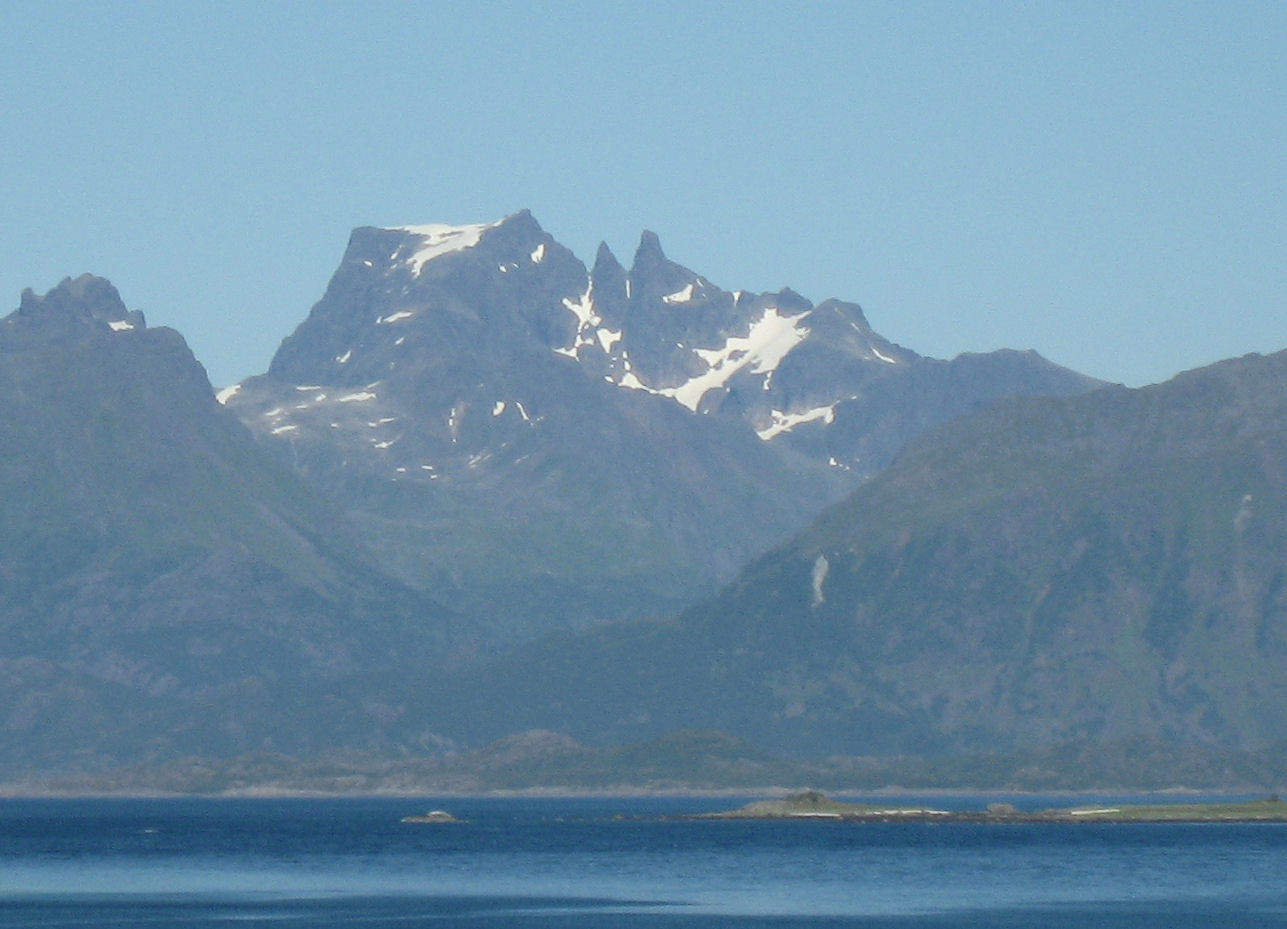
Moysalen National Park
White-tailed eagles circle above the Vestpollen fjord, riding thermals that rise where the sea meets mountain rock. Below them, birch forests climb from the shoreline into fens and bogs, then give way to bare alpine terrain that culminates in the 1,262-meter peak of Moysalen. This is one of the few national parks in Norway where you can stand at the edge of a fjord and look directly up at an alpine summit without leaving the park's boundaries. Established in 2003 on the island of Hinnoya in Nordland county, Moysalen National Park protects a landscape that has remained largely undisturbed -- a vertical slice of northern Norwegian wilderness running from salt water to snowfield.
Sea to Summit
Most of Norway's national parks begin in the mountains and stay there. Moysalen is different. The Vestpollen fjord, a branch of the larger Oksfjorden, penetrates deep into the park, bringing the sea into the wilderness and the wilderness down to sea level. This vertical range -- from tidal zone to the 1,262-meter summit of Moysalen mountain -- compresses an extraordinary variety of ecosystems into a compact area. Undisturbed birch forests line the lower valleys, gradually thinning as elevation increases. Fens and bogs dot the middle elevations, most of them small but ecologically significant. Above the treeline, alpine meadows give way to bare rock and persistent snow. The park lies primarily within Lodingen Municipality, with its northern edge crossing into Sortland Municipality, and its terrain is steep enough that the transition from forest to summit happens in just a few kilometers of horizontal distance.
Raptors and the Hunting Sky
The combination of steep coastal mountains, rich seashore, and abundant rodent populations makes Moysalen exceptional hunting territory for birds of prey. White-tailed eagles, the largest raptors in northern Europe with wingspans exceeding two meters, patrol the fjord and coastline. Golden eagles work the higher ridges, where hares and ptarmigan provide prey. Gyrfalcons -- the largest falcon species in the world -- breed in the park, as do peregrine falcons, kestrels, merlins, and rough-legged buzzards. Several of these species are classified as rare or endangered in Norway, making Moysalen a critical breeding refuge. The density and diversity of raptors here is unusual even by Norwegian standards, a consequence of the park's topographic range creating overlapping habitat zones within a relatively small area.
Otters, Moose, and the Hinnoya Wild
Below the raptor highways, the park's ground-level wildlife is characteristic of Nordland county but includes species of special conservation concern. The Eurasian otter, classified as vulnerable across Norway as a whole, thrives in the streams and shoreline of Moysalen -- the park's clean, undeveloped waterways providing exactly the habitat the species requires. Around the Oksfjorden, the terrain supports a core population of moose on Hinnoya island, the animals moving between the birch forests and the lush growth along the fjord's edge. Red foxes, stoats, mountain hares, and American mink -- an invasive species that has established itself throughout coastal Norway -- round out the mammal community. The park's largely undisturbed state means these populations face minimal human pressure, a rarity even in a country as sparsely populated as Norway.
An Island Fortress
Hinnoya is Norway's largest island, a mountainous landmass sitting at the junction of the Lofoten and Vesteralen archipelagos. The park occupies the island's most rugged interior, terrain so steep and roadless that it effectively protected itself for centuries before receiving formal designation in 2003. There are no maintained roads into the park and no developed facilities. Access requires hiking over demanding terrain or approaching by boat through the Oksfjorden. This remoteness is both the park's defining characteristic and its most effective form of protection. The peaks jutting directly from the ocean create a landscape that looks carved rather than eroded, the geological equivalent of a fortification. For the birds and mammals that inhabit Moysalen, this inaccessibility is a gift -- a stretch of Norwegian coastline where human presence remains an occasional intrusion rather than a permanent condition.
From the Air
Located at 68.52N, 15.50E on Hinnoya island in Nordland county, Norway. The park's 1,262-meter Moysalen peak is the dominant summit on the island, visible as a sharp pyramid rising above surrounding ridges. The Vestpollen fjord penetrates into the park from the south. The island sits at the junction of the Lofoten and Vesteralen archipelagos. Nearest airports include Stokmarknes/Skagen (ENSK) and Harstad-Narvik/Evenes (ENEV). Best viewed at 4,000-6,000 ft to appreciate the sea-to-summit terrain and raptor habitat. White-tailed eagles may be visible circling above the fjord.