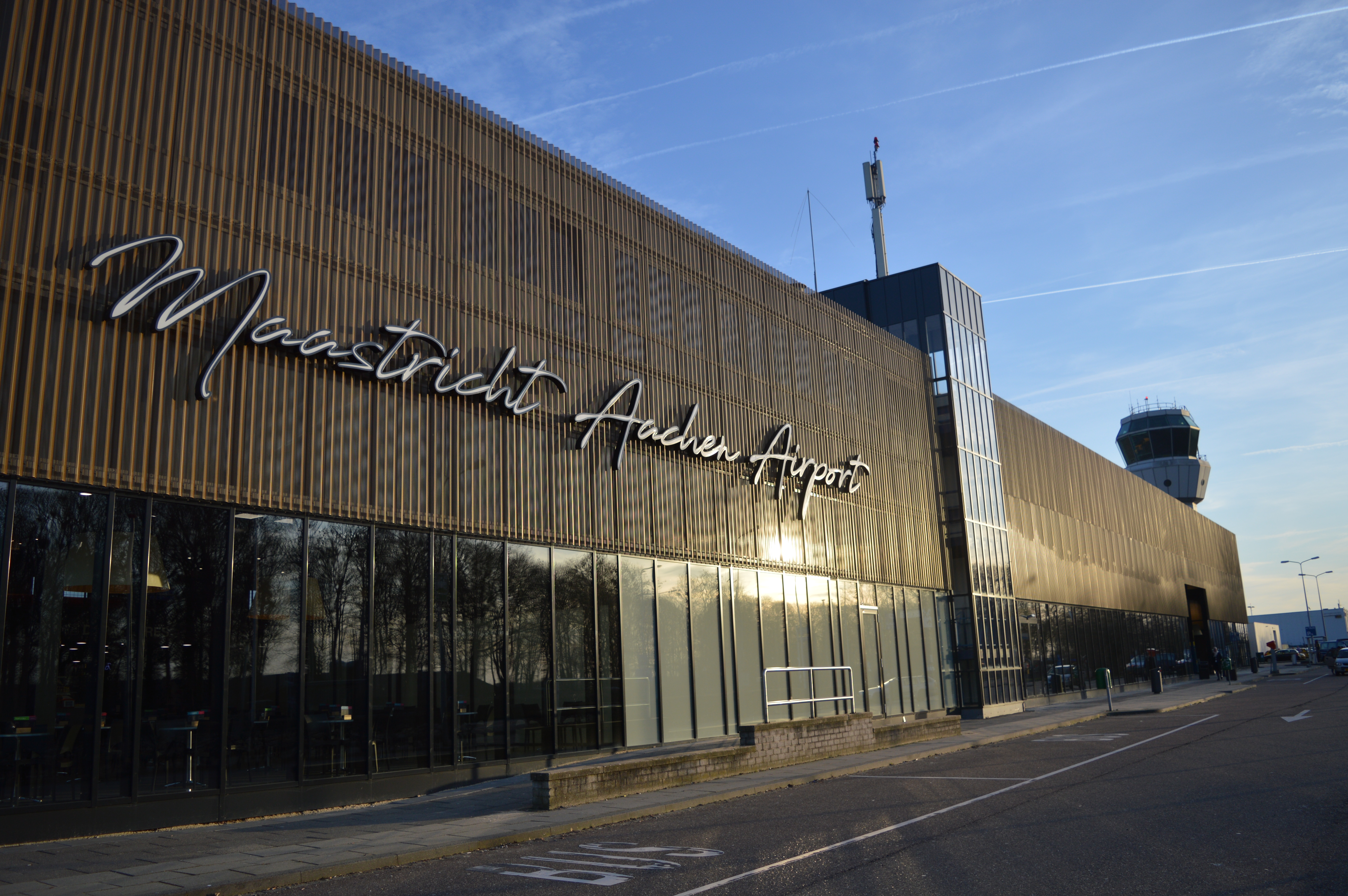
Maastricht Aachen Airport
In the autumn of 1944, US Army engineers needed a runway and they needed it fast. The front had ripped past Maastricht and supplies were chasing it. So they took several orchards already torn up by tank fire, scraped them flat, and hauled in rubble from Geleen, a nearby town that had been bombed by mistake two years earlier. By 22 March 1945 the strip was operational, designated Y-44, surfaced with pierced steel planking laid over crushed Dutch limestone and shattered Dutch brick. The war was already disappearing eastward, so no combat sorties ever launched from here. But the airfield stayed. Today it is EHBK, Maastricht Aachen Airport, threading freighters and budget jets across the southern tip of the Netherlands.
From Orchards to Asphalt
Limburg had wanted an airport since 1919, but the municipalities could not agree on where or how to pay for one. The provincial government finally said yes in July 1939. Two months later Hitler invaded Poland and the plans went into a drawer. When the answer arrived, it came on the wing of the IX Engineer Command, slotted between the villages of Beek, Geulle and Ulestraten because the headquarters of the XIX Tactical Air Command had just moved into Maastricht. The 31st Tactical Reconnaissance Squadron, flying F-6 photo-Mustangs, was first in. By the time the B-26 Marauders of the 387th Bombardment Group arrived on 4 May 1945, Germany was four days from surrender. The airfield's wartime career had lasted barely six weeks.
The Government Air Service
Authority passed to the Dutch on 1 August 1945. Roads and rails across the country lay in ruins, so the field was repurposed as a kind of aerial bus stop for officials and people on urgent business. Six de Havilland Dragon Rapides, biplanes loaned by the British, made up the entire fleet of the Regeeringsvliegdienst, the government air service. KLM took over in 1946 with Douglas DC-3 Dakotas. As bridges came back and trains started running again, demand for the service evaporated. By 1949 it was gone, but Beek airfield was here to stay.
The Runway Magnetic North Forgot
The runway has been resurfaced and rebadged over the decades. The biggest tell sits in the numbers themselves. Between August and October 2005, contractors resurfaced the main strip and quietly renamed it from 04/22 to 03/21. Nothing had moved on the ground. The Earth's magnetic field had drifted, and runway numbers are tied to magnetic bearing in tens of degrees. The slow wander of the magnetic north pole had nudged Beek's alignment one digit closer to true north. Pilots updated their charts and a generation of taxiway signs went into the scrapyard. The shorter cross runway, 07/25, had already been pulled up to make room for a cargo terminal.
Air Force One, the Pope, and Ryanair
Big moments at EHBK tend to involve unexpected guests. On 14 May 1985 Pope John Paul II celebrated open-air mass on the apron for fifty thousand people. Two decades later, on 7 May 2005, Air Force One brought George W. Bush in for the next day's visit to the American cemetery at Margraten. In December 2012 Ryanair opened its first Dutch base here, initially one Boeing 737-800 and a fresh map of yellow-and-blue routes. By 2025 the airline was responsible for 76.3 percent of all passenger traffic, then announced in May it was leaving by October. Wizz Air filled some of the gap with flights to Bucharest and Tuzla. The airport, perpetually a few balance sheets from crisis, kept going.
Quiet Cargo, Loud Skies
Above the terminal, in a separate building, sits the Maastricht Upper Area Control Centre of Eurocontrol, the room that runs the high-altitude airspace over Belgium, the Netherlands, Luxembourg, and northwest Germany. The controllers there talk to airliners cruising at altitudes the airport below them cannot reach: only Schiphol and EHBK in the Netherlands carry the Category III instrument landing system needed to bring a heavy jet down in true zero-visibility fog. Most days the noise belongs to Cargolux and AirBridge freighters and to whichever low-cost carrier currently considers Beek a good idea. The runway built from a bombed town's bricks is still working.
From the Air
ICAO EHBK / IATA MST, elevation 375 ft, single runway 03/21 (2,750 m). Located at 50.91 N, 5.77 E, 5 NM northeast of Maastricht and 15 NM northwest of Aachen. Category III ILS on runway 21. Maastricht Upper Area Control (MUAC) sequences high-altitude traffic from a building adjacent to the field.