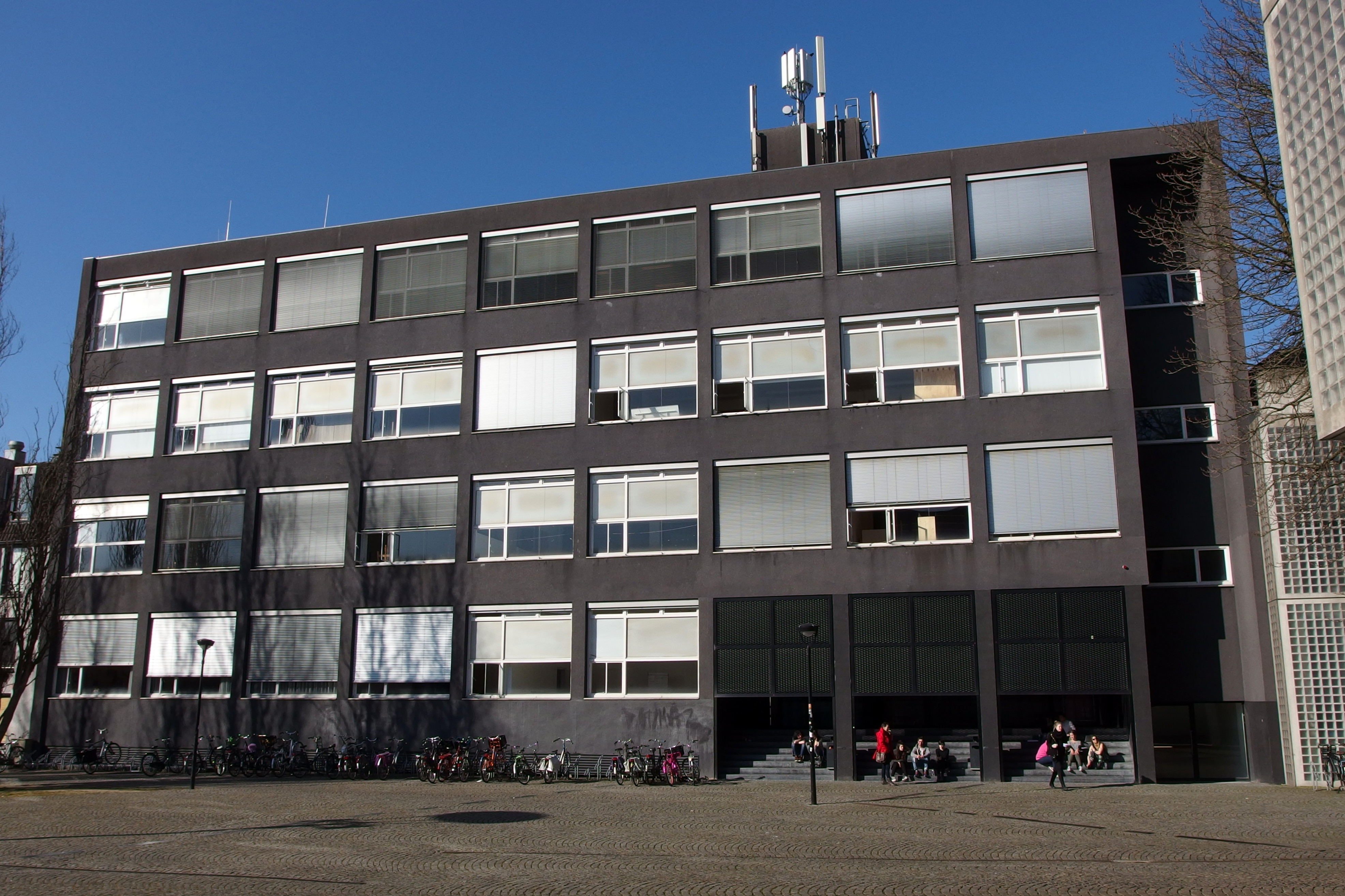
Maastricht Institute of Arts
Walk down Brusselsestraat and watch the wall change. On one side, a square stack of arches, ten wide and four storeys high, painted black on the advice of its own architect. Across the way, two minimalist blocks sheathed in glass bricks, linked by a footbridge whose floor is also made of glass. At night, the southern block glows like a lit-up ice cube full of student work. This is the Maastricht Institute of Arts, the city's school of fine arts and design, and the buildings themselves tell you what is taught inside: that material, light, and proportion are not decoration but argument.
A Royal Decree, a Drawing School
Dutch art education in Maastricht traces its founding to a Royal Decree of 13 April 1817, which called for Tekenscholen, drawing schools, in as many cities as possible. The aim was egalitarian for its time: train young people and tradesmen alike in the drawing of the human figure and the basic rules of architecture. The Stadsteekenschool opened in Maastricht in 1823 with no more than a hundred students. It bounced from address to address, the former Latin school behind the theatre, then the Augustijnenkerk, then a convent of the Cellebroeders, then a building on Herbenusstraat. A silver medal and a certificate went each year to the most advanced pupils. One of those pupils, Victor de Stuers, would later invent Dutch heritage protection.
Painting Pottery, Painting Saints
By the time the school merged in 1926 with the Middelbare Kunstnijverheidsschool, the curriculum had spread to almost every applied art there was. Painting, graphics, glass design, theatre design, advertising letters, costume. Lecturers were beginning to look toward Bonnard and Matisse. But the bread and butter of the studios remained local: decorative painting for the Maastricht potteries, religious paintings and sculptures and stained glass for the churches commissioning new work all over Limburg. The local Astra glass factory lent the school an oven for glass class. Headmaster Jef Scheffers, who ran the place from 1935 until 1972, pushed his best students onward to Amsterdam. One of them, Ger Lataster, would become one of the most important Dutch painters of the postwar era.
The Building Painted Black
The main building on Herdenkingsplein went up in 1969 and 1970, a square block of ten arches across, four floors high, with wide windows tuned to flood the studios with northern light. In 1995 the institute brought in the architect Wiel Arets, a Limburg native who would later run Berlage Institute and the Illinois Institute of Technology's College of Architecture. His advice on the older building was almost playful: plaster it, then paint it black. He also designed the adjoining extension, completed between 1990 and 1994, two minimalist blocks of concrete frame and glass building blocks, linked by a glass-floored skybridge. The design won a string of architecture awards and gives the institute its current double identity: heavy and dark on one side, weightless and transparent on the other.
The Plaster Library
Hidden inside the institute is a collection unique in the Netherlands: the gipsotheek, a working library of plaster casts of classical sculpture. It was assembled at the school's founding on 3 February 1823 and it is still used today, students drawing from the same casts that students drew from in the nineteenth century. Most European academies dispersed or destroyed their plaster collections during the twentieth century, when casts fell out of intellectual fashion. Maastricht kept its gipsotheek active. In 2023, on the bicentennial of art education in the city, the casts were exhibited in the Koepelzaal of the Bonnefantenmuseum, a moment of public credit for two hundred years of pencil studies done by candlelight, then gaslight, then fluorescent.
The Alumni Map
Walk the institute's alumni list and the geography of postwar Limburg art opens up. Painters Jef Diederen, Pieter Defesche, Ger Lataster, and Fons Haagmans. Sculptors Piet Killaars, Appie Drielsma, Jef Wishaupt, and Fons Bemelmans, several of them taught here by Charles Vos and Albert Meertens, who shaped a whole generation of Limburg sculpture. More recent graduates include the curator and critic Krist Gruijthuijsen, the painter Keetje Mans, winner of the 2012 Koninklijke Prijs voor Vrije Schilderkunst, and the internet-native visual artist Rafael Rozendaal. Fashion designer Branko Popovic, who founded Fashionclash, also came through. Two centuries on, the Maastricht drawing school is still casting outward.
From the Air
Located at 50.85 N, 5.68 E in the Brusselsestraat neighbourhood of central Maastricht, west of the Vrijthof. Visible from low approaches into Maastricht Aachen Airport (EHBK), about 5 NM southwest of the airport.