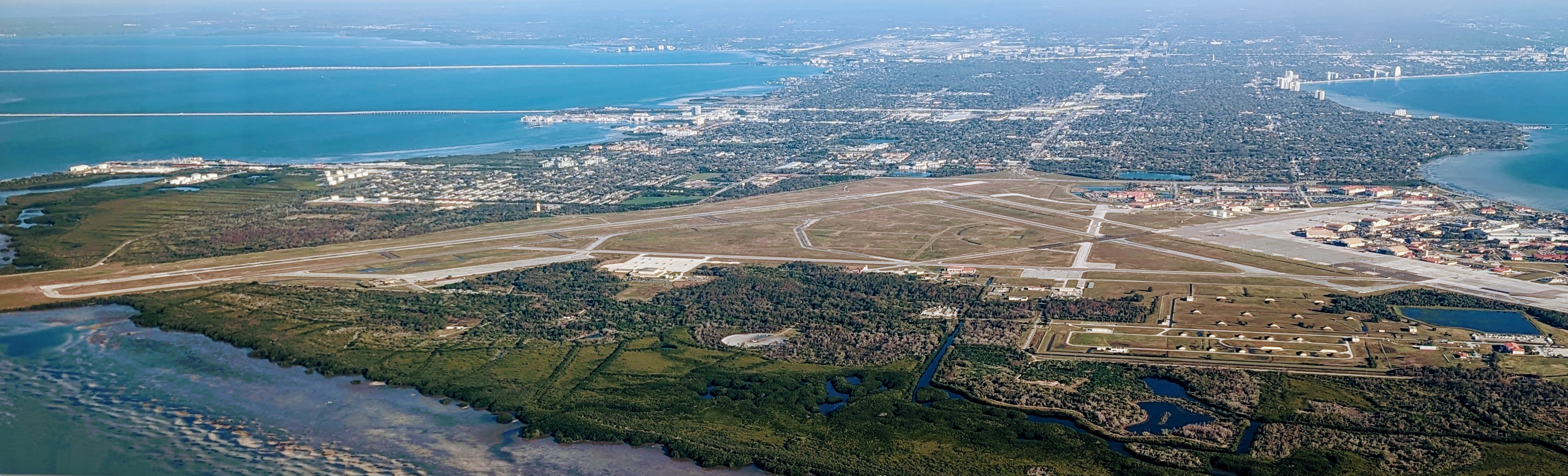
MacDill Air Force Base
The slogan was dark but accurate: 'One a day in Tampa Bay.' During World War II, so many early-model B-26 Marauder bombers crashed into the waters surrounding MacDill Field that the grim phrase became common knowledge among pilots stationed there. The B-26's short wings and high landing speeds made it notoriously difficult to fly, and the warm waters of Tampa Bay became an unforgiving proving ground. That deadly reputation was eventually tamed by design improvements, but the base itself has proven equally hard to kill. Slated for closure multiple times, MacDill Air Force Base has reinvented itself through every era of American military history, transforming from a World War II bomber training ground into the nerve center for some of the nation's most critical global operations.
Born Before the Storm
MacDill was established in 1939 as Southeast Air Base, Tampa, renamed MacDill Field in December of that year in honor of Colonel Leslie MacDill, an Army aviator who died in a 1938 aircraft accident. Construction on the peninsula south of downtown Tampa was barely complete when the United States entered World War II. The base became a major training center, cycling through bomber groups flying B-17s, B-26s, and B-24s on antisubmarine patrols over the Gulf of Mexico and preparing crews for deployment to European and North African theaters. Bombardment groups trained at MacDill before deploying to England, Egypt, and beyond. By war's end, the field had served as headquarters for III Bomber Command and hosted reconnaissance training and heavy bomber operations that helped shape the air war overseas.
Cold War Thunder
With the establishment of the U.S. Air Force as an independent service in 1947, MacDill Field became MacDill Air Force Base and entered the jet age as a Strategic Air Command installation. The 306th Bombardment Wing received some of the first Boeing B-47A Stratojets delivered to the Air Force in 1951, and throughout the 1950s, the swept-wing bombers became a familiar sight over Tampa Bay. When the B-47 era waned, the base faced its first closure threat in 1960. The Cuban Missile Crisis of 1962 changed everything. MacDill's position on a peninsula jutting into Tampa Bay, just 250 miles from Cuba, made it invaluable as a staging area. The base was repurposed for tactical fighters, and the United States Strike Command was established there as a crisis response force, one of the first unified commands drawing from all military branches.
Fighter Country
For nearly three decades, MacDill was fighter country. The F-84 Thunderstreak gave way to the F-4 Phantom II in 1964, and the distinctive twin-engine jets roared over Tampa through the 1960s and 1970s under multiple tactical fighter wings. In 1975, the 56th Tactical Fighter Wing took command, eventually transitioning to the F-16 Fighting Falcon. The wing's jets performed flyovers at Super Bowls XVIII and XXV at Tampa Stadium, trailing across the sky after the national anthem. But the Cold War's end brought another existential crisis. Increasing commercial air traffic from two nearby international airports created hazardous conditions for F-16 training, and jet noise clashed with the growing residential neighborhoods surrounding the base. The 1991 Base Realignment and Closure Commission ordered all flight-line activities to cease by 1993.
The Survivor's Reinvention
MacDill refused to die quietly. When Hurricane Andrew devastated Homestead Air Force Base in 1992, evacuating F-16s staged at MacDill for months, demonstrating the base's ongoing value. Congressman Bill Young helped rescind the flight-line closure order in 1993, and NOAA's Hurricane Hunters relocated their operations to MacDill's Hangar 5. The base reinvented itself around aerial refueling, receiving KC-135R Stratotankers and standing up the 6th Air Refueling Wing in 1996. The Air Force Reserve's 927th Air Refueling Wing joined as an associate unit in 2008. Meanwhile, the base had become something far more significant than a flight line. The Rapid Deployment Joint Task Force, activated in 1980, became United States Central Command in 1983, and United States Special Operations Command stood up at MacDill in 1987. These two four-star commands, overseeing American military operations across the Middle East and special operations worldwide, made MacDill one of the most strategically important installations in the Department of Defense.
Layers Beneath the Tarmac
MacDill's story extends deeper than its runways. In 2019, the Tampa Bay History Center informed the Air Force about a forgotten African American cemetery on base grounds. Archival city records revealed a segregation-era burial site used by Black families between 1840 and 1920. Ground-penetrating radar and cadaver dogs confirmed the site, and in January 2024, officials announced the discovery of 121 potential unmarked graves. Today, approximately 15,000 people work at MacDill, and the base is a significant economic engine for the Tampa Bay area, twice winning the Abilene Trophy as the most supportive Air Force city in Air Mobility Command. The 6th Air Refueling Wing is slated to receive 24 new Boeing KC-46 Pegasus aircraft in coming years, ensuring MacDill's flight line remains active well into the future. The base that was nearly closed multiple times now hosts 28 tenant organizations across every branch of the military.
From the Air
Located at 27.85°N, 82.52°W on a peninsula extending into Tampa Bay, south-southwest of downtown Tampa. The base occupies the southern tip of the Interbay Peninsula and is unmistakable from the air with its prominent runway (ICAO: KMCF) extending nearly to the water's edge. Best viewed at 3,000-5,000 feet AGL. Caution: MacDill has active restricted airspace. Tampa International Airport (KTPA) is approximately 8 nm to the north, and Peter O. Knight Airport (KTPF) is about 4 nm to the northeast. The Gandy Bridge and Howard Frankland Bridge crossing Tampa Bay provide strong visual references.