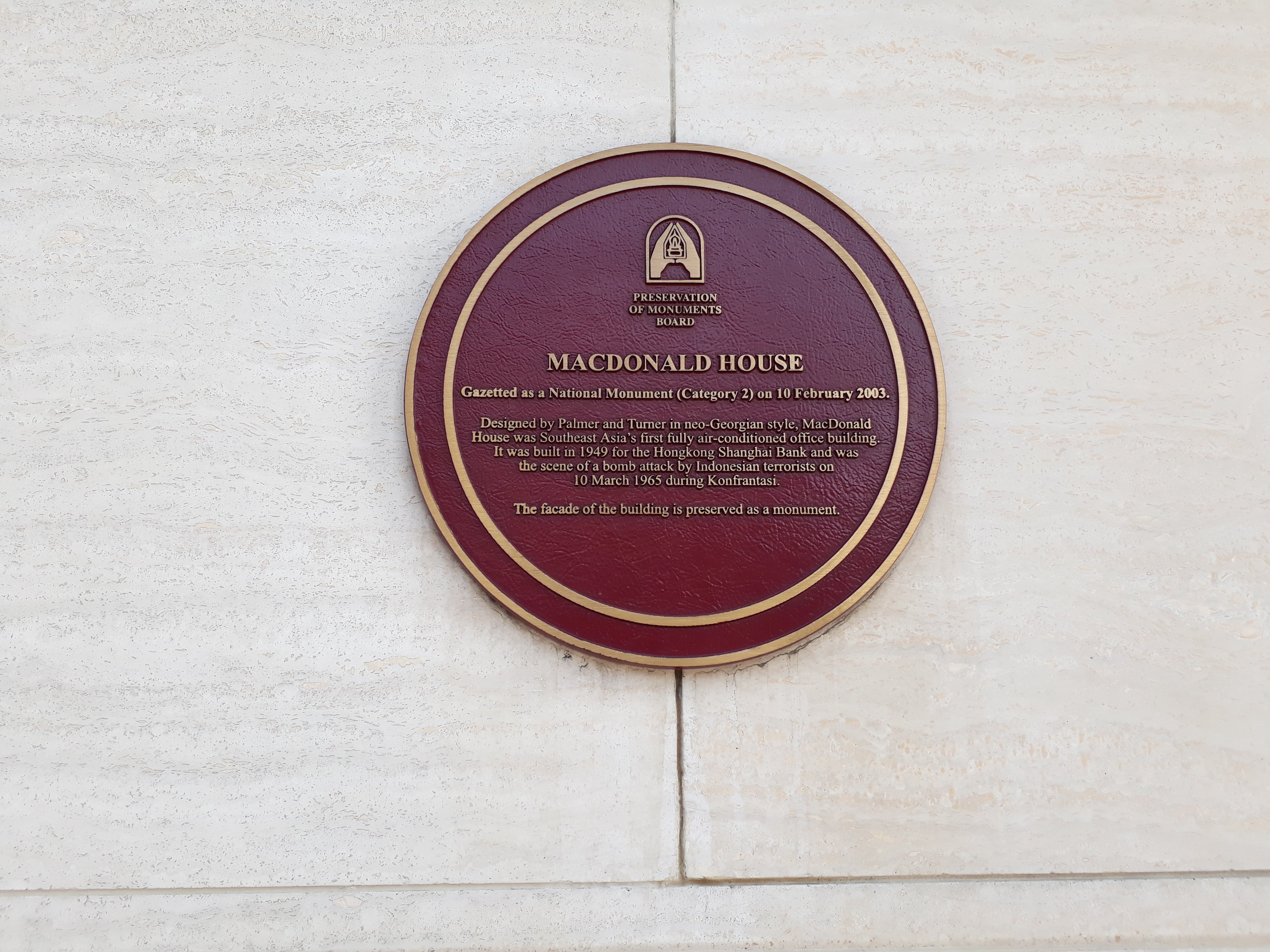
MacDonald House Bombing
At 3:07 in the afternoon on 10 March 1965, workers inside MacDonald House on Orchard Road heard what many mistook for a thunderclap. It was raining heavily that day, and the sound seemed to fit. But the blast that tore through the mezzanine floor was no act of weather. A nitroglycerin bomb, planted by two Indonesian marines in civilian clothes, had just killed two people instantly and injured thirty-three others. A third victim would die in a coma two days later. The explosion shattered windows up to nine storeys, sent an elevator crashing into the basement, and opened a wound in Singapore's national memory that would take a generation to close.
Konfrontasi Comes to Orchard Road
The bombing was not an isolated act of violence but part of the Konfrontasi, Indonesia's confrontation against the formation of Malaysia. Between 1963 and 1966, Indonesian saboteurs carried out a total of 37 bombings in Singapore, which was then a state within Malaysia. The saboteurs had been trained to strike military installations and power stations, but when those proved too well-guarded, they turned to softer targets. MacDonald House, named after former Governor General Malcolm MacDonald and opened in 1949, housed the Hongkong and Shanghai Bank, the Australian High Commission, and the Japanese Consulate. Two marines, Harun bin Said and Osman bin Haji Mohamed Ali, had arrived from Java that morning with orders to bomb a power station. Instead, they chose the busy commercial building on Singapore's most famous shopping street.
Capture on the Water
After planting the bomb, Harun and Osman attempted to flee Singapore by motorboat. Their escape went wrong almost immediately when the boat either sprang a leak or struck something beneath the surface, leaving both men clinging to a wooden plank in the water. A bumboat operator named Lim Ah Paw fished them out. Harun told Lim they were fishermen, but when asked to produce an identity card, claimed it had fallen into the sea. Suspicious, Lim instructed his helmsman to flag down a passing police boat. The two marines were taken into custody. Their trial, which began on 4 October 1965, lasted thirteen days. The defense argued they should be treated as prisoners of war under the Geneva Convention. The prosecution called them mercenary soldiers, paid $350 for a particular assignment. Justice Chua found them guilty on all three murder charges and called the bombing a "cowardly act." After exhausting their appeals, including a final hearing before the Privy Council in London, Harun and Osman were hanged at Changi Prison on 17 October 1968.
Flowers on a Grave
The executions triggered an immediate diplomatic crisis. Three hundred students stormed the Singapore Embassy in Jakarta on the day of the hanging. Bilateral relations froze. The thaw came five years later through an act of remarkable political grace. In 1973, Singapore's Prime Minister Lee Kuan Yew visited Indonesia and went to the graves of the two executed marines. There, he performed nyekar, the Indonesian custom of scattering flowers on a grave to grant the deceased peaceful rest. The gesture carried weight precisely because it acknowledged Indonesian grief without conceding that the bombing was justified. Suharto visited Singapore the following year, and by the 1980s, exchanges between the two countries in politics, tourism, defense, and business had sharply increased. The relationship was tested again in 2014 when Indonesia named a warship the KRI Usman Harun, after the two bombers. Singapore banned the vessel from its waters. Indonesia apologized but said the naming was irreversible.
A Memorial Across the Street
MacDonald House still stands on Orchard Road, its red-brick facade bearing a plaque that commemorates the 1965 attack. Directly across the street, at Dhoby Ghaut Green, a different kind of remembrance took shape on the bombing's fiftieth anniversary. On 10 March 2015, a memorial dedicated to all victims of the Konfrontasi was unveiled, honoring not only the three people killed in the MacDonald House blast but also soldiers who died defending Singapore during the broader confrontation. The Singapore Armed Forces Veterans League had recommended the memorial to ensure younger generations understood what happened. Religious leaders from the Inter-Religious Organisation prayed at the site and laid a wreath. The memorial stands as a quiet counterpoint to the bustle of Orchard Road, a reminder that Singapore's present-day stability was not inevitable, and that the relationships between Southeast Asian neighbors were forged through acts of both violence and reconciliation.
From the Air
Located at 1.299N, 103.846E on Orchard Road in central Singapore. MacDonald House and the Dhoby Ghaut Green memorial are visible in the dense urban fabric of the Civic District. Nearby airports: Singapore Changi (WSSS) approximately 16 km to the east, Seletar Airport (WSSL) approximately 12 km to the north. Best viewed below 3,000 feet for urban detail. The building sits near the intersection of Orchard Road and Penang Road.