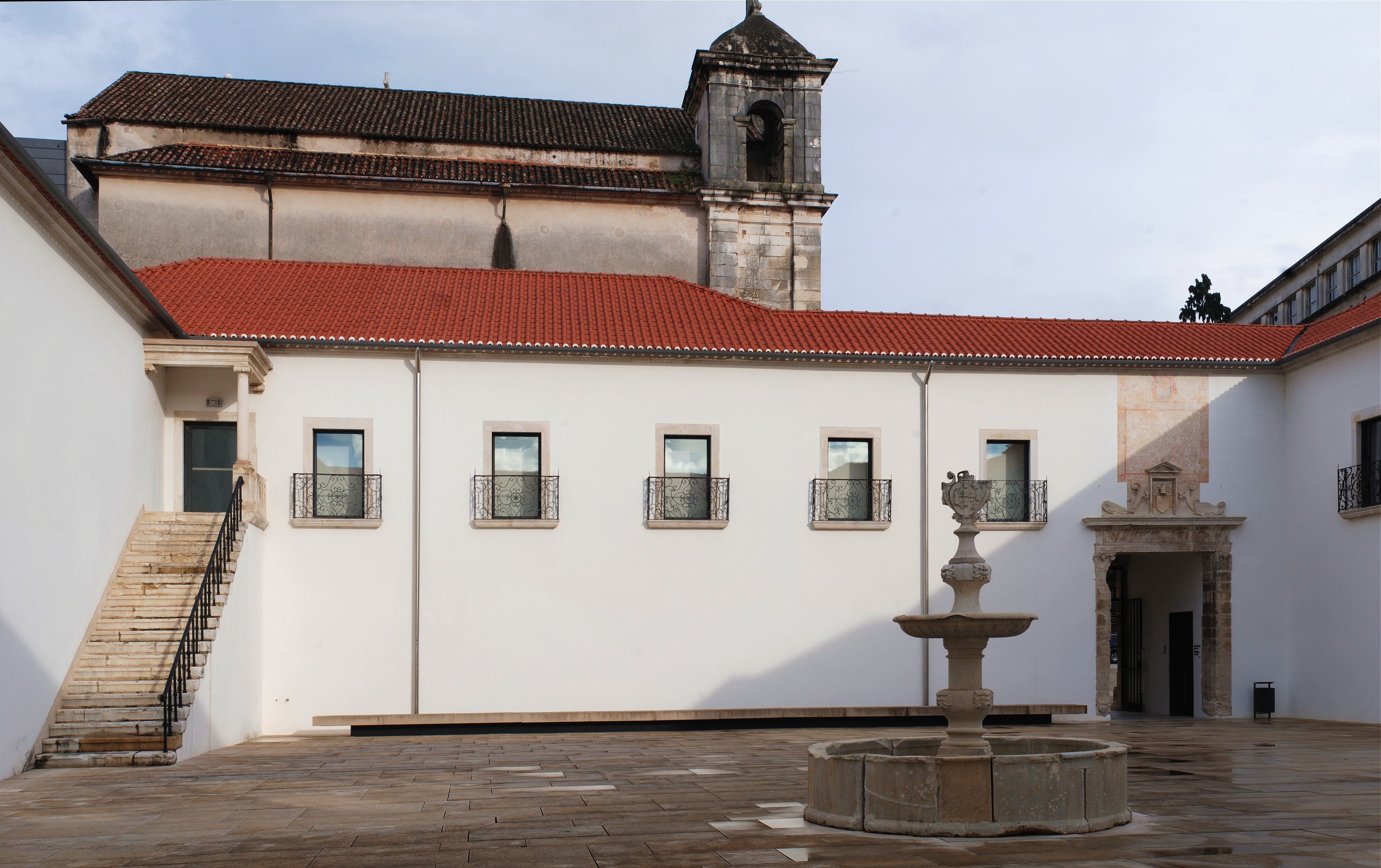
Machado de Castro National Museum
Descend far enough into the Machado de Castro National Museum and you leave Portugal entirely. Below the medieval bishop's palace, below the galleries of Renaissance sculpture and Manueline woodwork, the lower floors open into the Roman cryptoporticus of Aeminium -- a vaulted substructure that once supported the forum of the Roman city that preceded Coimbra. Visitors walk through barrel-vaulted corridors built in the 1st century AD, their feet on Roman pavement, their heads brushing stone arches engineered to distribute the weight of an entire civic center. Then they climb back up into galleries displaying 14th-century Black Christs and 16th-century Flemish triptychs. No other museum in Portugal compresses so much time into so little vertical space.
Aeminium Beneath
Before Coimbra was Coimbra, it was Aeminium -- a Roman administrative center whose forum occupied the highest ground in the city. The cryptoporticus that survives beneath the museum was the engineering solution to a topographical problem: the hilltop was too small and too uneven for the grand public space the Romans required, so they built a massive subterranean platform of arched corridors to level and extend the ground. When the Roman empire receded, the structures were buried and forgotten, built over by successive centuries of construction. The medieval Bishop's Palace rose on the same hilltop, unaware of the Roman bones beneath its foundations. Archaeological excavation revealed the cryptoporticus in the 20th century, and today it forms the museum's most dramatic exhibit -- not a collection of artifacts under glass, but an entire piece of Roman infrastructure, walked through rather than observed.
The Bishop's Palace Transformed
The building above the cryptoporticus accumulated its own centuries of history. Built as the episcopal residence beginning in the Middle Ages, the Bishop's Palace served Coimbra's religious establishment through the medieval and early modern periods. When the museum was established in 1913, its founders named it for Joaquim Machado de Castro, the 18th-century Portuguese sculptor considered one of the greatest artists the country has produced. His equestrian statue of King Jose I still stands in Lisbon's Praca do Comercio. The museum's most recent renovation, completed in 2012 after eight years of work, added a striking contemporary building designed by architect Goncalo Byrne. The project won the Piranesi/Prix de Rome Prize in 2014, an award for outstanding architectural works in historical contexts. The new building does not compete with the old palace -- it extends and opens it, creating light-filled galleries that connect seamlessly with the medieval and Roman layers below.
Sacred Art and Stone Faces
The museum's collections draw heavily from the churches and religious institutions that surrounded Coimbra for centuries, making it a repository of Portuguese devotional art. The sculpture collection is the most extensive of any national museum in Portugal, spanning from Roman portrait busts recovered from the cryptoporticus to Renaissance masterworks by Joao de Ruao, the French-born sculptor who worked in Coimbra throughout the 16th century. Ruao's Deposition of Christ and his figures of St. John the Baptist and St. Agnes demonstrate the emotional intensity of Portuguese religious sculpture at its peak. Among the most striking pieces is the 14th-century Black Christ -- a nearly three-meter wooden crucifix whose dark surface gives it a solemn gravity that photographs cannot capture. The painting collections include works by Quentin Metsys, Cristovao de Figueiredo, and Josefa de Obidos, the 17th-century artist considered Portugal's most important Baroque painter.
Tapestries, Tiles, and Persian Silk
Beyond sculpture and painting, the applied arts collections reveal the global connections that flowed through Portugal during its centuries as a maritime power. A 16th-century silk carpet from Kashan, in present-day Iran, speaks to the trade networks that linked Lisbon to the Persian world. Flemish tapestries depicting Venus and Mars, each measuring over 3.5 meters, document the artistic exchange between Portugal and the Low Countries. An altar frontal made of ceramic azulejo tiles from around 1670 represents the decorative tradition that became one of Portugal's most recognizable artistic contributions. The 18th-century monstrance known as the Custodia do Sacramento -- standing over 1.6 meters tall and worked in precious metals -- embodies the wealth and devotional ambition of the Portuguese church at its most extravagant. Each piece arrived in Coimbra through a different route, but together they form a portrait of a small country that engaged with the world far beyond its borders.
From the Air
Located at 40.21N, 8.43W in the hilltop university quarter of Coimbra, central Portugal. The museum complex is situated near the University of Coimbra on the city's highest ground. Nearest airport is Coimbra (no commercial service); the closest commercial airports are Porto (LPPR) approximately 120 km north and Lisbon (LPPT) about 200 km south. Best viewed at 2,000-3,000 feet for context within Coimbra's hillside cityscape along the Mondego River.