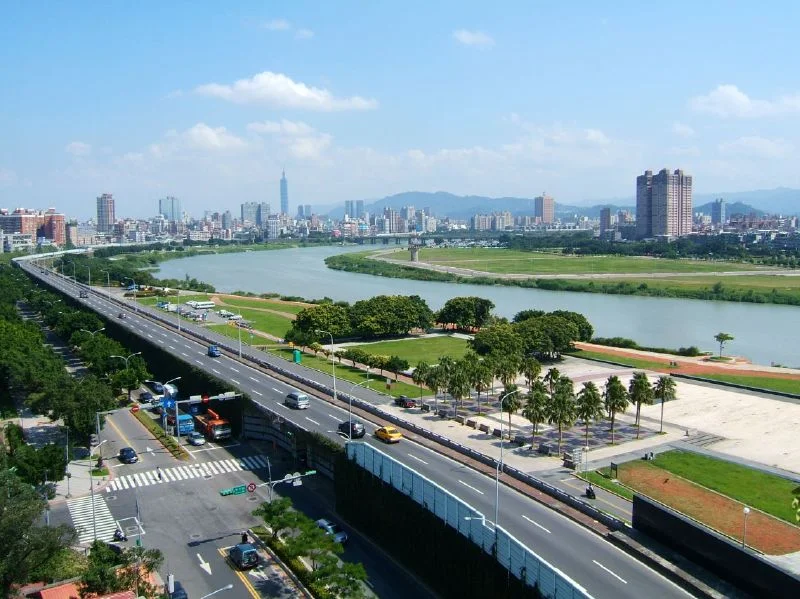

Machangding Memorial Park
There is a park on the southwestern edge of Taipei where the Xindian River runs wide and quiet. People come to cycle along the riverside paths, or to sit in the grass. The setting is peaceful now, in the way that deliberate memorials are peaceful — not because nothing happened here, but because the choice was made to acknowledge it. Machangding Memorial Park stands on ground that served as an execution site during the Japanese colonial era and, after 1945, during the period Taiwanese people call the White Terror. Those who were put to death here had names and lives. The park exists so that those names are not entirely lost.
From Riding Ground to Reckoning Place
The site's history before it became an execution ground was unremarkable. Under Japanese colonial rule, when Taipei was known as Taihoku, this area was named Babachō and used for military training grounds and horse-riding activities — the name Machangding itself means something close to 'horse track ground,' from the Chinese characters for horse (馬), field (場), and the Japanese colonial administrative unit for a district (町). Military use of the site continued under various forms through the colonial era before it transitioned to other purposes in 1949. After the colonial period ended, the ground continued under military supervision, briefly serving as a horse racing venue accessible only to government officials. The leisure function did not last. The site acquired a darker use that would define how it is remembered.
The Executions
The precise number of people executed at Machangding is difficult to verify, and that uncertainty is itself part of the record. During the Japanese era, the site was used to carry out capital sentences. After World War II, when the Kuomintang government took control of Taiwan, the executions continued under martial law — the period known as the White Terror, which lasted from 1949 until martial law was lifted in 1987. Many of those put to death during the White Terror were accused of political offenses: suspected communists, labor organizers, intellectuals, and others whose deaths were rarely documented with care. Among those known to have been executed here was Wu Shi. Huang Mei — the uncle of writer Li Yuan — was also executed at Machangding. These two names appear in the record. Others do not. The difficulty of counting the dead is inseparable from the nature of the system that produced them.
A Park Built on Memory
In 1998, Taipei mayor Chen Shui-bian decided to create a park on the site. It was completed in 2000 and formally named Machangding Memorial Park by the then-mayor Ma Ying-jeou. The choice to memorialize rather than simply to redevelop was significant. On March 6, 2020, Taipei's Department of Cultural Affairs officially designated Machangding a historic site — a formal recognition that what happened here belongs to Taiwan's public history, not to be quietly absorbed into urban development. The park includes riverside cycling paths, a pedestrian skyway with an elevator connecting it to the adjacent riverside park, and a small parking area. These ordinary amenities coexist with the weight of what the ground carries.
Remembrance Across Borders
Machangding's history has occasionally reached audiences far from Taiwan. In 2025, a Chinese television drama called Silent Honor aired and depicted events connected to the executions that took place here. The series — produced with the involvement of China's state security apparatus — centers on Wu Shi, who is presented as a heroic communist intelligence operative executed at Machangding. Some viewers in mainland China, encountering this history for the first time through the drama's narrative, expressed grief for those shown dying here. For Taiwanese audiences and advocates of transitional justice, the intersection was complicated: the park's significance does not depend on foreign drama to validate it, and the show's framing reflects PRC political priorities rather than Taiwan's own reckoning with the White Terror. Still, the attention underscored how incompletely this period is known, even within the Chinese-speaking world.
Visiting Machangding
The park sits in Wanhua District, with the Xindian River forming its southern boundary. It is a place that asks something of visitors: the willingness to hold two realities at once. The river path is genuinely pleasant, and families do come to cycle and walk. The memorial dimension does not announce itself loudly — there are no dramatic monuments overwhelming the site. Instead, the historic designation and the park's name carry the meaning. To visit is to recognize that the ground under your feet was, at certain moments in the twentieth century, a place where people were brought and did not leave. The park's calm is earned, not assumed.
From the Air
Machangding Memorial Park lies at approximately 25.019°N, 121.504°E in Taipei's Wanhua District, on the northern bank of the Xindian River. From the air at 2,000–4,000 feet, the riverside park appears as a narrow green band running along the river's edge, southwest of central Taipei. The Xindian River's confluence with the Tamsui River is visible a short distance to the northwest — a useful aerial landmark. Taipei Songshan Airport (RCSS) lies approximately 6 km to the northeast; Taiwan Taoyuan International (RCTP) is about 35 km west. Visibility over the river corridor is typically good on clear days, with the urban grid of Wanhua District providing orientation.
Nearby Stories
- Dapu Incident 9.3 km away
- Shuanglianpi Wetland 18 km away
- Toufen 41 km away
- North Jiangsu Main Irrigation Canal 980 km away
- General Cliff Rock Paintings 1050 km away
- Sinking of MV Sewol 1061 km away
- Yellow Sea 1111 km away
- Twin Forts of Romblon 1358 km away