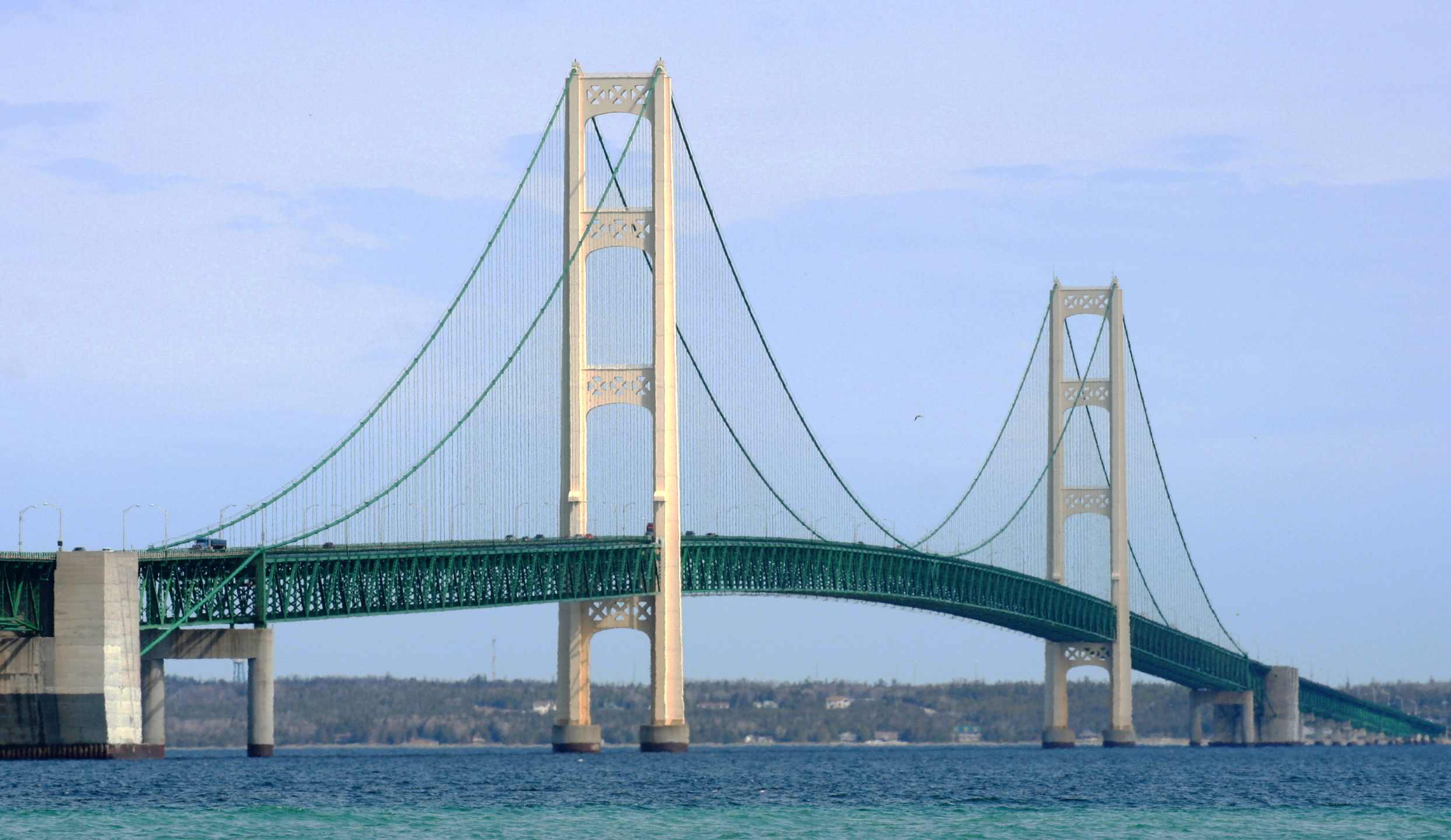
Mackinac Bridge
In 1884, a shopkeeper in St. Ignace clipped an artist's rendering of the Brooklyn Bridge from a newspaper and ran it as an advertisement with one bold caption: "Proposed bridge across the Straits of Mackinac." It was wishful thinking -- the technology did not exist, the money was not there, and the five-mile channel where Lake Michigan pours into Lake Huron was one of the most punishing stretches of water in the Great Lakes. Seventy-three years later, on November 1, 1957, the first cars rolled across the Mighty Mac, and the ferry service that had linked Michigan's two halves since 1881 shut down the same day. The bridge they crossed was not just an engineering triumph. It was a direct answer to one of the most famous structural failures in American history.
The Place of the Great Turtle
The Algonquian peoples who lived at the straits long before Europeans arrived called this region Michilimackinac -- widely understood to mean "Place of the Great Turtle," likely a reference to the humped profile of Mackinac Island rising from the water. The straits served as a meeting ground and summer trading hub for centuries. When railroads pushed north in the 19th century, the crossing became a commercial chokepoint. In 1881, three competing rail lines jointly created the Mackinac Transportation Company to run car ferries between the peninsulas. By the 1920s, Michigan was running its own automobile ferry fleet. At peak season, nine boats shuttled as many as 9,000 vehicles a day across the straits, and traffic backups on shore stretched for miles. The bridge was not a luxury. It was an inevitability.
Lessons from Galloping Gertie
The Mackinac Bridge owes its existence to a disaster. In 1940, the first Tacoma Narrows Bridge in Washington State twisted itself apart in a 42-mile-per-hour wind, its roadway undulating so violently that the span earned the nickname "Galloping Gertie" before it collapsed into Puget Sound. Engineer David B. Steinman, appointed to design the Mackinac crossing in 1953, had published a theoretical analysis of suspension-bridge stability problems just three years after the Tacoma failure. His prescription: deep stiffening trusses beneath the deck and an open-grid roadway to let wind pass through rather than push against solid surfaces. Both features became defining elements of the Mackinac Bridge. The road deck is shaped as an airfoil so that crosswinds generate lift, while the center two lanes use open steel grating that allows air to flow upward, precisely canceling that lift. The result is a bridge stable in winds that would have torn Galloping Gertie to pieces.
Five Lives and a Hundred Million Dollars
Construction began on May 7, 1954, and lasted three and a half years -- four summers of work with no winter construction. Two massive contracts divided the labor: the Merritt-Chapman and Scott Corporation handled all substructure work for $25.7 million, while the American Bridge Division of U.S. Steel built the superstructure for more than $44 million. The total cost reached $100 million. Five workers died during construction. Diver Frank Pepper, 46, ascended too quickly from depth on September 16, 1954, and died of decompression sickness. James LeSarge, 26, lost his balance and fell into a caisson on October 10. Albert Abbott, 40, fell into the water from a narrow beam on October 25. Jack Baker, 28, and Robert Koppen, 28, fell from a temporary catwalk near the north tower on June 6, 1956 -- their first day on the job. All five are memorialized on a plaque near the bridge's northern end at Bridge View Park. Contrary to persistent folklore, no bodies are embedded in the concrete.
Walking the Mighty Mac
Governor G. Mennen Williams was the first person to pay the toll -- $3.25 -- when the bridge opened on November 1, 1957. He then rode the ferry Vacationland on its final crossing, and the following year started a tradition that endures to this day: the Mackinac Bridge Walk. Every Labor Day, thousands of people follow the governor of Michigan on foot across the five-mile span from St. Ignace to Mackinaw City. It is the only day of the year that pedestrians are allowed on the bridge, and the only day hikers can walk this section of the North Country National Scenic Trail. Since 2017, the entire bridge has been closed to vehicle traffic for the duration of the walk. For those who find the crossing daunting from behind a steering wheel, the Mackinac Bridge Authority offers a Drivers Assistance Program -- more than a thousand gephyrophobic motorists use it every year, handing their keys to a professional who drives them across.
A Bridge That Never Stops Being Painted
The Mackinac Bridge carries Interstate 75 across the straits at a total shoreline-to-shoreline length of 26,372 feet -- just short of five miles. It remains the longest suspension bridge with two towers between anchorages in the Western Hemisphere. Maintaining it is a Sisyphean task: painting the bridge takes seven years, and when the crew finishes, they start again from the beginning. The current painting cycle, which began in 1999, has been slowed by the need to remove and safely dispose of the original lead-based paint. The bridge reached its 100 millionth vehicle crossing on June 25, 1998 -- exactly 40 years after its formal dedication. By September 2009, the count had passed 150 million. In 1959, a Strategic Air Command pilot named Captain John S. Lappo flew his B-47 Stratojet bomber beneath the span. He was court-martialed and permanently removed from flight status -- but he remained in the Air Force for another 18 years, retiring as a lieutenant colonel in 1972.
From the Air
The Mackinac Bridge spans the Straits of Mackinac at approximately 45.817N, -84.728W, connecting Michigan's Upper and Lower peninsulas. The bridge is one of the most recognizable visual landmarks in the Great Lakes region from the air -- its twin towers and five-mile suspension span are visible from well above 10,000 feet AGL in clear conditions. Best viewed from 3,000-5,000 feet for full structural detail. Pellston Regional Airport (KPLN) lies approximately 15 nm south-southwest, and Mackinac Island Airport (KMCD) is roughly 8 nm east. St. Ignace (83D) sits just north of the bridge. The straits frequently produce fog, especially in spring and early summer, which can reduce visibility dramatically.