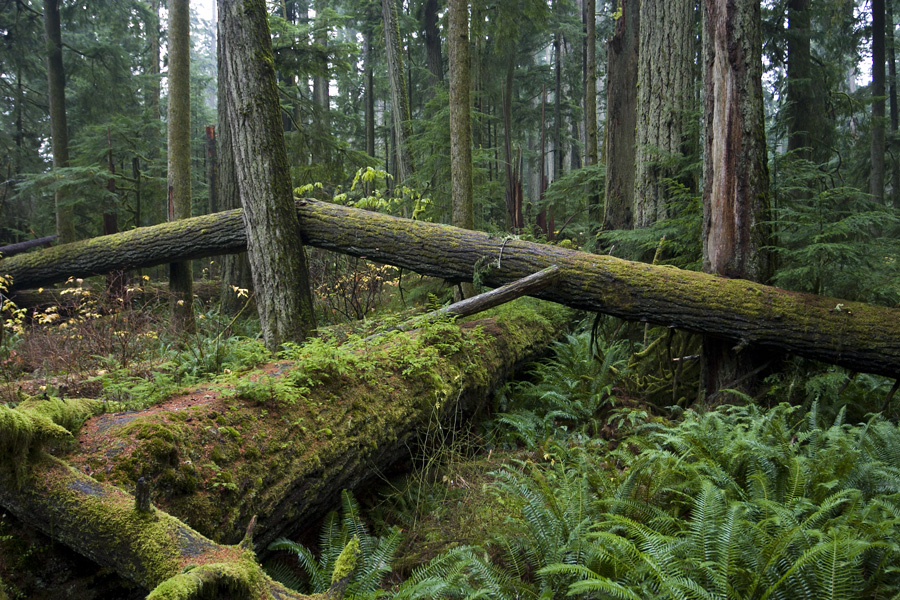
MacMillan Provincial Park
The name came first, before the park, before the protection. Sometime in the late 1920s, the Governor General of Canada, Viscount Willingdon, reportedly looked up at the towering Douglas firs along Highway 4 on Vancouver Island and called the place Cathedral Grove. The name stuck, appearing in correspondence to the provincial government and spreading by word of mouth among tourists who already treated the ancient trees as a pilgrimage site. What nobody could have guessed was that it would take nearly two more decades of public pressure, petitions, and political maneuvering before these trees gained any legal protection at all.
The Industrialist's Gift
H.R. MacMillan was not an obvious savior for old-growth forest. British Columbia's first chief forester had become one of the province's most powerful logging industrialists, heading the H.R. MacMillan Export Company, which later became MacMillan Bloedel. For years, he refused public demands to donate the company's timber holdings around Cathedral Grove. Then in 1944, he reversed course, donating 136 hectares "for the perpetual enjoyment of the public in recognition of the unique stand of trees." By 1947, the area was established as a Class A provincial park. The irony of a logging magnate preserving old-growth forest was not lost on British Columbians, but the result spoke for itself: the only highway-accessible protected old-growth Douglas-fir forest in the province.
Walking Among Giants
The 301-hectare park straddles Highway 4 between Qualicum Beach and Port Alberni, nestled on the western shore of Cameron Lake where the Cameron River fans into a broad delta. The ancient firs within the 157-hectare Cathedral Grove stand are immense, their trunks wider than cars, their canopy so dense that the forest floor exists in permanent twilight. The forest sits in a transitional zone between two biogeoclimatic regions: the drier Coastal Douglas-fir zone of Vancouver Island's east coast and the wetter Coastal Western Hemlock zone of the west. This overlap gives the grove its particular character, where moisture-loving mosses drape trees that evolved for drier conditions.
When the Wind Came
Protecting old-growth forest from logging is only part of the challenge. Upstream logging throughout the late 20th century left the valley increasingly vulnerable to natural forces. In 1990, extreme runoff from a tropical storm caused extensive flooding and streambank erosion along the Cameron River, toppling six hectares of trees. In 1997, high winds tore through the grove, snapping ancient trunks and reshaping the canopy. More storm damage struck in December 2018 and again in November 2024. Each event was a reminder that Cathedral Grove exists within a wider landscape, and that the health of the surrounding watershed directly affects what survives within the park. BC Parks initiated a trail rehabilitation program in the 1990s to manage the compounding effects of both storms and foot traffic.
A Cathedral Without a Parking Lot
For decades, visitors simply pulled off Highway 4 and parked along both sides of the narrow road near the Cameron River bridge. Tour buses, cars, and loaded logging trucks shared the same stretch of pavement, creating conditions that by the 1990s were judged genuinely dangerous. The parking problem has never been fully resolved, a fitting metaphor for the tension between accessibility and preservation that defines Cathedral Grove. In 2007, the grove made the shortlist on CBC's Seven Wonders of Canada competition, a testament to its hold on the national imagination. The trees that Viscount Willingdon named nearly a century ago continue to draw visitors from around the world, each one stepping into the same green twilight that convinced a logging baron to give away his timber.
From the Air
Located at 49.29N, 124.661W on central Vancouver Island, straddling Highway 4 between Qualicum Beach and Port Alberni. Cameron Lake is the key visual reference, a narrow lake oriented east-west. The park sits at the western end of the lake along the Cameron River delta. Nearest airport is Comox Valley Airport (CYQQ), about 60 km northwest. Port Alberni Airport (CBS8) is closer but smaller, roughly 25 km west. Recommended viewing altitude 2,000-4,000 ft AGL to appreciate the old-growth canopy contrast with surrounding logged areas.