Madha
Open a map of the border between Oman and the United Arab Emirates, and Madha appears as an impossibility. It is a piece of Oman -- specifically, an exclave of the Musandam Governorate -- completely surrounded by UAE territory. Drive across the border into Madha, and you enter Oman. But keep driving to the center, and you reach Nahwa, a village that belongs to the UAE's Emirate of Sharjah. A country inside a country inside a country. No barriers separate them. No border checkpoints mark the transitions. You simply drive, and the sovereignty changes beneath you.
The Vote That Drew a Border
In the late 1930s or early 1940s, the leaders of the four rival clans who controlled the Musandam Peninsula -- the Al Qassimi of Ras Al Khaimah, the Al Qassimi of Sharjah, the Al Sharqi of Fujairah, and the Bu Said of Oman -- gathered the village elders of Madha and posed a straightforward question: which sheikhdom did they wish to belong to? Every surrounding village, including Nahwa within Madha itself, chose one of the Emirates' ruling families. The Madhanis chose Oman. Their reasoning was practical: Oman appeared wealthier, had a stronger government, and seemed better positioned to protect the village's water supply. The boundary was formally settled in 1969, and that pragmatic decision made Madha an exclave.
The Enclave Within the Enclave
Nahwa complicates things further. This small village sits inside Madha but belongs to Sharjah. It is what geographers call a second-order enclave -- a piece of one country surrounded by a piece of another country, which is itself surrounded by the first country. There are only a handful of such arrangements in the world. What makes Madha and Nahwa unusual is how casually the arrangement functions. There are no barriers, no passport checks, no visible border infrastructure. The Fujairah-Khor Fakkan road, which runs through the area, has two exits to Madha. Residents and visitors move freely between Omani and Emirati territory.
New Madha
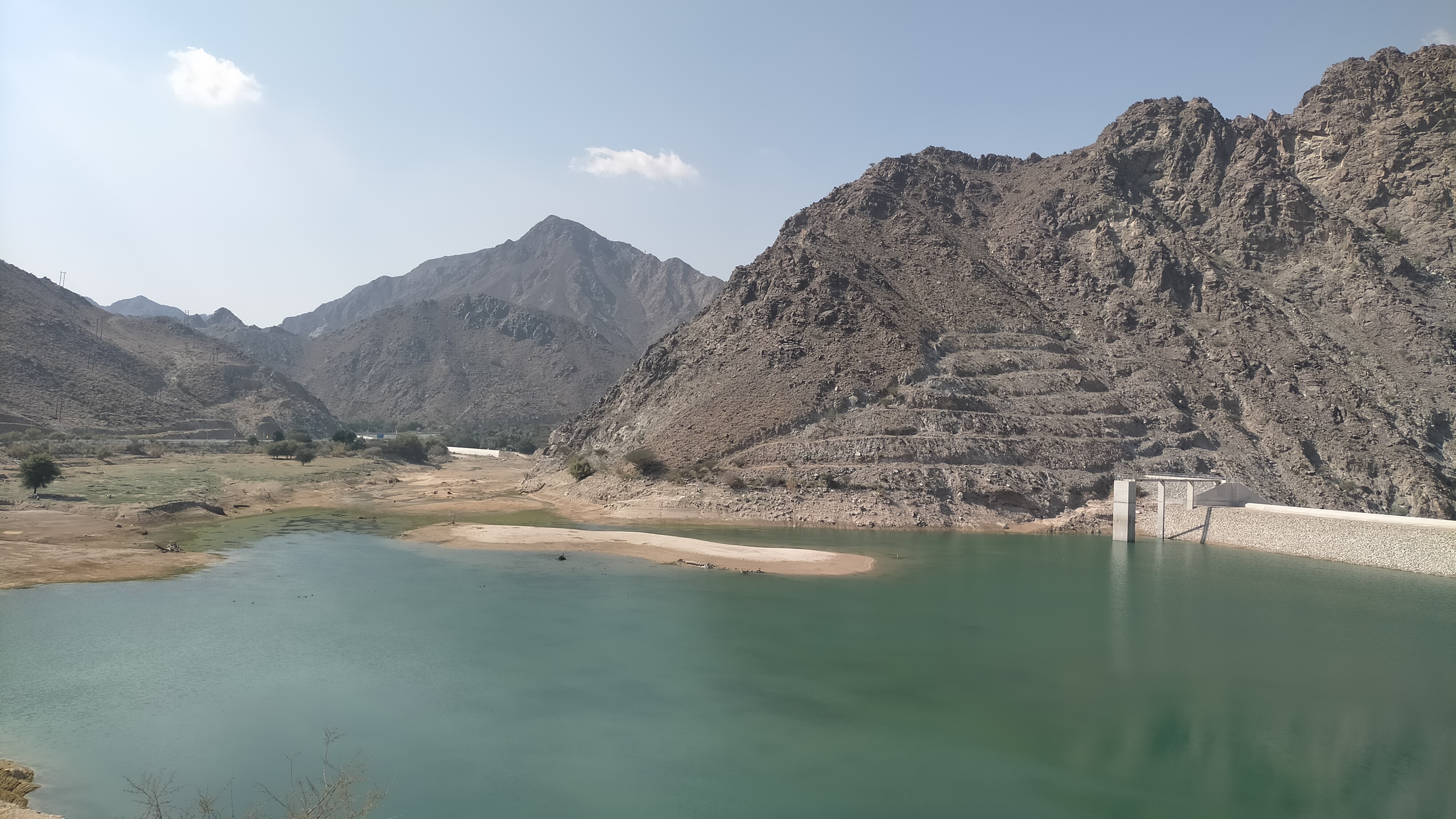
Most of Madha is empty. The developed portion, called New Madha, contains roads, a school, a post office, a police station, an Omani bank, electricity and water supply, and an airstrip. A Royal Oman Police patrol operates in the territory. The farming area is watered by a falaj system fed by mountain springs, and a group of well-established banyan trees grow among the irrigated fields. The As Saruj Dam, standing 25.5 meters tall with a capacity of 1.35 million cubic meters, fills after rains to create a freshwater lake that draws visitors from the surrounding region.
Coins From Alexander's Time
Muhammad bin Salem Al Madhani founded a house museum in 1976, gathering artifacts that span millennia. The collection includes pottery, agricultural implements, and coinage from before the Common Era. Among the coins is a Greek silver piece from the reign of Alexander the Great, alongside currency minted during the Umayyad and Abbasid caliphates. Arrowheads, spear fragments, and inscribed stones round out a collection that testifies to Madha's position along ancient trade and military routes. A 17th-century fort, thought to have been built under Sultan bin Saif Al-Yarubi, adds another layer of history. Madha may be a geographic oddity, but its antiquities suggest it has been a place of consequence for far longer than the modern borders that make it remarkable.
From the Air
Located at 25.28N, 56.33E in the Hajar Mountains region between the Musandam Peninsula and the main body of Oman. Madha is completely surrounded by UAE territory. An airstrip is present in New Madha. Nearest major airport is Fujairah International (OMFJ) to the south. The terrain is mountainous with wadis and agricultural areas.