.jpg)
Madidi National Park
Eleven percent of all bird species known to science live in a single park. That statistic alone would make Madidi National Park remarkable, but the birds are only the beginning. Tucked into the northwest corner of Bolivia's La Paz Department, Madidi spans nearly 1.9 million hectares of terrain so varied that a traveler could walk from snow-capped Andean peaks into steaming Amazonian lowlands without ever crossing a fence. Established in 1995, the park protects one of the most biologically concentrated landscapes anywhere on the planet, a place where jaguars share territory with Andean condors and where scientists are still cataloging species they have never seen before.
From Glaciers to Jungle Floor
Madidi's extraordinary biodiversity stems from its extraordinary geography. The park begins high in the Apolobamba range, where the Andes pile up into snow-dusted ridgelines above 5,000 meters. From those frozen heights, the land plunges through a succession of ecosystems that reads like a textbook of South American ecology: high-altitude grasslands give way to cloud forests perpetually wrapped in mist, which descend into lowland tropical forests and eventually flatten into pristine savanna at the edge of the Amazon basin. Few protected areas on Earth compress so many ecological zones into a single boundary. The rivers that carve through these landscapes, including the Tuichi and the Beni, have cut deep valleys that isolate populations and accelerate speciation, turning Madidi into an engine of evolution.
A Census That Never Ends
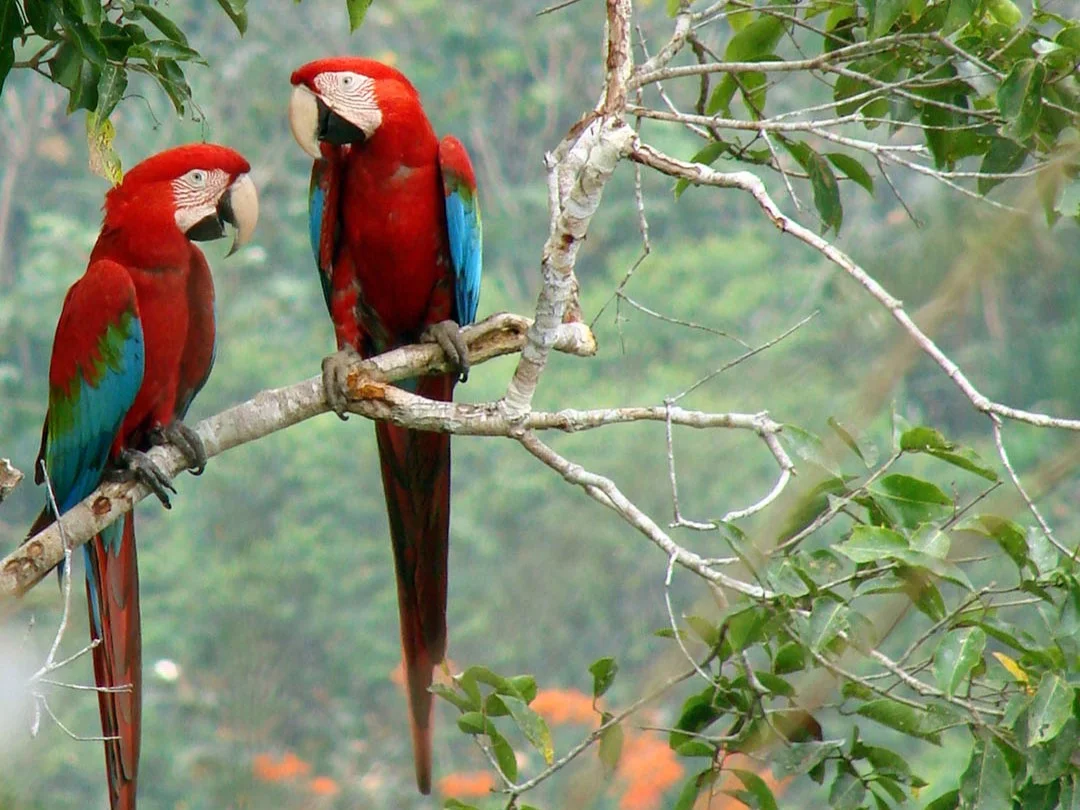
The numbers are staggering, and they keep growing. More than 1,000 bird species have been recorded within Madidi's borders, from iridescent hummingbirds flickering through the cloud forest understory to military macaws flashing scarlet and green above the canopy. The park harbors large populations of jaguars, spectacled bears, maned wolves, vicunas, and giant otters -- a roster of Latin America's most iconic and elusive wildlife. A monkey species discovered in recent years lives in Madidi and nowhere else, a reminder that this forest still holds secrets. Birders travel from around the world to work through even a fraction of the park's avian checklist, and biologists suspect the true count of species across all taxa remains far higher than current records reflect.
A Wilderness Without Borders
Madidi does not stand alone. It connects with neighboring protected areas in Bolivia and southeastern Peru, forming a vast corridor of unbroken wilderness that ranks among the largest in the Americas. This continuity matters enormously for wide-ranging species like the jaguar, which needs immense tracts of habitat to maintain viable populations. The park's isolation has also preserved ecosystems that have been degraded or destroyed elsewhere in the Andes-Amazon transition zone. Cloud forests, which trap moisture from Pacific-born weather systems and feed it into the Amazon watershed, survive here in a state that would have been familiar centuries ago. The result is a landscape that functions as both a refuge for threatened species and a living laboratory for understanding how tropical ecosystems work.
Entering Madidi
The gateway to Madidi is Rurrenabaque, a small town on the Beni River where tour operators organize multi-day expeditions into the park. There are no roads into Madidi's interior; access is by river, and the journey itself becomes part of the experience as motorized canoes push upstream past clay riverbanks where macaws gather to eat mineral-rich soil. Eco-lodges dot the park's edges. The oldest and best known is Chalalan Ecolodge, a community-run operation on the Tuichi River that has become a model for sustainable tourism in Bolivia. Nearby, the San Miguel del Bala Eco-Lodge sits on the banks of the Beni, reachable by a 40-minute boat ride upstream from Rurrenabaque. Both offer guided walks into primary forest where the density of life is palpable -- the air hums, the canopy rustles, and something unseen always seems to be watching.
From the Air
Located at 14.33S, 68.33W in northwest Bolivia. The park stretches from Andean peaks to lowland Amazon basin. Overfly at 15,000-20,000 feet to appreciate the dramatic elevation transitions from snow-capped Apolobamba range down to river valleys. The Tuichi and Beni rivers are visible landmarks threading through dense forest. Nearest airport is Rurrenabaque (SLRQ). La Paz El Alto (SLLP) is the major international airport, roughly 200 nm southeast. Expect cloud cover over the cloud forest zone; clearest visibility from June to October during the dry season.
Nearby Stories
- San Miguel del Bala 44 km away
- Pilón Lajas Biosphere Reserve and Communal Lands 84 km away
- Tambopata National Reserve 133 km away
- Taquile Island 156 km away
- Iturralde Crater 165 km away
- San Borja 178 km away
- Isla del Sol 191 km away
- Pando Department 345 km away