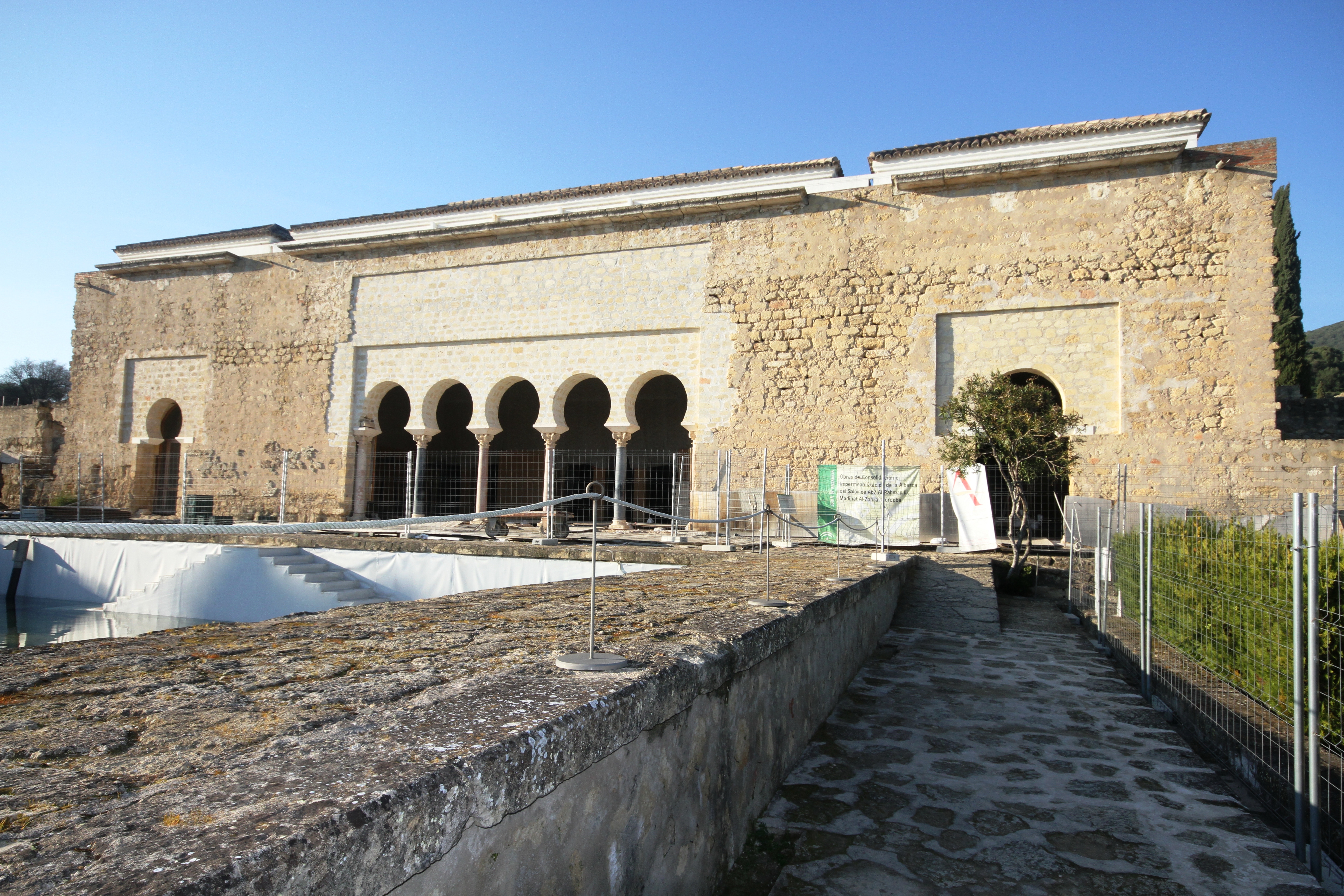
Madinat al-Zahra
In 936, Abd ar-Rahman III began building a city. Not a neighborhood or a palace wing -- an entire city, stretching 1.5 kilometers across the foothills of the Sierra Morena west of Cordoba. He had declared himself caliph seven years earlier, claiming spiritual and political leadership of the Muslim world, and a title that audacious required an equally audacious capital. Madinat al-Zahra -- the "Shining City" -- was his answer to the Abbasid palaces of Baghdad and the Fatimid courts of North Africa. It lasted barely seventy years before civil war tore it apart, but its ruins remain one of the most important archaeological sites in Spain.
A Caliph's Ambition in Stone
The construction was a statement of political theology. By declaring himself caliph in 929, Abd ar-Rahman III challenged both the Abbasid caliphs in Baghdad and the Fatimid caliphs in North Africa. The existing capital of Cordoba, however grand, belonged to his predecessors. A new caliph needed a new city. He chose a site on the slopes of Jabal al-Arus -- Bride Hill -- overlooking the Guadalquivir valley, where the terrain allowed a hierarchical arrangement: the caliph's palace at the highest point, administrative buildings on middle terraces, and the general population below. The city covered 112 hectares and was protected by thick stone walls with square bastions. Construction continued through Abd ar-Rahman III's reign and into that of his son, Al-Hakam II, involving thousands of workers and materials drawn from across the Mediterranean, including marble columns from North Africa and carved capitals from Constantinople.
Palaces Within a Palace-City
The Salon Rico -- the Rich Hall -- was the ceremonial heart of Madinat al-Zahra, where the caliph received ambassadors and dispensed justice. Its walls were covered in intricate carved stone panels depicting stylized vegetation, a decorative program of extraordinary density and refinement. Above the hall, the Upper Garden stretched across an artificial terrace ten meters higher than the surrounding land, with a central pavilion surrounded by pools and plantings arranged in a geometric four-part design. Water flowed through the complex in channels and fountains, a display of engineering as much as aesthetics -- in semi-arid Andalusia, controlling water was the ultimate expression of power. The Dar al-Mulk, the Royal House, occupied the highest terrace at the city's northwest corner, where the caliph could survey his creation and the plains stretching toward Cordoba beyond.
A City That Burned Too Bright
Madinat al-Zahra's splendor was its own undoing. During the fitna -- the civil war that consumed the Caliphate of Cordoba between 1009 and 1013 -- the city was sacked and systematically looted. Berber soldiers stripped it of its marble, its carved panels, its bronze doors. What they could not carry, they burned. Within a few decades, the most ambitious urban project in medieval Europe had been reduced to rubble, its stones carted off for reuse in buildings across Andalusia. The destruction was so thorough that the city's exact location was forgotten for centuries. It was not until the early 20th century that systematic excavation began, and even today only about 10 percent of the site has been uncovered.
What the Ruins Still Tell
Walking through Madinat al-Zahra today is an exercise in imagination guided by fragments. The reconstructed Salon Rico gives a sense of the decorative intensity that once covered these walls, but most of the city remains unexcavated hillside. The archaeological museum, opened in 2009 and designed by Nieto Sobejano Arquitectos, won the Aga Khan Award for Architecture in 2010 for its sensitive integration with the landscape -- much of it is built underground to preserve views of the ruins. The site was inscribed as a UNESCO World Heritage Site in 2018. What makes Madinat al-Zahra haunting is not the scale of what survives but the scale of what was lost. A city built to prove that Cordoba could rival Baghdad was destroyed by forces from within, a reminder that the grandest ambitions carry the seeds of their own collapse.
From the Air
Located at 37.886N, 4.868W, about 8 km west of Cordoba in the foothills of the Sierra Morena. From the air, the excavated ruins appear as geometric foundations and walls on a south-facing hillside. The site is visible at moderate altitudes as a cleared archaeological zone surrounded by olive groves. Nearest airport is Cordoba (LEBA). The Guadalquivir valley stretches south from the site, and Cordoba's historic center with the Mosque-Cathedral is visible to the east.