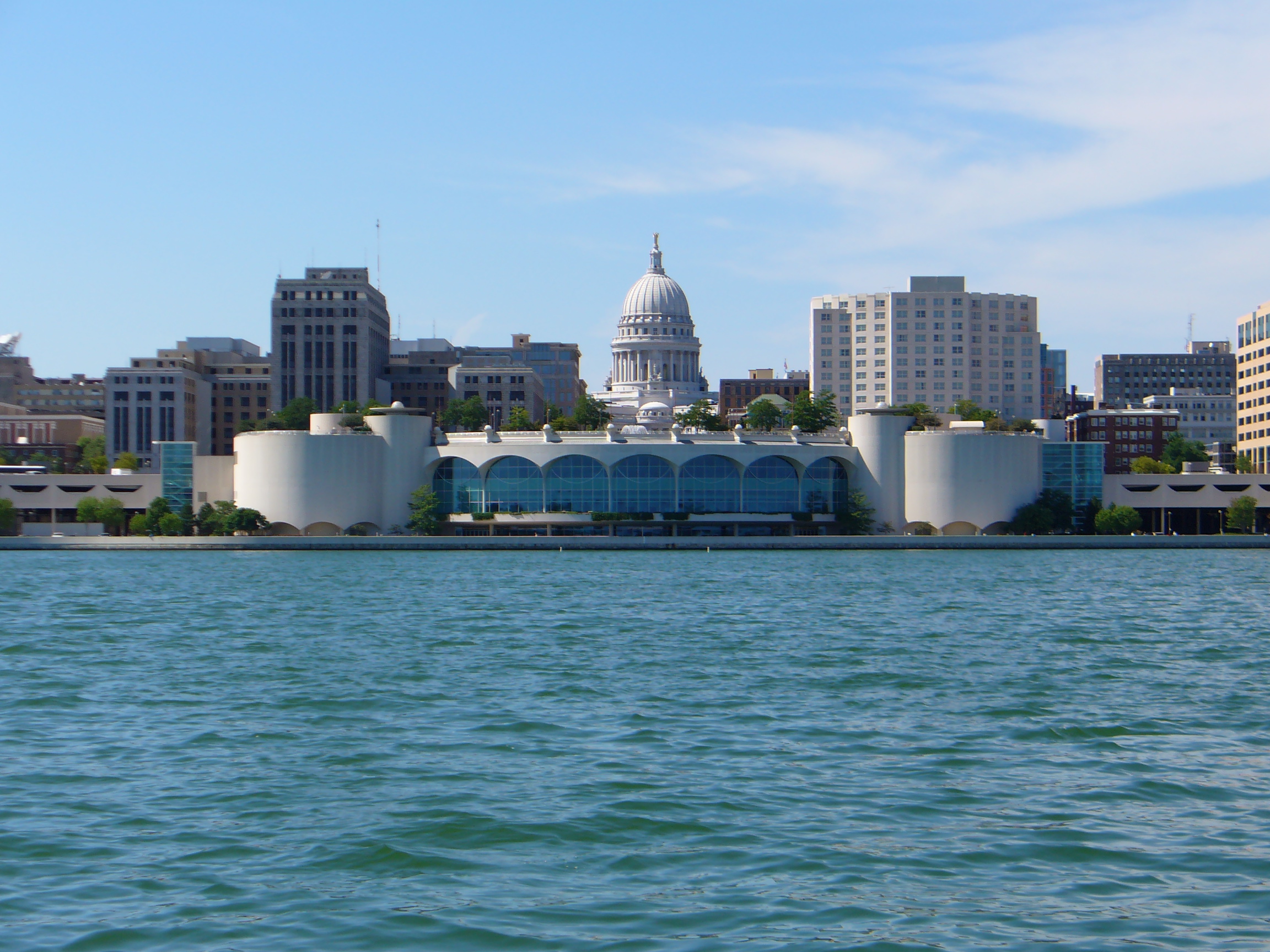
Madison: The Wisconsin Capital on an Isthmus
Madison is built on an isthmus - the narrow strip of land between Lake Mendota and Lake Monona, the Capitol dome at one end, the University of Wisconsin campus at the other, the connection between them defining the city. The location was chosen in 1836 when the area was still wilderness, the lakes visible from the future Capitol site, the geometry irresistible. The university that arrived in 1848 became the institution that shapes everything: the politics (liberal in conservative Wisconsin), the economy (education and healthcare), the culture (college-town character that persists regardless of calendar). Madison is what happens when a capital and a flagship university occupy the same small isthmus.
The Isthmus
The isthmus is less than a mile wide at its narrowest, Lake Mendota to the north, Lake Monona to the south. The Capitol sits at the high point; State Street connects it to the university; the density is forced by the water on both sides. The geography creates walkability that other Midwestern capitals lack; it also creates traffic problems when 250,000 people try to move through a bottleneck. The lakes freeze in winter, the ice fishing shacks appearing on Mendota; they fill with sailboats in summer. The isthmus setting makes Madison distinctive - the city that couldn't sprawl because water blocked the way.
The University
The University of Wisconsin-Madison enrolls 45,000 students and employs 24,000 people - the dominant institution in a city of 270,000. The campus stretches along Lake Mendota, the Memorial Union terrace providing sunset views, the Kohl Center hosting Badger basketball, the research programs generating the startups that diversify the economy. UW's presence makes Madison younger, more liberal, more culturally active than comparable cities. The university and the state government compete as economic anchors; between them, they ensure stability that other Midwest cities lack. Madison without UW would be unrecognizable.
The Politics
Madison is the most liberal city in the Midwest - the voting margins for Democrats regularly exceed 80%, the politics more aligned with Berkeley than with Milwaukee. The liberalism comes from the university (faculty and students), from the state employees (unionized and progressive), and from the self-selection of residents who chose Madison for its character. The contrast with conservative Wisconsin creates perpetual tension - the Walker-era attacks on public employee unions, the gerrymandered legislature, the sense that Madison and Wisconsin are different countries. Madison's liberalism is genuine, insular, sometimes smug. The city knows it's different; the rest of Wisconsin resents the reminder.
The Saturday
Saturday mornings in summer mean the Dane County Farmers Market - the largest producer-only farmers market in the country, vendors circling the Capitol Square, the crowds that make walking difficult. The market represents Madison's food culture: the organic vegetables, the artisan cheese, the farm-to-table ethos that pervades local restaurants. The Saturday also means Badger football in fall - Camp Randall Stadium packed with 80,000 fans, State Street bars overflowing, the 'Jump Around' tradition shaking the stadium. Saturday is when Madison is most itself, the market and the football showing what the city values.
Visiting Madison
Madison is served by Dane County Regional Airport (MSN). The Capitol is worth touring; the Saturday farmers market in summer is essential. State Street connects Capitol to campus, offering shops and restaurants. The Memorial Union terrace provides lake views and beer (cash only). The Chazen Museum of Art on campus is free and excellent. For cycling, the paths around the lakes offer easy routes. The food scene is strong; the cheese curds are mandatory. The weather is Midwestern: cold winters (really cold), hot summers, the lakes moderating temperatures slightly. Football season brings crowds; book ahead.
From the Air
Located at 43.07°N, 89.40°W on an isthmus between Lake Mendota and Lake Monona in southern Wisconsin. From altitude, Madison appears as development squeezed between two lakes - the Capitol dome visible at the isthmus center, the university campus visible along Mendota's shore. The geography constrains the city; the water defines it. What appears from altitude as a lakeshore capital is the university town - where liberal politics thrive in conservative Wisconsin, where the isthmus forces density, and where the Capitol and the campus define the city between them.