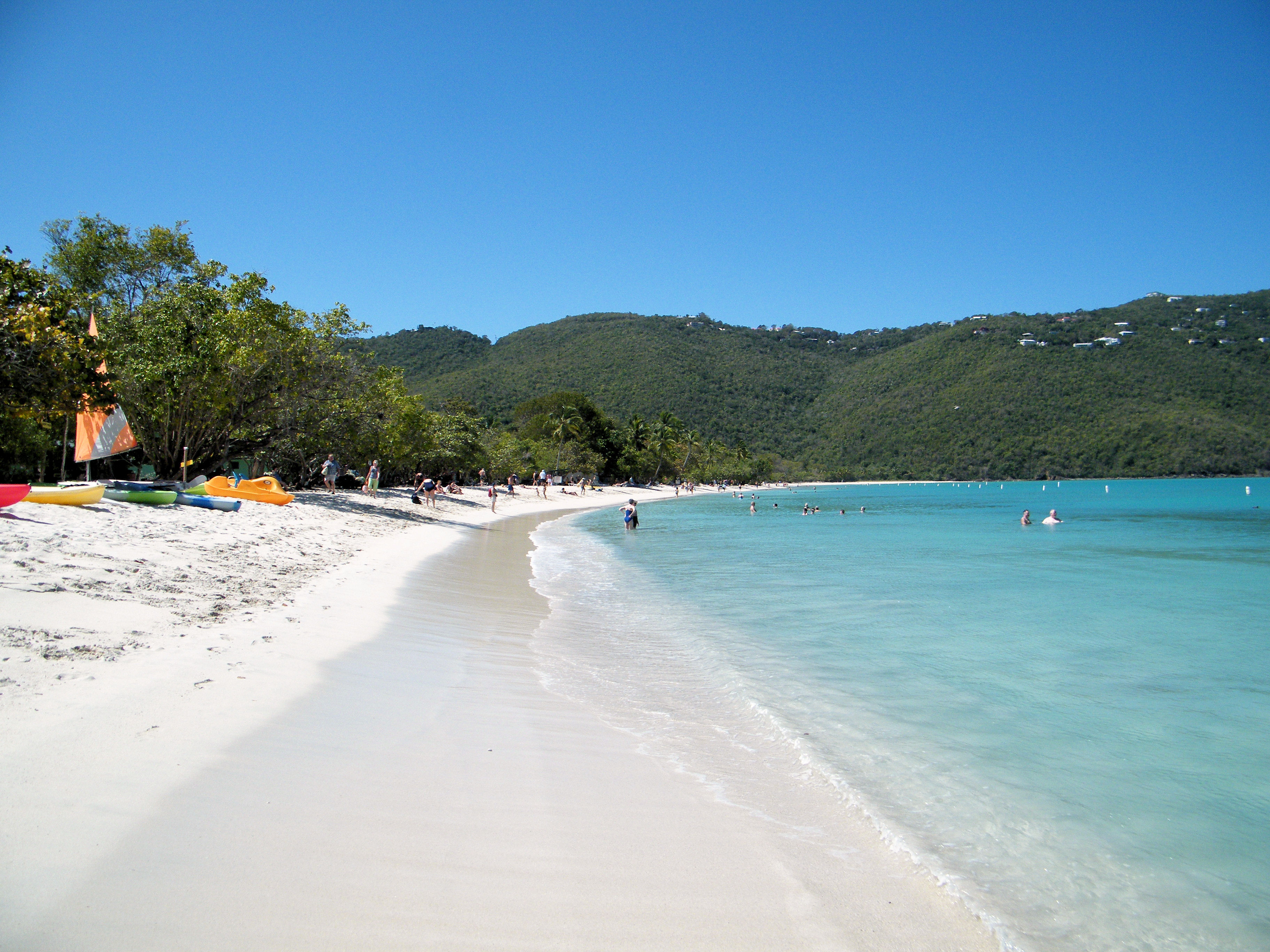
Magens Bay
Somewhere between 1200 and 1500 A.D., a Taino artisan carved a ritual spatula from the rib of a manatee and left it in the sand at the head of a deep bay on the northern coast of what is now St. Thomas. Centuries later, that same bay -- sheltered by the arms of Peterborg peninsula to the east and Tropaco Point to the west -- would become one of the most celebrated beaches in the Caribbean. Magens Bay stretches nearly three-quarters of a mile of white sand along the Atlantic side of the island, its waters kept calm by the bay's northwest exposure. Three hundred thousand visitors arrive each year, but this is no resort -- it is a public park, protected by the wishes of the man who gave it away.
From Great Northside Bay to Magens
Early maps of St. Thomas labeled this stretch of coastline simply "Great Northside Bay." The name that stuck came from the Danish colonial family that owned the land from 1817 to 1898: Arve Petersen Magens and his heirs, connected to the prominent Joachim Melchior Magens line that had shaped the island's affairs since the eighteenth century. Legend places Sir Francis Drake here too, anchoring in the bay while waiting for ships to plunder -- a story that persists in the name of Drake's Seat, the overlook above the bay that remains one of the most photographed viewpoints in the Virgin Islands. Whether Drake actually dropped anchor in these waters is uncertain, but the bay's deep natural harbor and protected position make the legend plausible.
Fairchild's Gift
In 1916, Wall Street financier Arthur S. Fairchild acquired the property. Thirty years later, in 1946, he donated 56 acres of beach and surrounding land to the Municipality of St. Thomas and St. John for use as a public park. His conditions were specific and forward-looking: no hotel or resort could ever be built on the property, no casino could operate there, and the beach must carry the name Magens Beach. Most striking was his stated intention -- that "the natural beauty and benefits be preserved for the enjoyment of the inhabitants of the Virgin Islands without discrimination of any kind by reason of race, color or creed." In 1946, in a Caribbean still shaped by colonial hierarchies, this was a radical stipulation. The far western portion of the bay was later donated by Fairchild's nephew's widow, Christine Wheaton, in 2002, completing the public trust.
Life at the Water's Edge
Today, the semi-autonomous Magens Bay Authority manages the beach and its surrounding park as a self-sustaining entity. Lifeguards watch over the calm, sandy-bottomed waters where sea turtles, stingrays, spotted eagle rays, and tarpon are commonly spotted -- though the sandy bottom makes snorkeling of limited interest compared to rockier Caribbean bays. Visitors pay seven dollars for entry, locals two, and children under twelve get in free. The revenue, supplemented by parking fees and concession payments from the restaurant and rental operations, funds everything from beach wheelchairs to the fitness trail that winds through the property. Small local fishing boats still anchor in the eastern part of the bay, a reminder that this is a working waterfront as much as a tourist destination. Beyond the sand, the property includes a coconut grove, a mangrove, and an arboretum.
Wings and Trails Above the Bay
In 2004, The Nature Conservancy and local organizations opened a hiking trail that descends from the hills above Magens Bay through a 319-acre preserve, covering a mile and a half of shifting ecosystems from ridgeline to coast. BirdLife International has designated a 572-hectare area encompassing the bay, beach, mangroves, and protected forests as an Important Bird Area, recognizing the populations of green-throated caribs, Antillean crested hummingbirds, Caribbean elaenias, and pearly-eyed thrashers that live in the canopy above the sunbathers. The trail belongs to a preserve jointly overseen by The Nature Conservancy, the Magens Bay Authority, and the V.I. Department of Planning and Natural Resources, with 25 acres donated exclusively for the path. Hollywood has noticed the bay too: scenes from The Twilight Saga: Breaking Dawn - Part 1 and Weekend at Bernie's II were filmed on its shores.
From the Air
Magens Bay sits at 18.366N, 64.930W on the northern (Atlantic) coast of St. Thomas, U.S. Virgin Islands. From the air, the bay is unmistakable: a deep, U-shaped indentation in the coastline flanked by Peterborg peninsula to the east and Tropaco Point to the west, with a long crescent of white sand at its head. The surrounding hillsides are lush green. Drake's Seat overlook is visible on the ridge above. Nearest airport: Cyril E. King Airport (TIST) on St. Thomas, approximately 5nm southwest. Recommended viewing altitude: 1,500-2,500 feet for the full bay panorama.