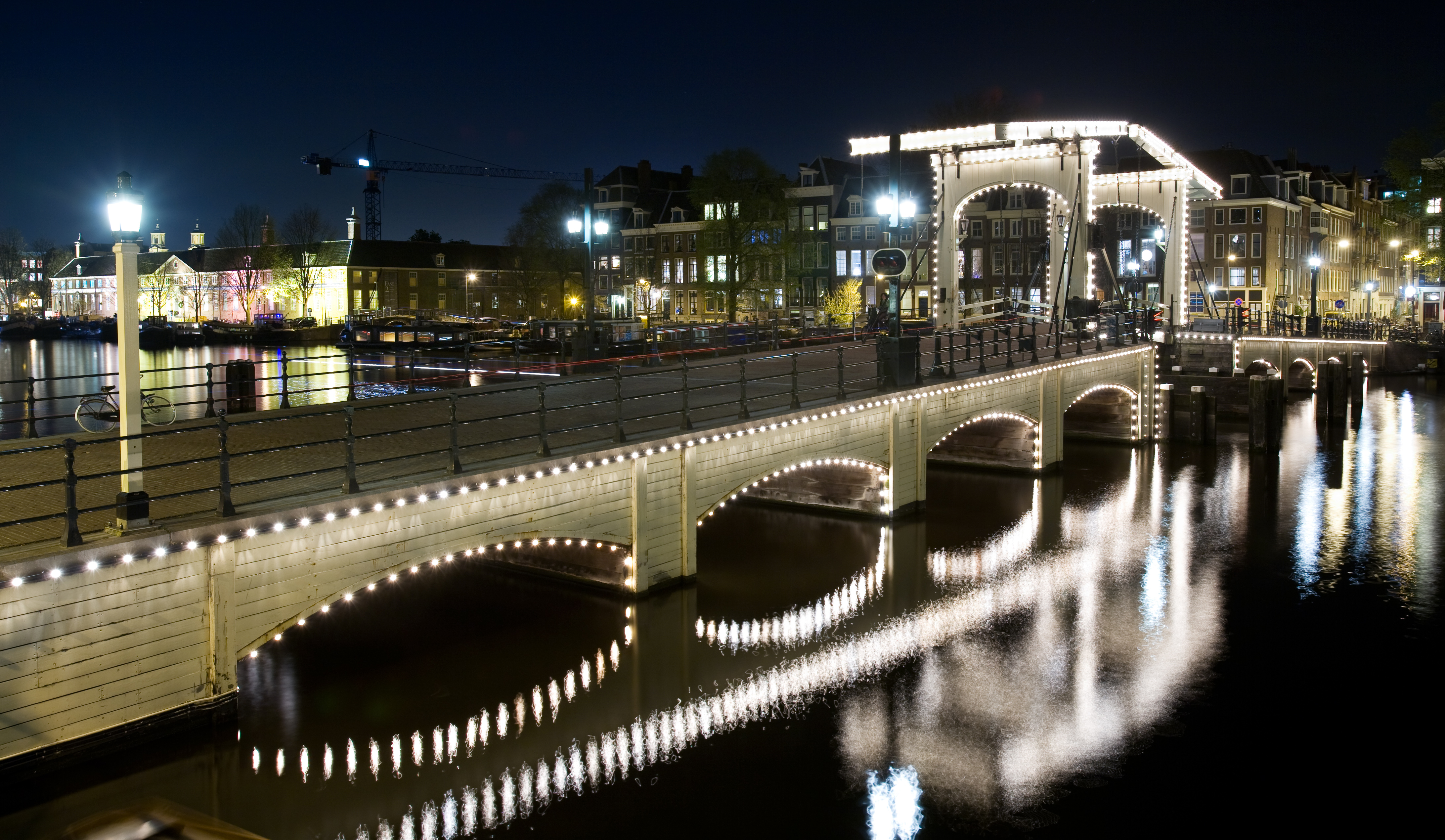
Magere Brug
Ask an Amsterdammer for the most cliched photo in the city and they will probably mention the Magere Brug. It is the picture that turns up on calendars and chocolate tins and refrigerator magnets: a slim white wooden drawbridge slung across the Amstel, the cables and counterweights making a shape like a child's drawing of a bridge. It has been there in some version since 1691. The current bridge is from 1934. The bulbs strung along its frame, 1,200 of them, switch on at dusk and turn the structure into a doodle of light on black water. Locals say a kiss on the Magere Brug, or under it from a passing boat, locks two people in love forever. The story is older than anyone alive. Plenty of marriages have proved it true. Plenty have proved it wrong.
A Bridge Named Skinny
The first bridge crossed the Amstel here in 1691, built where Kerkstraat meets the river. It had thirteen arches and was so narrow that locals took to calling it magere brug, the skinny bridge. By 1871 it had rotted past saving and was replaced with a nine-arched wooden version, which itself wore out by the 1930s. The architect Piet Kramer, of the Amsterdam School, drew up alternatives in steel and stone; the city instead asked him to build a near-replica of what had been there before, only slightly bigger. In 1934 the current bridge opened, a white-painted bascule with the same skinny profile its predecessors had carried for nearly two and a half centuries. The last big renovation came in 1969. Until 1994 it was raised by hand. Now it lifts under automatic control, many times a day, for the boats.
The Two Sisters
Tour guides will tell you the bridge was built by two sisters who lived on opposite banks and wanted to visit each other every day. In one version, they could not afford a proper wide bridge, so they paid for the skinniest planking the city would approve and named the result for what their purse allowed. In another version, the sisters' family name was Mager, skinny, and the bridge took their surname rather than its dimensions. Neither story holds up to historical scrutiny. The 1691 record is dry, civic, unromantic. But the sisters are folklore now, and folklore is hard to evict from a wooden bridge. James Bond gets told the story by a boat tour guide in the 1971 film Diamonds Are Forever, and the legend has acquired a permanent on-screen citation it never quite earned.
The Lit Bridge
Since 2003 cars have been banned. Only pedestrians and cyclists cross, except the river-traffic that slides through underneath several times an hour. The sightseeing boats are built low enough to pass under the bridge when its central span is down. Higher craft trigger the lift: lights flash, the road tilts up, a bell rings, the boat passes, the road comes back. At night the 1,200 bulbs trace every cable and beam, doubling the bridge in the river's reflection. Locals call it the most romantic bridge in Amsterdam, which is a contested category in a city of more than a thousand bridges. The Magere Brug has tradition on its side, and tradition usually wins. Engagement rings come out here more often than anywhere else in the canal ring.
What's Nearby
Walk south on the Amstel a few minutes and you reach the Zuiderkerk, the Carre theatre, the Hermitage Amsterdam. Walk west on Kerkstraat and you slip into the Negen Straatjes, the small grid of canal-cross streets famous for bookstores and coffee. From the bridge itself, the view downriver picks up the Blauwbrug, blue bridge, decorated with cast-iron lanterns shaped like crowns; the view upriver opens onto the wider Amstel where the houseboats moor. Pause at the centre on a clear evening when the bulbs come on. The bridge sways slightly underfoot, almost imperceptibly, the kind of micro-motion a wooden span in moving water has always had. The story about the sisters is probably not true. The kiss legend is definitely a tourist invention. The bridge is still beautiful, and the bulbs still come on at dusk, and somewhere in the world tonight two people who first kissed here will fall asleep next to each other.
From the Air
The Magere Brug sits at 52.3636°N, 4.9024°E, crossing the Amstel at Kerkstraat between the Keizersgracht and Prinsengracht in central Amsterdam, a few minutes' walk east of Rembrandtplein. Best viewed at low altitude in clear weather. Nearest airport is Amsterdam Schiphol (EHAM), about 13 km southwest.