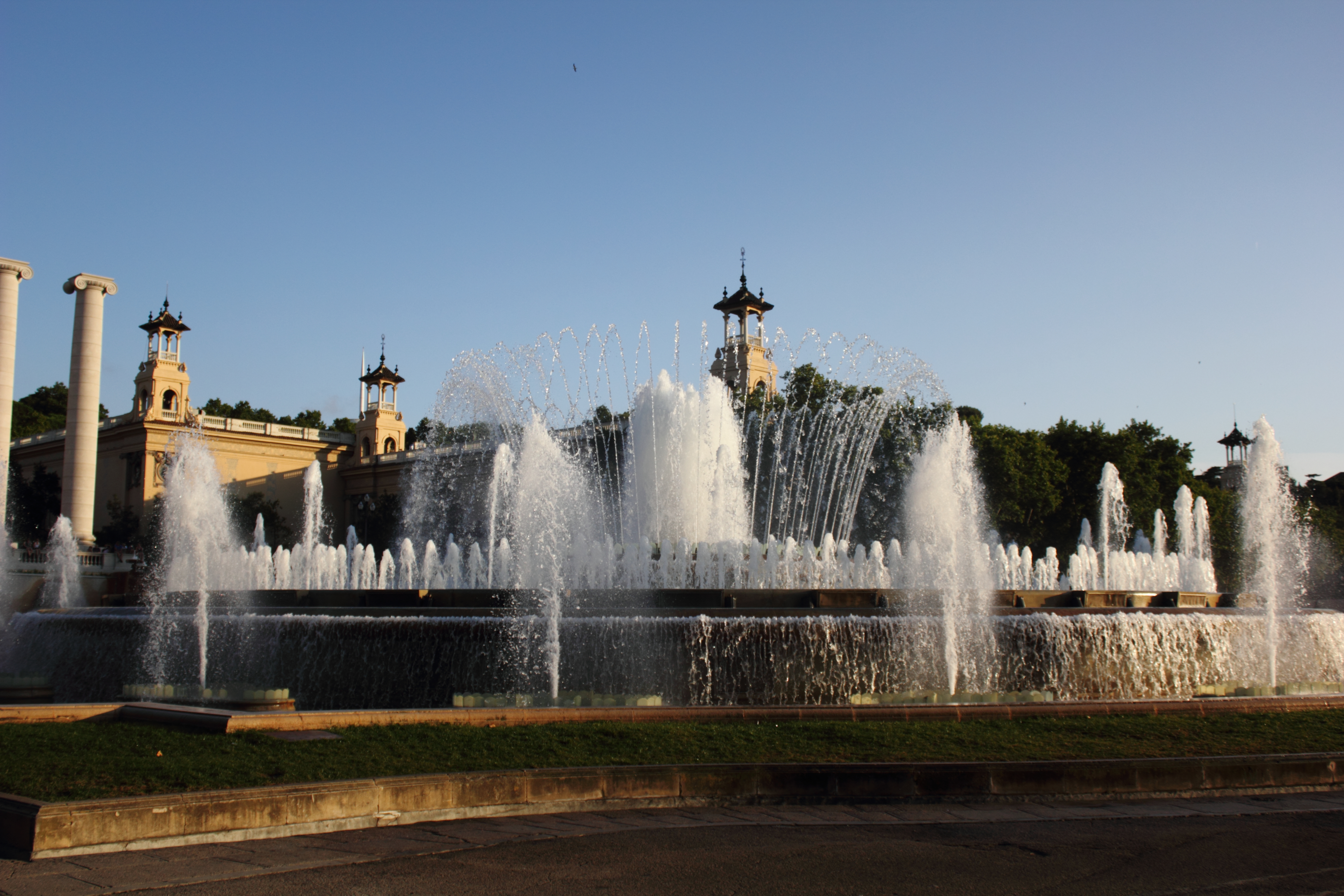
Magic Fountain of Montjuic
They said it could not be done. When engineer Carles Buigas submitted his design for a monumental illuminated fountain at the base of Montjuic, Barcelona's officials declared the plan too ambitious and the timeline impossible -- the 1929 International Exposition was barely a year away. Buigas, who had been designing illuminated fountains since 1922, disagreed. Over three thousand workers were deployed. On 19 May 1929, the day before the Exposition opened, the Magic Fountain of Montjuic performed for the first time, sending 700 gallons of water per second through 3,620 jets while colored lights transformed the cascades into something that justified the name Barcelona chose for it.
What Stood Here Before
The fountain sits on ground with political weight. Before Buigas's creation, this site held The Four Columns, a monument designed by architect Puig i Cadafalch as a symbol of Catalanism -- the four bars of the Catalan flag rendered in stone. In 1928, Prime Minister Miguel Primo de Rivera ordered the columns demolished, part of his broader campaign to suppress Catalan identity. The demolition cleared the site for the fountain, which was built on the foundations of a political statement the Spanish state had tried to erase. In 2010, eighty-two years after their destruction, the Four Columns were re-erected a few meters from their original location. Today they stand alongside the fountain, the suppressed symbol and its replacement coexisting on the same hillside.
Engineering as Spectacle
The fountain sits at the head of Avinguda Maria Cristina, below the Palau Nacional -- now the Museu Nacional d'Art de Catalunya -- on the Montjuic hillside. Its position is theatrical by design: cascading water descends toward the viewer, framed by the grand staircase and neo-Baroque architecture of the Exposition grounds, with the Placa d'Espanya and the city stretching beyond. The highest water spout reaches 170 feet. The original 1929 installation used colored glass filters and manually operated valves to create its effects. Modern upgrades have added computer-controlled lighting and music synchronization, but the fundamental engineering -- gravity-fed water, dramatic elevation changes, and the interplay of light through moving water -- remains Buigas's design.
Silenced by War, Restored by Time
The Spanish Civil War badly damaged the fountain. From 1936 to 1939, Barcelona was a front line, and Montjuic, with its fortress and strategic elevation, saw intense military activity. The fountain's mechanisms were wrecked, its infrastructure neglected. It sat dormant for nearly two decades. In 1955, Buigas himself oversaw the repairs that brought his creation back to life, more than a quarter century after he had first proven the skeptics wrong. The restoration was fitting -- the man who built the impossible fountain was the one who resurrected it. Today, performances run at half-hour intervals on weekend evenings, with extended schedules during summer. The show draws thousands of spectators who gather on the steps of the Palau Nacional and along the avenue, watching water and light perform a choreography that has been running, with interruptions, for nearly a century.
The Mountain's Gathering Place
Montjuic has served Barcelona as fortress, cemetery, execution ground, fairground, and park. The Magic Fountain occupies the gentlest of these roles -- it is the mountain's invitation to pleasure. The Poble Espanyol, an open-air architectural museum built for the same 1929 Exposition, sits nearby, as does the Placa d'Espanya, one of Barcelona's largest public squares. The fountain anchors the ceremonial axis that runs from the square up to the Palau Nacional, a route designed to impress foreign visitors nearly a century ago and still performing that function for the millions who visit each year. On summer nights, when the jets are synchronized to music and the water cycles through shifting colors, the fountain achieves what Buigas intended: a spectacle grand enough to justify the impossible deadline, built on a site where political symbols were destroyed and rebuilt, in a city that treats public space as theater.
From the Air
Located at 41.37N, 2.15E on the northern slope of Montjuic hill in Barcelona. The fountain is visible from the air at the base of the Palau Nacional, at the top of the grand axis of Avinguda Maria Cristina leading from Placa d'Espanya. Nearest major airport is Barcelona-El Prat (LEBL), approximately 10 km southwest. The Montjuic fortress and Olympic stadium complex are visible higher on the hill. Best viewed at 2,000-5,000 feet AGL.