Magic Kingdom
The entire park is on the second floor. Most visitors never realize it. When engineers broke ground on Magic Kingdom in 1967, they discovered that Florida's water table sat too close to the surface to dig the underground service tunnels Walt Disney had envisioned. So they built the tunnel network, called utilidors, at ground level, then filled in the surrounding terrain with 8 million cubic yards of dirt excavated from the man-made Seven Seas Lagoon next door. Every sidewalk, every castle turret, every ride queue at Magic Kingdom sits one story above the earth. Walt Disney himself never saw any of it. He died in 1966, a year before construction began, leaving his brother Roy to shepherd the most ambitious theme park in history from blueprint to opening day on October 1, 1971.
Opening Credits on Main Street
Walk through the main gate and you pass under the Walt Disney World Railroad station, which functions exactly like a theater curtain rising on a show. Main Street, U.S.A. stretches ahead, modeled after an idealized early-twentieth-century American town inspired by Walt Disney's childhood hometown of Marceline, Missouri. The buildings use forced perspective: first floors are full scale, but second and third stories are built progressively shorter, making the street feel longer and the structures taller than they are. Look up at the upper-floor windows and you will see the names of fictional businesses, each one a tribute to a real person who shaped the Walt Disney World Resort. The soundtrack piped through hidden speakers draws from the 1943 Broadway musical Oklahoma! and the 1957 musical The Music Man. At the far end, Cinderella Castle anchors the hub-and-spoke design, with pathways radiating outward to six themed lands. The Dapper Dans, a men's a cappella quartet, stroll Main Street singing barbershop harmonies, a tradition as old as the park itself.
Six Lands, One Kingdom
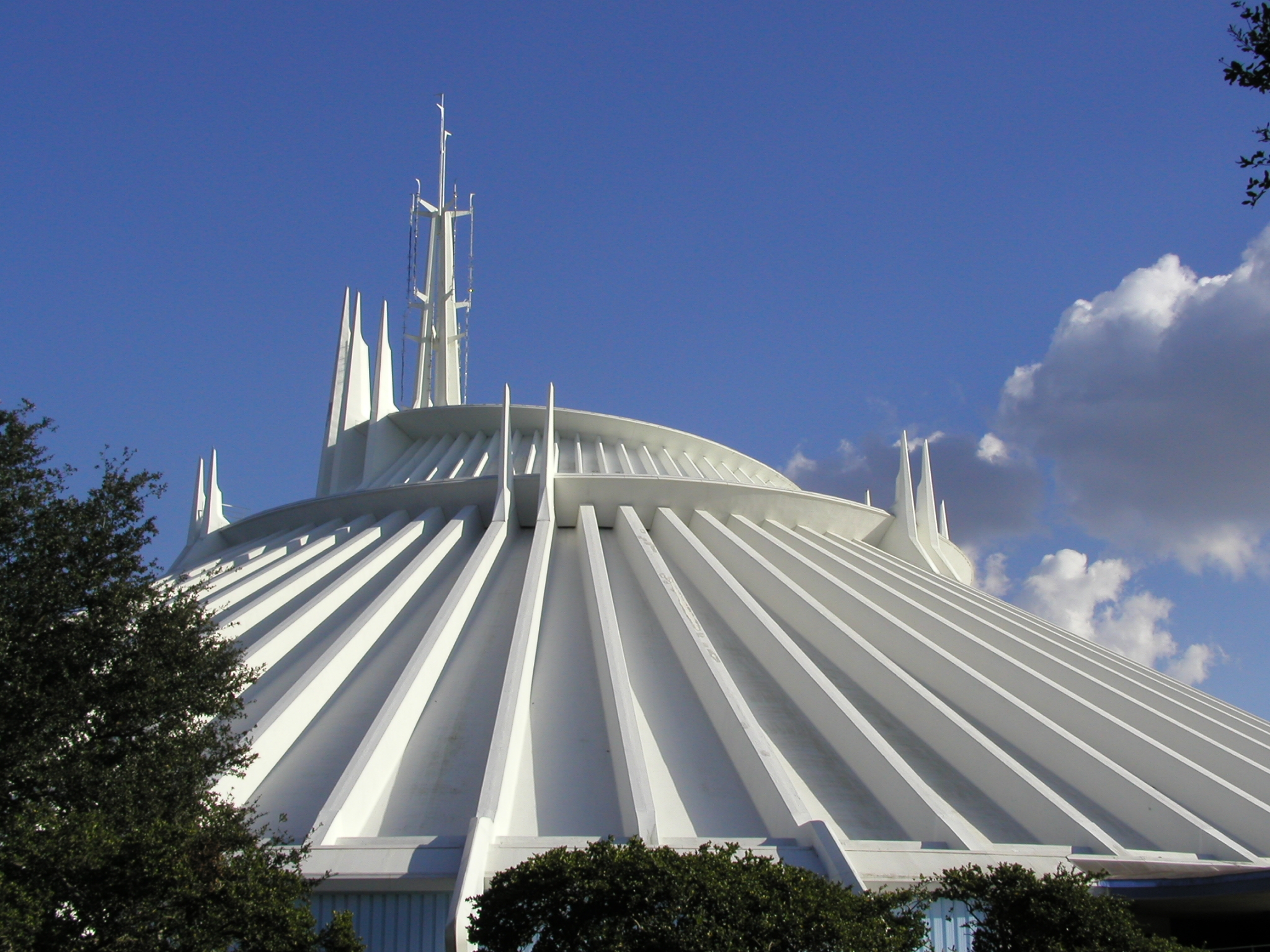
Magic Kingdom opened with twenty-three attractions split across six themed lands. Five mirrored their counterparts at Disneyland in Anaheim: Main Street U.S.A., Adventureland, Frontierland, Fantasyland, and Tomorrowland. The sixth, Liberty Square, was exclusive to Florida, replacing Disneyland's New Orleans Square with a colonial American town set during the Revolutionary War. Liberty Square houses the Hall of Presidents, a stage show featuring Audio-Animatronics of all 45 individual American presidents, and the Haunted Mansion, an omnimover dark ride tucked into a haunted New England manor. Across the park, Adventureland sends riders through the comedic Jungle Cruise and the pirate siege of Pirates of the Caribbean. Tomorrowland pushes into Space Mountain's dark cosmos and the neon Grid of TRON Lightcycle / Run. Frontierland's Big Thunder Mountain Railroad rattles through mine shafts of the American Southwest. Fantasyland gathers Peter Pan's Flight, It's a Small World, and the Seven Dwarfs Mine Train behind castle walls. Each land operates as its own sealed world, the transitions between them designed so that the sights and sounds of one never leak into another.
The Invisible City Below
Beneath the park's surface, nine acres of utilidors form a city of their own. The name is a portmanteau of utility and corridor. Cast members use these tunnels to move between lands without being seen by guests, ensuring that a Tomorrowland employee is never spotted walking through Frontierland in the wrong costume. The tunnels also carry utilities, trash removal via an automated vacuum system, and connect to kitchens, break rooms, and wardrobe departments. The utilidors were built during the original construction and were never extended as the park grew, partly because of financial constraints and partly because the engineering required burying an entire park's worth of infrastructure before the first building went up. Disney had planned to include utilidor systems in every subsequent Walt Disney World park, but the idea was set aside after the enormous cost became clear. Magic Kingdom remains the only Disney park with a full utilidor network.
Hurricanes, Pandemics, and Fifty Years of Reinvention
In more than half a century of operation, Magic Kingdom has closed for nine hurricanes: Floyd, Charley, Frances, Jeanne, Wilma, Matthew, Irma, Ian, and Milton. The first non-hurricane closure came on September 11, 2001. The longest shutdown lasted from March 15 to July 11, 2020, during the COVID-19 pandemic. Through it all, the park kept reinventing itself. Mickey's Birthdayland appeared in 1988 to celebrate Mickey Mouse's 60th birthday, morphed into Mickey's Starland, then Mickey's Toontown Fair, and finally closed in 2011 to make way for the Fantasyland expansion. Alcohol was prohibited from opening day until 2012, when Be Our Guest Restaurant became the first location in the park to serve wine and beer. By 2018 every table service restaurant sold it. In 2024, Disney confirmed new lands in development: a Villains-themed land and a Cars-franchise area replacing part of Frontierland. In 2024, Magic Kingdom hosted 17.83 million visitors, making it the most visited theme park in the world for the eighteenth straight year. The tagline says it plainly: The Most Magical Place On Earth.
From the Air
Located at 28.4186N, 81.5811W within Walt Disney World Resort in Bay Lake, Florida. A permanent FAA Temporary Flight Restriction (TFR) covers the resort complex, prohibiting general aviation within 3 nautical miles up to 3,000 feet AGL. Cinderella Castle at 189 feet serves as the visual centerpiece. The park is separated from its parking lot by the man-made Seven Seas Lagoon, with monorail and ferry transportation connecting guests. Nearest airports include Orlando Executive (KORL) approximately 15nm east and Orlando International (KMCO) roughly 20nm southeast. The flat Central Florida terrain makes the castle and surrounding structures visible from significant distance on approach.