Magnolia Plantation and Gardens
The oldest section of the house was not built here. It was floated down the Ashley River on a barge after the Civil War, salvaged from a Drayton property near Summerville and grafted onto whatever foundation remained after Union troops had finished with the original. That improvised reconstruction tells you something essential about Magnolia Plantation: it has survived by adaptation, not by standing still. The Drayton family has held this land since 1679, when Thomas and Ann Drayton built a house and formal garden on 464 acres along the Ashley River west of Charleston. Fifteen generations later, the family name is still on the deed. The gardens that Reverend John Grimke Drayton expanded in the 1840s -- among the first in America to feature outdoor plantings of Camellia japonica and azaleas -- have been open to the public since 1871, making Magnolia one of Charleston's oldest tourist attractions and one of the most continuously cultivated landscapes in the Western Hemisphere.
Rice, Rivers, and Forced Labor
Magnolia was originally a rice plantation. The Draytons brought enslaved people from Barbados in the 1670s, and the earthworks that made rice cultivation possible along the Ashley River -- the dams, dikes, and irrigation channels carved into the tidal marshland -- were built by enslaved Africans, many of whom came from rice-growing regions of West Africa and carried the agricultural knowledge that made the crop viable. Over generations, these communities of enslaved people developed the Gullah language, a Creole tongue rooted in West African languages with English elements woven in. They also built a distinct culture marked by specific foodways -- rice and seafood at its center -- and craft traditions including the coiled sea grass baskets that remain a signature of Lowcountry artistry. The neighboring Drayton Hall, built in 1738 by enslaved laborers for John Drayton on an adjoining property, still stands as one of the finest examples of Georgian-Palladian architecture in America.
A Minister's Garden
The gardens that visitors walk today owe their character to Reverend John Grimke Drayton, who inherited the plantation in the 1840s. An Episcopal minister with a love of horticulture, Drayton reimagined the grounds in a romantic English garden style, replacing rigid formal beds with curving paths, natural water features, and masses of flowering shrubs. He was among the first Americans to plant Camellia japonica outdoors, beginning in the 1820s. The collection now holds nearly 900 camellia varieties, with roughly 150 bred in the plantation's own nursery. Drayton is also credited with introducing azaleas to American gardens, and in spring the plantation erupts in banks of pink, white, and magenta that have drawn visitors for more than 150 years. The oldest section of the gardens, Flowerdale, dates to 1680 -- its 50 acres of formal plantings set within triangular beds enclosed by boxwood hedges, with two large camellias that have been growing since the 1840s.
What the Cabins Remember
Five cabins stand on the plantation grounds. Four were built during slavery times, one around 1900. During Reconstruction and into the twentieth century, formerly enslaved people and their descendants continued to live in these structures as freedmen and paid laborers. The cabins have been restored to represent different periods: one is set in 1850, showing the conditions of enslaved life, while others reflect the decades after emancipation when Black families on the plantation navigated a changed but still constrained world. The interpretive program, From Slavery to Freedom, traces African American history at Magnolia from the earliest Barbadian arrivals through Reconstruction and beyond. Ongoing archaeological work continues to reveal details about the lives of both enslaved and free Black workers -- skilled gardeners and craftsmen whose labor created the landscape that visitors admire. Magnolia has been recognized for directly addressing slavery in its public presentations, a practice that was once rare among Southern plantation museums.
Living Maze and Cypress Mirror
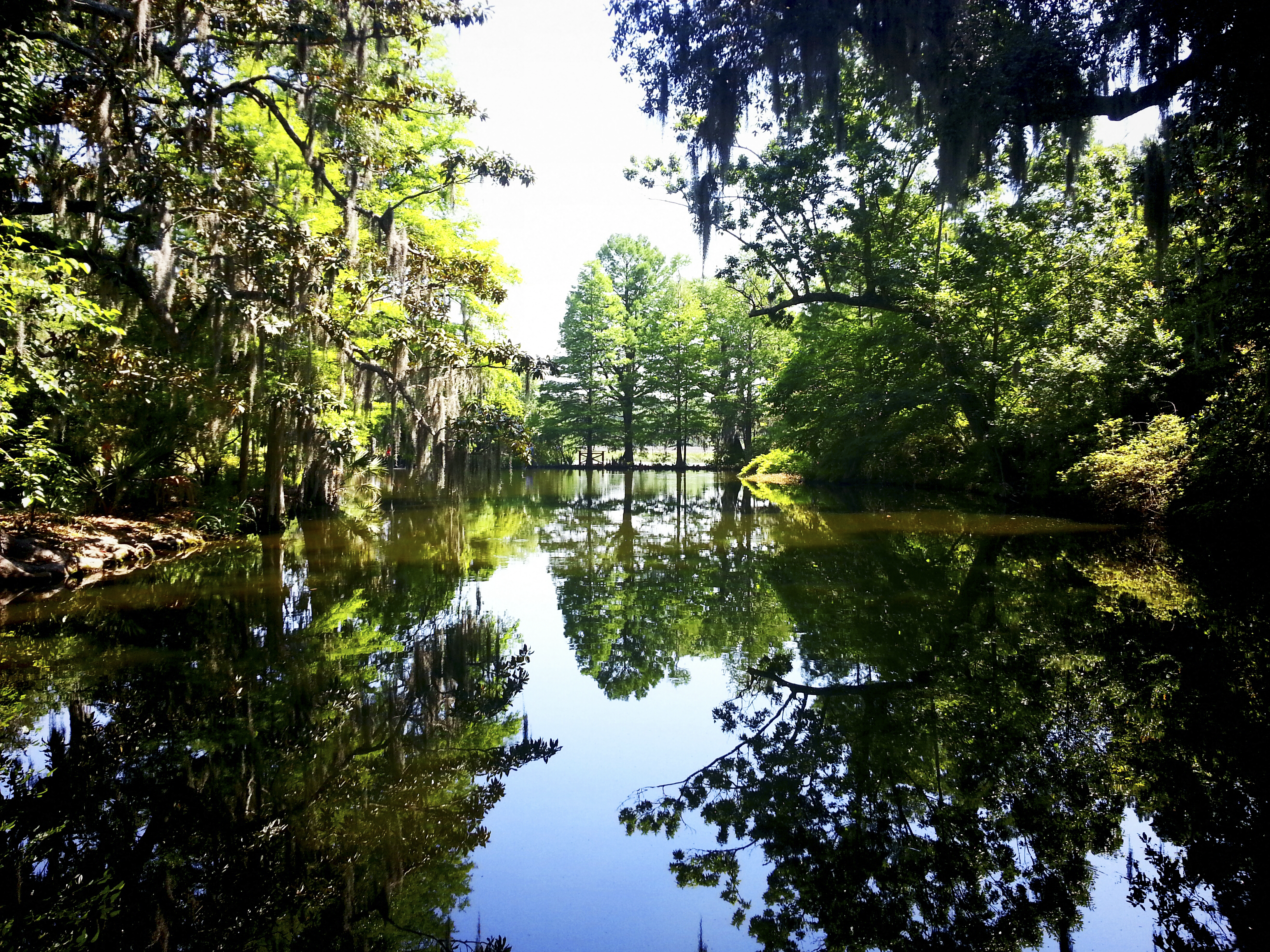
The gardens today sprawl across hundreds of acres with features that range from intimate to theatrical. A hedge maze replicates the famous Hampton Court maze in England but substitutes 500 Camellia sasanqua shrubs interspersed with Burford holly for the original yew hedging. Cypress Lake, lined with bald cypress trees up to a century old, produces the glassy reflections that have made it one of the most photographed spots in the Lowcountry -- the red footbridge spanning the dark water has become an icon of Charleston tourism. The Barbados Tropical Garden houses plants from the Caribbean island where the Drayton family began their American journey. A Biblical Garden grows plants referenced in Scripture. The Cattail Wildlife Refuge covers roughly 500 acres with an observation tower for birding. A nature train, marsh boat tour, and swamp garden emphasize the wild Lowcountry ecosystem that surrounds and interpenetrates the cultivated spaces.
Three Centuries on the Ashley
What makes Magnolia unusual among Southern plantation sites is continuity. The Drayton family's unbroken tenure across 15 generations means the property has never been sold, subdivided, or abandoned. It survived the Revolution, the Civil War, Reconstruction, and the economic upheavals of the twentieth century. That continuity extends to the landscape itself: the live oaks draped in Spanish moss along the entrance drive are older than the nation. The rice field dikes built by enslaved hands still shape the contours of the marshland. The camellias that Reverend Drayton planted before the Civil War still bloom each winter. Magnolia Plantation sits on the Ashley River at 32.88 degrees north, directly across the water from North Charleston, close enough to the city to hear its church bells but far enough into the Lowcountry to feel like a different world -- one measured in growing seasons rather than calendar years.
From the Air
Located at 32.88°N, 80.08°W on the Ashley River, approximately 10 miles west-northwest of downtown Charleston, South Carolina. The plantation's 464 acres are visible along the western bank of the Ashley River, with the gardens, cypress lake, and main house distinguishable from low altitude. The Ashley River provides a clear visual corridor leading upstream from Charleston Harbor. Drayton Hall, the neighboring historic property, is visible approximately 1 mile to the south along the same riverbank. Charleston International Airport (KCHS) is approximately 8 miles north-northeast. Charleston Executive Airport (KJZI) is 6 miles southeast. Best viewed at 1,000-2,000 feet altitude; the formal garden layout, cypress lake, and maze are visible in clear conditions.