Mahamuni Buddha Temple
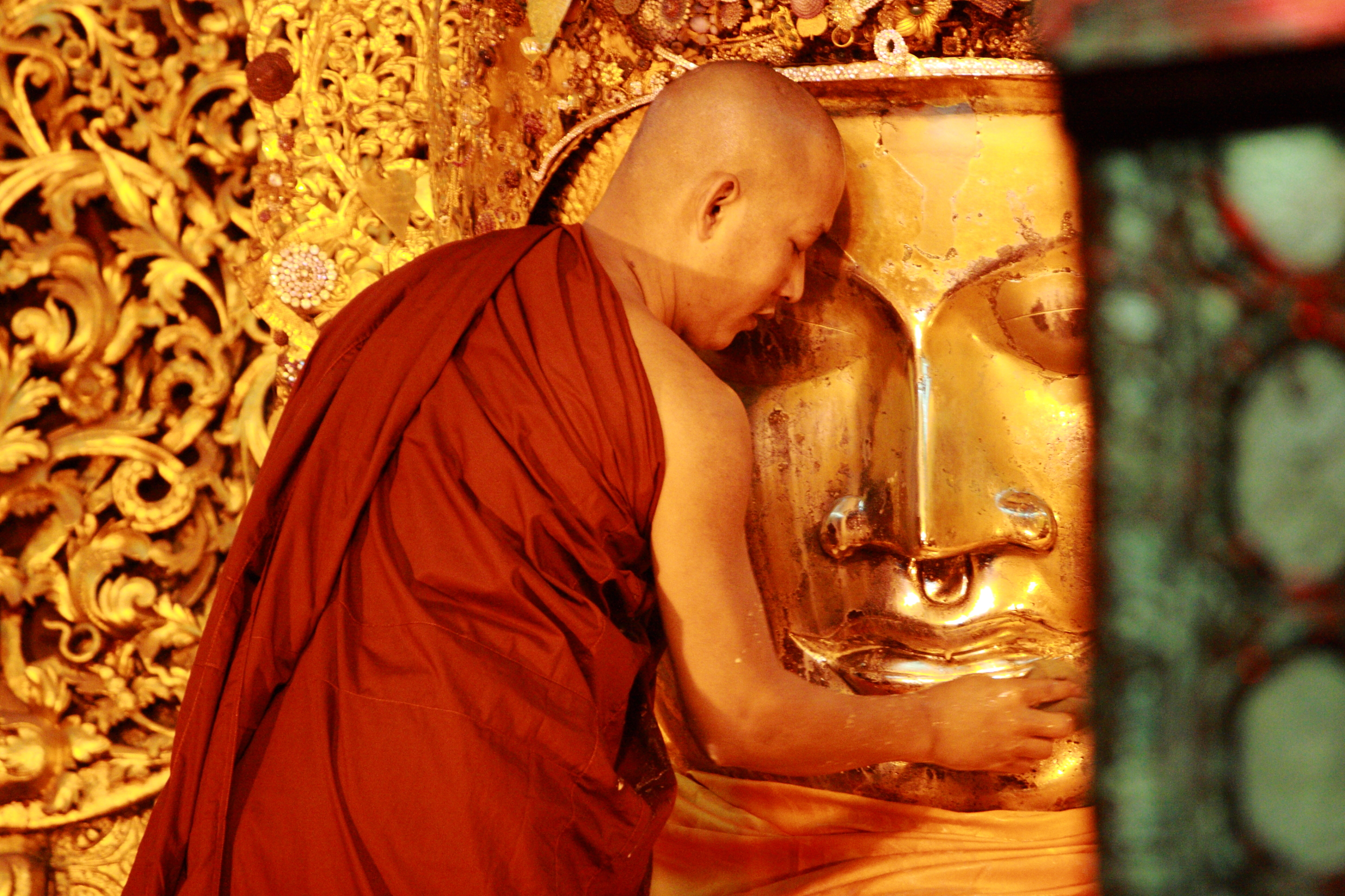
Every morning at four o'clock, monks wash the face of the Mahamuni Buddha. They brush its teeth with a small brush and wipe its bronze cheeks with a cloth, performing the ritual with the unhurried care of attendants tending to a living person. And in a sense, to the millions who venerate it, the Mahamuni is alive. Ancient tradition holds that only five likenesses of the Buddha were made during his lifetime: two in India, two in paradise, and the fifth -- this one -- in Myanmar. Centuries of devotees pressing gold leaf onto the statue's surface have added an estimated six inches of gold to its body, transforming its original contours into something lumpy and organic, as though the image were slowly growing under the accumulated faith of generations.
A Statue's Thousand-Year Journey
The Mahamuni image's journey to Mandalay was neither straight nor gentle. According to Arakanese tradition, the statue originated in the ancient city of Dhanyawadi in what is now Rakhine State, where legend holds the Buddha himself visited in 554 BC. For centuries, the image remained in Arakan, surviving one attempted seizure by King Anawratha of Pagan in the 11th century. In 1784, the Konbaung dynasty finally succeeded where Anawratha had failed. Crown Prince Thado Minsaw conquered the Kingdom of Mrauk U, and the Mahamuni image was confiscated along with other religious relics. The statue was too large to transport whole, so soldiers cut it into sections and carried the pieces to Amarapura, where King Bodawpaya had established his capital just two years earlier. There, the image was reassembled and installed in a new temple. It has not moved since.
War Trophies from Three Kingdoms
The Mahamuni is not the only artifact in the temple courtyard with a complicated past. Several bronze statues lining the grounds trace a journey across Southeast Asia that reads like a catalog of conquest. Originally Khmer works from Angkor Wat, they were seized by the Siamese when they sacked the Cambodian capital in 1431. In 1564, the Burmese king Bayinnaung conquered the Siamese capital of Ayutthaya and carried thirty such statues to Bago. Then in 1599, King Razagri of Mrauk U invaded Bago and brought them to his own capital in Arakan. When the Konbaung forces took Mrauk U in 1784, the statues made their final journey to Amarapura alongside the Mahamuni image. Devotees today believe these bronze figures possess healing qualities and rub specific body parts of the statues to cure their own ailments -- a practice that has polished certain areas of the bronze to a bright, mirror-like sheen.
Fire, Gold, and Reconstruction
The temple has not survived intact through the centuries. During the reign of King Thibaw in the 1880s, fire destroyed the seven-tiered spire on the brick temple, along with devotional halls and causeways. The Great Image itself survived, though the blaze melted enough gold from the surrounding structures to fashion a new robe for the statue from the recovered metal. In 1887, the statesman Kinwun Mingyi U Kaung took charge of the site, and by 1896 he had constructed the present temple around the original shrine that Bodawpaya had built more than a century before. The temple that stands today features 252 gilded and carved columns supporting arcades adorned with frescoes. When the pagoda burned in 1884, workers recovered 91 kilograms of gold from the site -- a measure of how deeply the practice of gilding was woven into worship here long before the current layers of leaf began accumulating on the image itself.
The Living Ritual
The face-washing ceremony that opens each day at the Mahamuni Temple was formalized on 17 February 1988 by the Sayadaw of Htilin Monastery. Beginning between four and four-thirty in the morning, monks wash the face and brush the teeth of the Buddha image while a congregation of devotees watches from the foyer. Men sit in the front enclosure; women and children gather further back. Devotees bring trays of food and offerings, chanting prayers as the ritual unfolds. During festival seasons, the Pattana recitation -- monks chanting sacred Pali scriptures in groups of two or three -- continues for days. These festivals draw large crowds of pilgrims, accompanied by dance, music, and theater. The temple is not a quiet place of solitary contemplation but a living center of communal devotion, where the act of pressing one more square of gold leaf onto a statue already thick with centuries of offering remains an intimate gesture of faith.
Layers Beyond Counting
The Mahamuni image today looks nothing like it did when it was cast. Only men are permitted to approach the statue and apply gold leaf, and the practice has continued so long and so intensely that the original bronze surface is buried under a thick, uneven crust of gold. The face, which is washed daily, retains its defined features, but the body has become amorphous -- rounded and swollen with accumulated devotion. A gallery of inscription stones collected by King Bodawpaya lines the southeastern corner of the temple courtyard, some in gilded marble, others in sandstone, gathered from across the country. Adjacent to the temple, the Mahamuni Museum displays artifacts related to Buddhism throughout Asia. But it is the image itself that draws people -- Rakhine, Mon, and Bamar pilgrims who come to venerate a statue that tradition says the Buddha himself breathed life into, and whose changed shape is not decay but testament.
From the Air
Located at 21.95N, 96.08E in southwestern Mandalay. The temple complex with its golden spire is visible from the air amid the dense urban fabric of southern Mandalay. Mandalay International Airport (VYMD) is approximately 30 km to the south. Best viewed at 2,000-4,000 feet. Mandalay Hill and the Royal Palace moat to the northeast provide strong orientation landmarks. The Irrawaddy River runs north-south to the west.