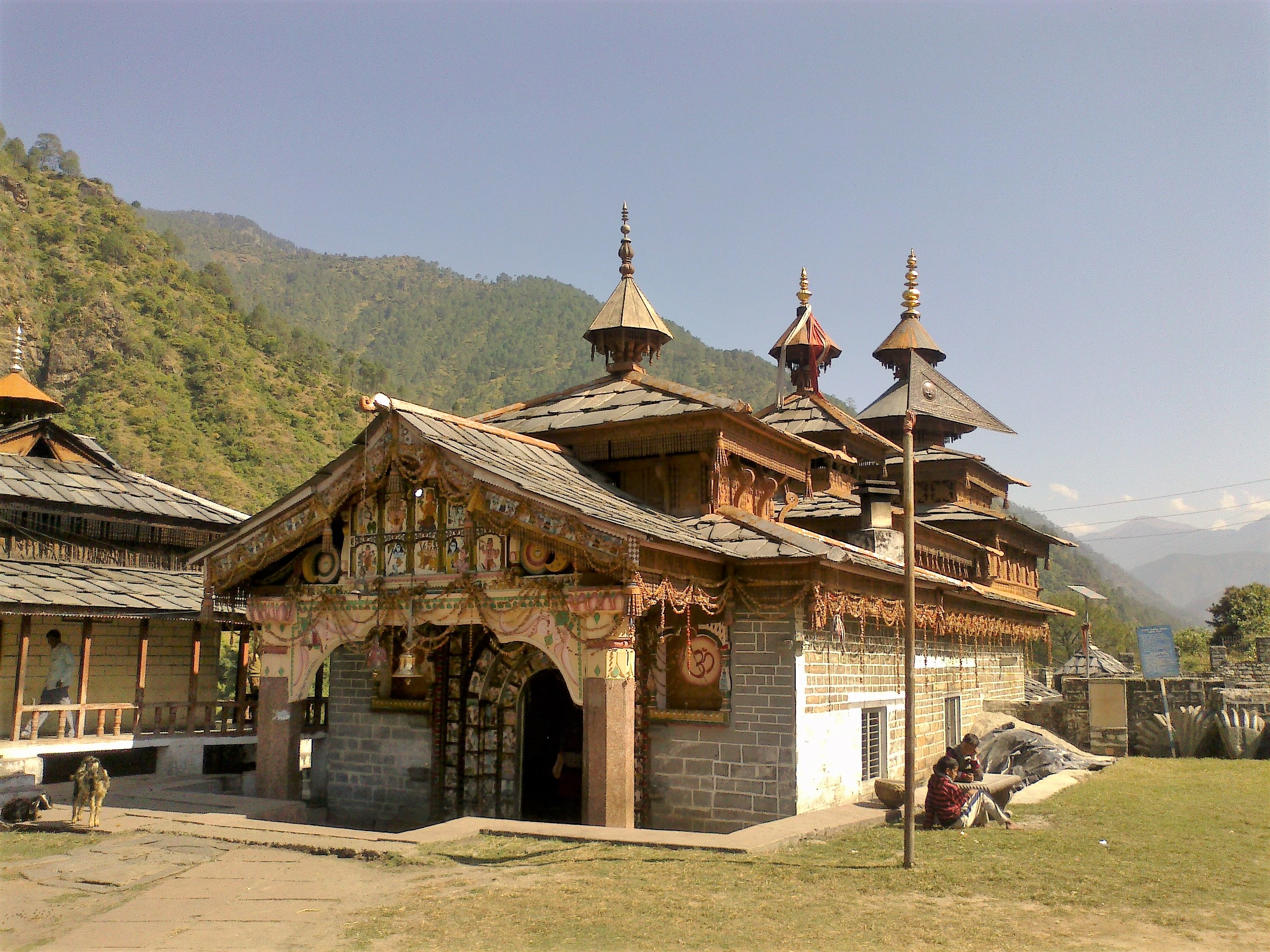
Mahasu Devta Temple
In the village of Hanol, on a hill slope above the River Tons, a goat shivers. The trembling is not from cold. It is a signal, watched by hundreds of gathered worshippers in the dark of a Bhadon night: the deity Mahasu has accepted the offering. This ritual has repeated itself for more than a thousand years at the Mahasu Devta Temple, a place where ancient stonework and Himalayan timber interlock as seamlessly as the spiritual and everyday lives of the people who worship here. The temple stands where the Tons carves through the lower Himalayas in Uttarakhand's Jaunsar region, roughly 180 kilometers from Dehradun by winding mountain road. Getting here takes patience. Staying changes your understanding of how a living faith can anchor an entire region.
Where Stone Embraces Wood
The oldest surviving portion of the Mahasu Devta Temple dates to the ninth or tenth century CE, when builders raised a curvilinear Shikhara tower in the Nagara style from local stone. But what makes this temple extraordinary is what came after. Over the centuries, a mandapa and mukhamandapa were added using the Kath-Kuni technique, an indigenous Himalayan architectural tradition that alternates layers of stone and deodar timber without mortar or nails. The wood flexes where rigid masonry would crack, giving the structure a resilience against the earthquakes that periodically shake this seismically active zone. The Archaeological Survey of India lists the temple among its protected ancient monuments in the Dehradun Circle. Walking around it, you notice how the grain of weathered cedar plays against rough-cut granite, each material aging at its own pace yet holding together across a millennium.
The God Who Judges
Mahasu Devta is not a passive idol receiving incense and flowers. He is a judge. Across the Mahasu region, which spans parts of both Uttarakhand and Himachal Pradesh, he reigns supreme over mortals and over the innumerable indigenous gods and goddesses of the hills. When disputes arise between villagers, they do not always go to a courtroom. Instead, they submit to LotaPani, a ritual adjudication. Water is ceremonially filled in a metallic goblet in Mahasu's name, and each disputant drinks. The party giving a false statement, tradition holds, will suffer. The British encountered this system during their land settlements in the region in the 1820s and found it deeply entrenched. They also deemed the twelve-year sojourn of Mahasu's idol through the region, called Chalda Mahasu, burdensome to common people. But the tradition endured. Faith here does not merely comfort; it arbitrates, punishes, and organizes society.
Four Brothers from Silver and Gold
The origin story of Mahasu binds the cosmic to the agricultural. A Brahmin named Huna Bhatt, tormented by the demon Kirmir who had cast desire upon his wife, prayed for divine intervention. In response, four deity brothers were created: Bashik, Pavasi, Chalda, and Botha, along with four warrior spirits called birs. The temple at Hanol is dedicated to Botha, the second eldest. Each brother presides over different parts of the Mahasu domain, their wooden palanquins carried between villages during festivals. The founding myth instructed Huna Bhatt to plow his field on a Sunday with a solid silver plow and a pure gold shoe. These details are not metaphor to the faithful; they describe the specific conditions under which the divine entered the landscape. The story roots the Mahasu cult in the soil itself, making every terraced hillside field a potential threshold between the human and sacred worlds.
The Jagara Night
The most vivid expression of Mahasu worship is the Jagara, held on the eve of Naga Chauth in the month of Bhadon. During the day, the deity's metal images are ritually bathed and wrapped in cloth so carefully that no uninvited gaze may fall upon them. As darkness settles, a tall pole of kail pine is planted in the ground and the deity's flag is hoisted. A shorter forked pole supports a large slate slab called a chira, and upon it a fire blazes. Drums begin. The community gathers. Men and women move in concentric circles around the burning chira, singing invocations that build through the night. The goat's shiver confirms divine presence. By morning, the ceremony has reaffirmed every bond in the village: between people and deity, between families, between the living and the generations who danced these same circles before them.
The Long Road to Hanol
Reaching the Mahasu Devta Temple is itself a kind of pilgrimage. The 180-kilometer drive from Dehradun via Chakrata takes roughly seven hours on narrow mountain roads that grow treacherous during monsoon season. An alternative route runs through Mussoorie and Purola to Naugaon, slightly better maintained but no shorter. The nearest airport is Jolly Grant at Dehradun. Summer, from March to May, brings the most pleasant weather and the heaviest foot traffic. Winters are bitterly cold. The Garhwal Mandal Vikas Nigam guesthouse offers six rooms and a dormitory, and basic accommodation exists on the temple premises. None of this is convenient, and that is part of the point. The temple was not built for tourists. It was built for a community that measures distance in days of walking, and for a god who still expects to be consulted before any serious decision is made.
From the Air
Located at 30.97°N, 77.93°E at roughly 1,500 meters elevation in the Jaunsar region of Uttarakhand. The temple sits on the eastern bank of the River Tons, visible as a small settlement on forested hillside. Nearest airport is Jolly Grant Airport, Dehradun (VIDN), approximately 180 km to the southwest. Shimla Airport (VISM) is roughly 140 km to the northwest. Approach from the south follows the Tons River valley. Terrain is steep Himalayan foothills with limited visibility in monsoon season.