Maheshwar
The looms never stopped. For at least 1,500 years, weavers in Maheshwar have been threading cotton into fabric on the banks of the Narmada River, their craft surviving every dynasty, invasion, and political upheaval that swept through central India. Today, about 130 weavers affiliated with the Rehwa Society produce over 100,000 meters of fine Maheshwari saris each year in a workshop housed inside one of the town's historic buildings. The saris -- distinguished by their stripes, checks, and floral borders -- owe their modern reputation to an 18th-century queen, but owe their existence to something older and less easily explained: this town of 24,000 people, perched on the north bank of the Narmada in Madhya Pradesh's Khargone district, has simply never stopped making beautiful things.
The Town Named for a God
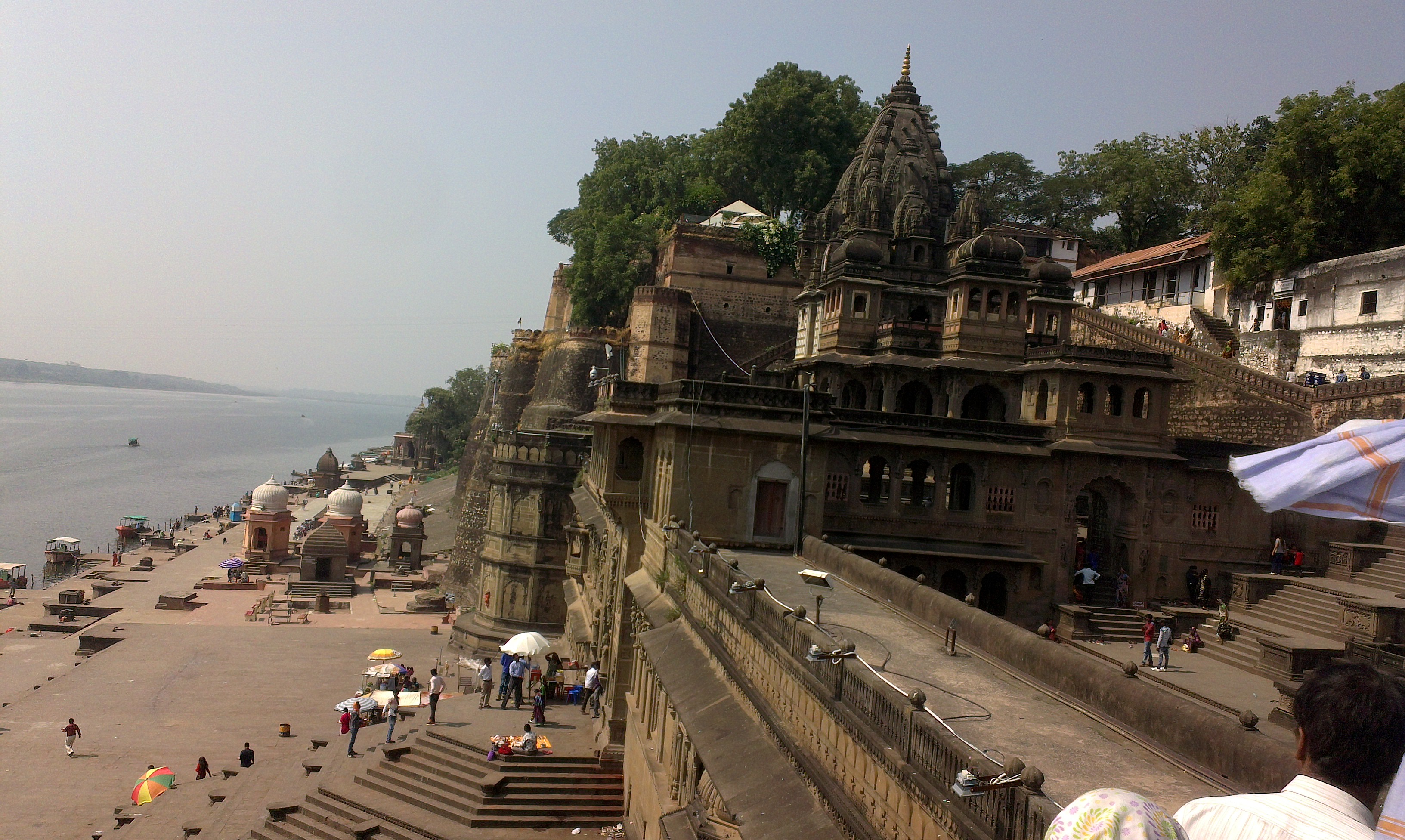
Maheshwar means "Great God" in Hindi -- an epithet of Lord Shiva -- and the name is earned. More than 100 temples line the right bank of the Narmada near the town's ghats, their spires and domes telling a history that stretches back to the ancient kingdom of Mahishmati. Hindu epic tradition places this as the realm of the Hehaya king Kartavirya Arjuna, a ruler of such power that even the god Agni entered his court in disguise. The Mahabharata records that Agni granted the kingdom divine protection, swearing to shield it from invasion. Whether or not the protection was divine, the location was certainly strategic: Maheshwar sits 91 kilometers from Indore, the commercial capital of Madhya Pradesh, on a stretch of the Narmada where the river runs broad and calm past sandstone ghats and fort walls.
Ahilya Bai's Legacy
In the late eighteenth century, Maheshwar became the capital of Malwa under Rajmata Ahilya Devi Holkar, one of the most celebrated rulers in Maratha history. A queen who governed with pragmatism and devotion in equal measure, Ahilya Bai embellished the town with temples, public works, a fort, and the broad stone ghats that step down to the Narmada -- the defining feature of Maheshwar's riverfront. She is credited with personally designing the first Maheshwari sari, commissioning weavers from Mandu and Surat to produce fabrics worthy of royal gifts. The saris were worn by women of her court and presented to visiting dignitaries. Her palace and fort still stand; the fort has been converted into a heritage hotel by Prince Richard Holkar of Indore, a descendant of Ahilya Bai. The capital eventually moved to Indore in 1818 under Malhar Rao Holkar III, but Maheshwar retained the character its queen had given it.
Threads That Endure
Maheshwar's handloom tradition predates Ahilya Bai by more than a millennium -- weaving has been documented here since the 5th century. But by the late 20th century, the craft was in danger of disappearing, undercut by machine-made textiles and economic pressures. In 1979, the Holkar family founded the Rehwa Society, a nonprofit that gave women employment and revived the town's textile heritage. The society provides a free school for weavers' children and runs a low-cost health scheme for member families. The weaving center occupies a historic building where the rhythmic clack of looms carries through stone corridors. Maheshwari saris draw their designs from the architecture around them -- you can trace the same geometric patterns on a cotton border and a fort balcony. The connection is not accidental; Queen Ahilya Bai intended it, and the weavers who followed her preserved it across generations.
Ghats, Temples, and Celluloid
Maheshwar's riverfront is irresistible to filmmakers. Bollywood and Tamil cinema have shot here repeatedly: Shah Rukh Khan's Ashoka, Mani Ratnam's Alai Payuthey, the Bajirao Mastani sequences, Pad Man, and Dabangg 3, among others. What draws them is the same thing that draws pilgrims: the ghats. These broad stone steps descend from the fort walls directly into the Narmada, creating a theatrical backdrop where water, stone, and sky compose themselves without art direction. The Sahasrarjun Temple near the river still lights 11 lamps daily, a tradition attributed either to honoring Lord Agni's ancient blessing or to Sahasrarjun's queens humiliating the captive ten-headed Ravana by placing candles on each of his foreheads. The Baneshwar Temple sits on a small island in the river itself, reachable only by boat, while the temple of Vindhyavasini Bhavani is counted among the 24 Shaktipeeths of Goddess Parvati.
Beyond the Fort Walls
Maheshwar anchors a constellation of historical sites along the Narmada. Mandleshwar, just 8 kilometers away, is where the 8th-century philosopher Adi Shankaracharya debated Mandana Mishra, and where Swami Vivekananda later came to meditate. The medieval fortress-town of Mandu lies 38 kilometers to the north, with its own sultanate-era palaces awaiting UNESCO World Heritage designation. Across the river sits Navdatoli, a Chalcolithic archaeological site that pushes the region's human story back thousands of years before any temple was built. Raverkhedi, between Maheshwar and the sacred jyotirlinga at Omkareshwar, holds the samadhi of Maratha Peshwa Baji Rao I, who died there in 1740. This stretch of the Narmada is one of the densest corridors of Indian history and devotion -- and Maheshwar, with its looms and ghats and hundred temples, is its quiet center.
From the Air
Located at 22.18N, 75.59E on the north bank of the Narmada River in Madhya Pradesh's Khargone district. The town's fort and ghats are visible along the riverbank, with the Narmada running broad and calm past sandstone steps. Nearest major airport: Indore / Devi Ahilya Bai Holkar Airport (VAID), approximately 91 km to the northeast. Best viewed at 2,000-4,000 feet AGL to see the ghats, fort complex, and temple-studded riverfront. The Baneshwar Temple on its mid-river island is a distinctive feature. Mandu's fortress ruins are visible 38 km to the north.