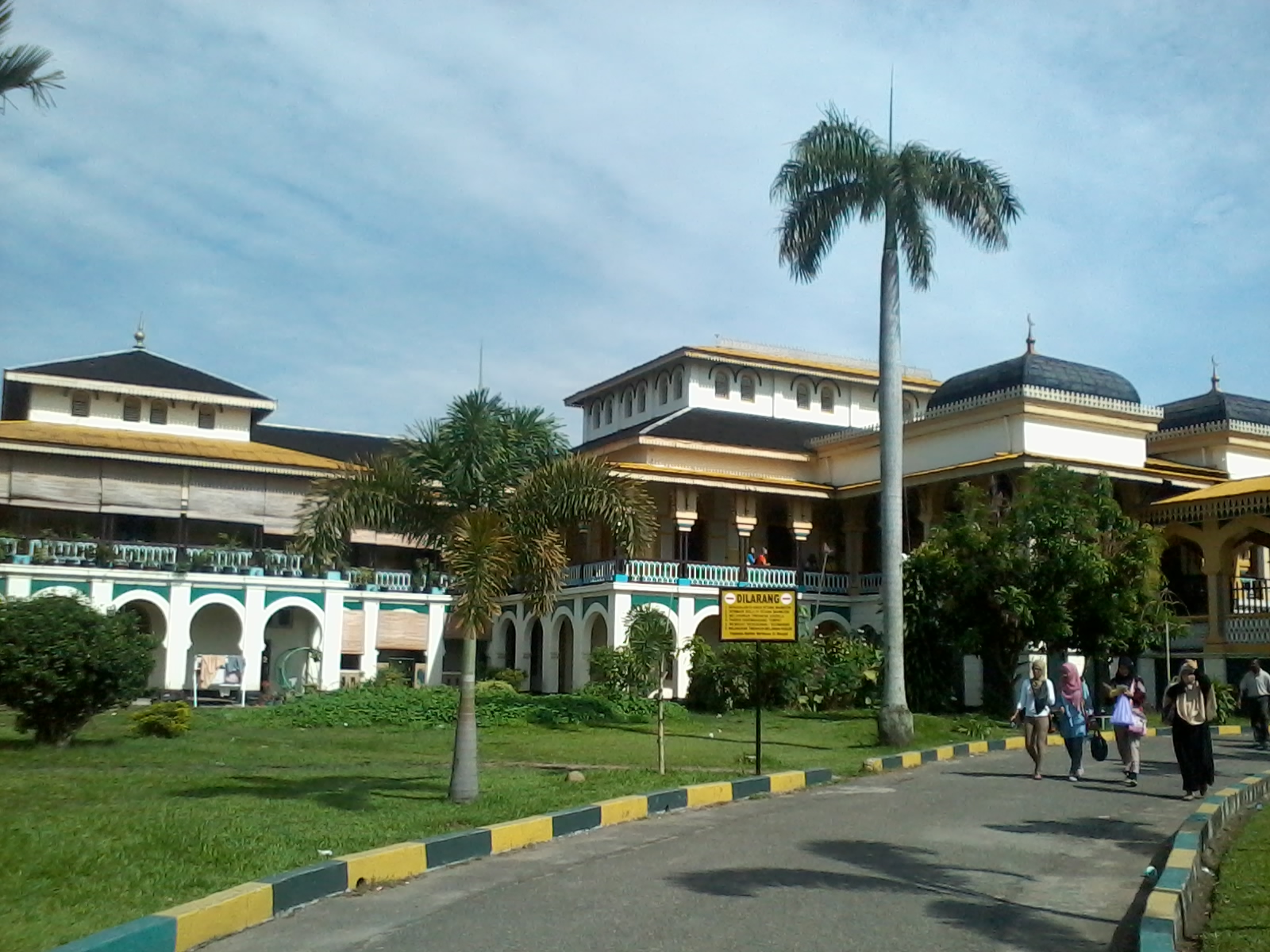
Maimun Palace
The name means "blessing" in Arabic, and the Maimun Palace has needed every bit of the luck its name implies. Built between 1887 and 1891 for the Sultan of Deli, it is the last surviving Malay palace in Sumatra -- the only one not burned during the East Sumatra revolution of 1946, spared because British troops happened to be garrisoned nearby. Today its 30 rooms stand open as a museum in central Medan, an improbable survivor that tells the story of a sultanate that grew rich on tobacco and spent its wealth creating something no one else in the archipelago could match.
A Sultan's Grand Ambition
Sultan Ma'mun Al Rashid Perkasa Alamsyah did not want an ordinary palace. The Sultanate of Deli, centered on Medan in northeastern Sumatra, had grown prosperous from the tobacco plantations that Dutch colonial enterprise had developed in the region. Ma'mun envisioned a residence that would announce his sultanate's place among the sophisticated courts of the Malay world. He commissioned Theodoor van Erp, a Dutch architect who would later become famous for his restoration of Borobudur, to design a structure that merged traditions rather than choosing between them. Construction began in 1887 and lasted four years. The result covered 2,772 square meters and contained 30 rooms -- a palace that was neither purely Malay, nor purely European, nor purely anything else.
Where Cultures Cross in Stone
Walk through the Maimun Palace and you cross civilizations with every doorway. The exterior follows Malay architectural forms, with wide verandas and an elevated main hall suited to the tropical climate. Islamic design appears in the arched windows and geometric ornamentation. Indian architectural influences surface in the ornate detailing and spatial arrangements. But sit in the throne room and you are surrounded by Spanish and Italian furniture -- carved wooden pieces and upholstered seats that could have come from a Mediterranean villa. Van Erp's genius was in making these elements feel inevitable rather than chaotic. The palace does not look like a collision of styles; it looks like a place where the Strait of Malacca's centuries of cultural exchange found architectural form.
Survival Against the Odds
In March 1946, revolution swept through East Sumatra. Indonesian nationalists, fueled by anti-feudal sentiment and the chaos following Japanese surrender, attacked the symbols of the old Malay aristocracy. Sultanate palaces across the region were destroyed. The Maimun Palace should have shared their fate -- it was the most prominent symbol of Deli royal authority in Medan. But British troops, present in the city as part of the post-war Allied occupation, provided protection that kept the revolutionaries at bay. The palace survived intact while its peers were reduced to rubble. It is a strange irony: a colonial military presence saved an indigenous royal palace from an anti-colonial revolution, preserving the one structure that now allows Indonesians to see what Malay court culture looked like before the upheaval erased it.
The Cannon and the Kingdom
Among the palace's artifacts, the Meriam Puntung -- a "separated cannon" -- carries its own legend. The weapon is said to have been used by the Deli Sultanate in its wars against the Aru Kingdom, a rival power in northeastern Sumatra. The cannon's name refers to its broken barrel, and local tradition holds that the damage came during a battle so fierce it split the weapon apart. True or embellished, the Meriam Puntung connects the palace to a deeper history than the Dutch colonial period, reaching back to the intra-Sumatran power struggles that shaped the region long before European interests arrived. Today the palace museum displays it alongside the sultan's throne, photographs from the 1890s, and the ornate interiors that visitors have marveled at for more than a century.
From the Air
Located at 3.575N, 98.684E in central Medan, North Sumatra. The palace compound is identifiable by its broad yellow facade and distinctive Malay roofline amid the surrounding urban grid. Nearest major airport is Kualanamu International Airport (WIMM), approximately 38 km southeast. Best viewed from the south at 2,000-3,000 feet for a clear perspective of the palace grounds. The Gunung Timur Temple and Sri Mariamman Temple are both within a 1 km radius to the west.