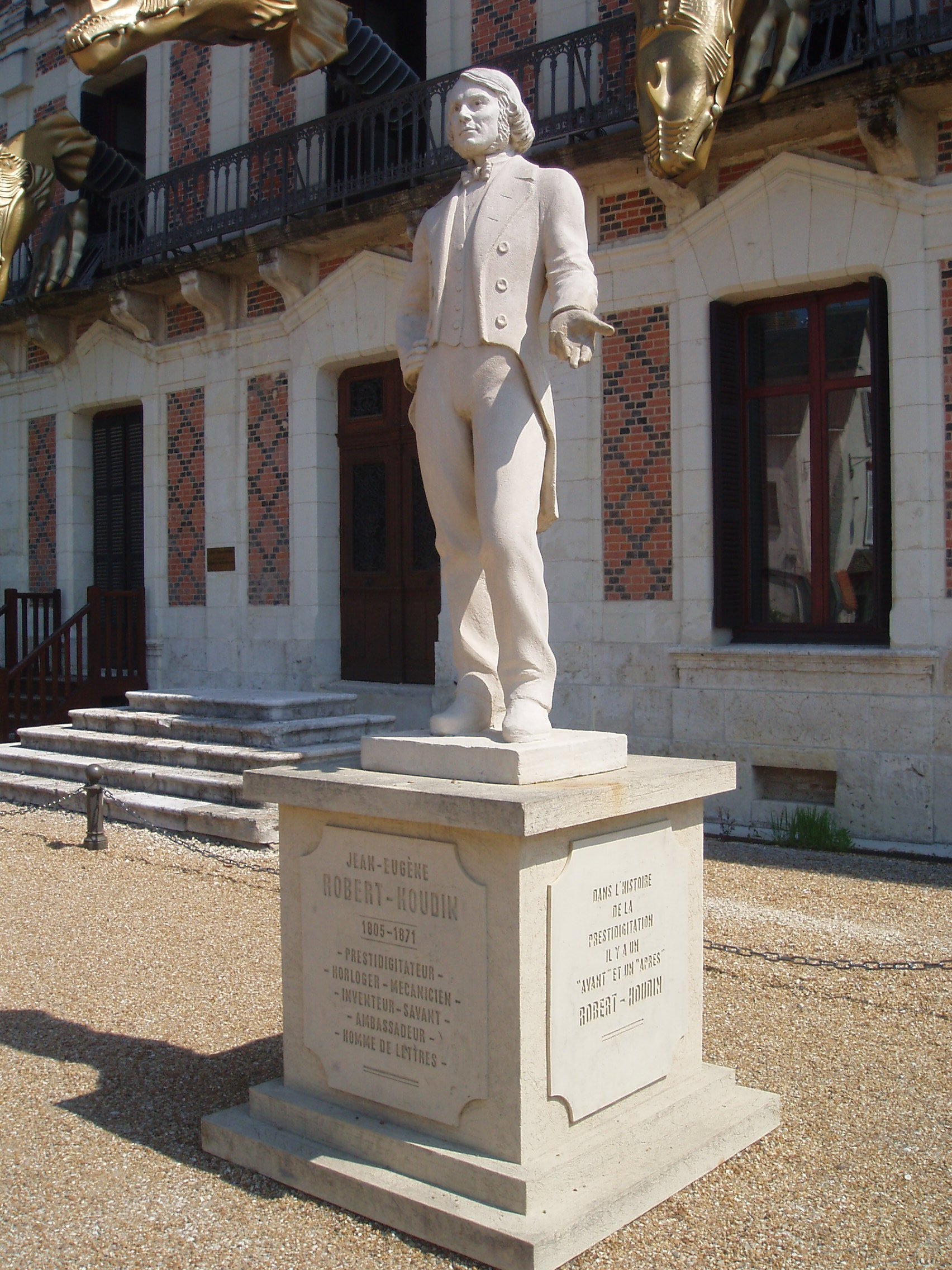
Maison de la Magie (Blois)
Every hour, six dragon heads emerge from the upper windows of a stately mansion facing the Royal Château de Blois. They twist and writhe above the street before retreating behind the shutters -- a mechanical greeting from the Maison de la Magie Robert-Houdin, the only public museum in Europe that combines a permanent collection of magical artifacts with daily live performances. The building honors a man born in this city in 1805 whose influence on the art of illusion was so profound that a young Hungarian-American escape artist named Erik Weisz adopted a version of his surname and became Harry Houdini.
The Clockmaker Who Reinvented Wonder
Jean-Eugène Robert-Houdin was not simply a magician. He was a clockmaker, an inventor, an optical researcher, and a builder of automata -- mechanical figures that could write, draw, and perform acrobatic feats. Born in Blois in 1805, he combined scientific precision with theatrical flair in a way that no predecessor had managed. His performances at the Palais-Royal in Paris in the 1840s and 1850s abandoned the robes and mystical trappings of earlier conjurers in favor of elegant evening dress, relocating magic from the fairground to the salon. He was, in effect, the inventor of modern stage magic. The French government recognized his talents beyond the theater, sending him to Algeria in 1856 to perform before local leaders -- using illusions to counter the influence of marabout mystics who were encouraging resistance to French rule. His legacy extends into cinema as well: Georges Méliès, the pioneer of film special effects, began his career as a stage magician directly inspired by Robert-Houdin.
A Museum Built on Misdirection
Inaugurated in 1998, the Maison de la Magie occupies a grand nineteenth-century house directly across the square from the Royal Château. The juxtaposition is deliberate: political power on one side, the power of illusion on the other. Inside, the museum unfolds across multiple levels. The first floor displays Robert-Houdin's watchmaking workshop, his scientific instruments for research in optics and electricity, and his most celebrated creation -- the 'mysterious clock,' whose hands move without any visible mechanism. The collection traces the evolution of conjuring from its origins in sleight of hand through the mechanical ingenuity of the nineteenth century to the cinematic trickery of Méliès.
Diving Twenty Thousand Leagues
On the third level, visitors encounter the hallucinoscope -- an immersive experience conceived by the French magician Gérard Majax that plunges participants into the world of Jules Verne's 1870 novel Twenty Thousand Leagues Under the Seas. The connection between Verne and Robert-Houdin is more than thematic: both men were products of the Loire Valley, both were fascinated by the intersection of science and spectacle, and both understood that the most powerful illusions are built on genuine mechanical and scientific knowledge. A separate space honors Georges Méliès, celebrating his dual identity as magician and as the father of cinematic special effects. His 1902 film A Trip to the Moon remains one of the most recognized images in cinema history, and it began with the same impulse Robert-Houdin had channeled decades earlier: the desire to make an audience believe the impossible.
The Show Goes On
The Maison de la Magie is not a static collection under glass. During the tourist season, magic shows are performed daily in the museum's theater, continuing a tradition of live performance that Robert-Houdin himself would recognize. The building carries the official 'Musée de France' designation, placing it in the same institutional category as the great national collections, though its subject matter could hardly be more different. In a city dominated by the political dramas of the royal château -- assassinations, exiles, wars of religion -- the Maison de la Magie offers a gentler kind of deception. Visitors leave the museum and cross the square to the château, moving from a house built on the principle that things are not what they seem to a palace where that principle played out in blood. Robert-Houdin would have appreciated the irony.
From the Air
Located at 47.586°N, 1.333°E, directly facing the Royal Château de Blois in the city center. Not independently distinguishable from the air -- the museum is within the urban fabric of Blois. Use the Château de Blois and the Loire River as visual references. Nearest airports: Blois-Le Breuil (LFOQ) approximately 5 km northwest. Best viewed at 1,500-2,500 ft AGL over Blois.