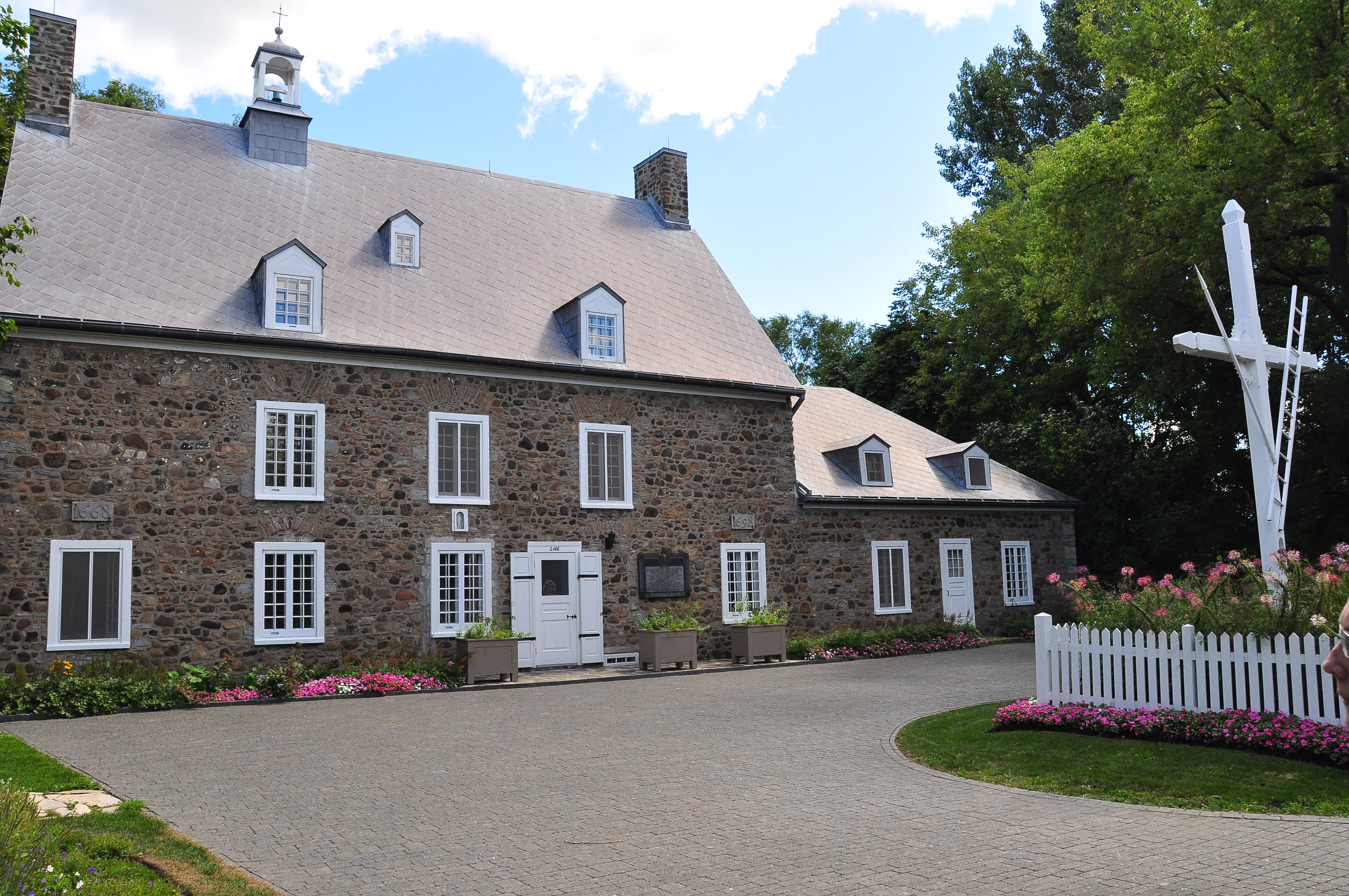
Maison Saint-Gabriel
The young women who arrived here had crossed an ocean to marry strangers. Between 1663 and 1673, the Filles du Roi -- the King's Daughters -- were recruited in France and shipped to New France to provide wives for the colony's surplus of single men. Their first home in the New World was not a grand hall or a convent chapel but a working farm on the outskirts of Montreal, where a determined nun named Marguerite Bourgeoys had been cultivating corn, wheat, and pumpkins since 1662. That farm is still standing. The Maison Saint-Gabriel, tucked into the Pointe-Saint-Charles neighborhood beneath the hum of modern Montreal, is one of the oldest surviving buildings on the Island of Montreal -- a stone farmhouse whose oak frame and ash beams have held for more than three centuries.
Marguerite's Gamble
On October 31, 1662, Paul de Chomedey de Maisonneuve granted a parcel of land in Pointe-Saint-Charles to Marguerite Bourgeoys, the founder of the Congregation of Notre Dame of Montreal. The purpose was bluntly practical: grow food to feed the Congregation and support its work. Hired workers called engages cleared the land, planted crops, and stood guard against potential attacks -- a reminder that 17th-century farming in New France was as much a military operation as an agricultural one. In 1668, Bourgeoys expanded by purchasing adjacent land from Francois Le Ber and Jeanne Testard, acquiring a house and barn that would eventually become the Maison Saint-Gabriel. Sister Catherine Crolo took charge of the farm, planning the planting, the harvest, and the distribution of produce to the surrounding community. Under her direction, the farmhouse became the nerve center of the Congregation's self-sufficiency.
A School for King's Daughters
The farm quickly took on a second role that would define its place in Canadian history. In addition to feeding the Congregation, it became a preparatory school for young women arriving in the colony -- including the Filles du Roi. King Louis XIV's plan was straightforward: boost the population of New France by sending marriageable women to a territory overrun with fur traders, soldiers, and farmers who had no families. The program ran for a decade, from 1663 to 1673, and the Maison Saint-Gabriel was where many of these women were housed, educated, and prepared for colonial life. They learned domestic skills, adjusted to the harsh realities of a Canadian climate most had never imagined, and eventually married into the settlement. The farmhouse that sheltered them witnessed one of the most deliberate experiments in colonial population engineering the continent had ever seen.
Fire, Stone, and Oak
In 1693, the original farmhouse burned to the ground. But fire could not erase the foundation. The stone base and the creamery survived intact, and the Congregation rebuilt on top of them, completing the new structure in 1698. Masons, carpenters, and woodworkers constructed a two-story building with an oak frame and ash beams, topped with lean-tos that gave the house its distinctive silhouette. That architecture -- functional, solid, rooted in 17th-century French structural design -- is precisely what makes the building remarkable today. Through the 18th century, the Sisters expanded the farm, buying surrounding parcels of land and cultivating wheat and oats. They built a chicken coop, a barn, and stables. By the 19th century, the farm produced butter, wool, soap, and leather. The Maison Saint-Gabriel was never a grand estate; it was a working farm that kept working.
Industrialization at the Door
The 19th century brought transformation that threatened to swallow the farm entirely. As Montreal expanded and industrialized, the Congregation sold off parcels of farmland for new housing construction. The opening of the Lachine Canal and the arrival of the railway turned Pointe-Saint-Charles into a hub of commerce and labor. From the 1850s onward, developers and the city gradually dismantled the agricultural domain that Bourgeoys had built two centuries earlier. The farmhouse itself survived -- too old, perhaps, or too stubborn to tear down -- but the fields that had once fed a congregation were paved over, built upon, and absorbed into the expanding urban grid. What had been a frontier outpost became an inner-city artifact, a stone farmhouse surrounded by row houses and factory smoke.
Rescued by Memory
The push to preserve the Maison Saint-Gabriel gained momentum in the early 1960s, after the Congregation celebrated the 300th anniversary of Bourgeoys' land grant. In 1965, the Quebec government classified the farmhouse as a historic monument, and architect Victor Depocas began a careful restoration. The goal was not to modernize but to reverse-engineer: strip away the centuries of modification and reconstruct the living conditions of the 17th-century Sisters. The kitchen, common room, chapel, dormitory, and the room once reserved for the King's Daughters were refurbished with period artifacts. Today, the Maison Saint-Gabriel Museum holds over 20,000 objects -- domestic tools, religious clothing, furniture, letters, and trade implements that together recreate the texture of daily life in New France. The site was designated a National Historic Site of Canada in 2007. In summer, costumed interpreters demonstrate 17th-century crafts in the gardens. The Farmhouse Gardens recreate a period vegetable plot. The Poetry Path winds through indigenous plants and shrubs. It is a quiet place, almost startlingly so for a neighborhood that thunders with commuter traffic, and it carries the weight of a story that begins with a nun, a land grant, and a shipload of women who crossed the Atlantic to start new lives in a country they had never seen.
From the Air
Maison Saint-Gabriel sits at 45.48N, 73.56W in the Pointe-Saint-Charles neighborhood of southwest Montreal, south of the Lachine Canal and west of the Victoria Bridge approach. From the air, the site is nestled within the dense residential grid of Pointe-Saint-Charles, identifiable by its garden grounds amid surrounding row houses. Best viewed from 2,000-3,000 feet AGL. Montreal/Pierre Elliott Trudeau International Airport (CYUL) is approximately 10 nm to the west. The Lachine Canal, Old Port, and Victoria Bridge provide strong visual reference points.