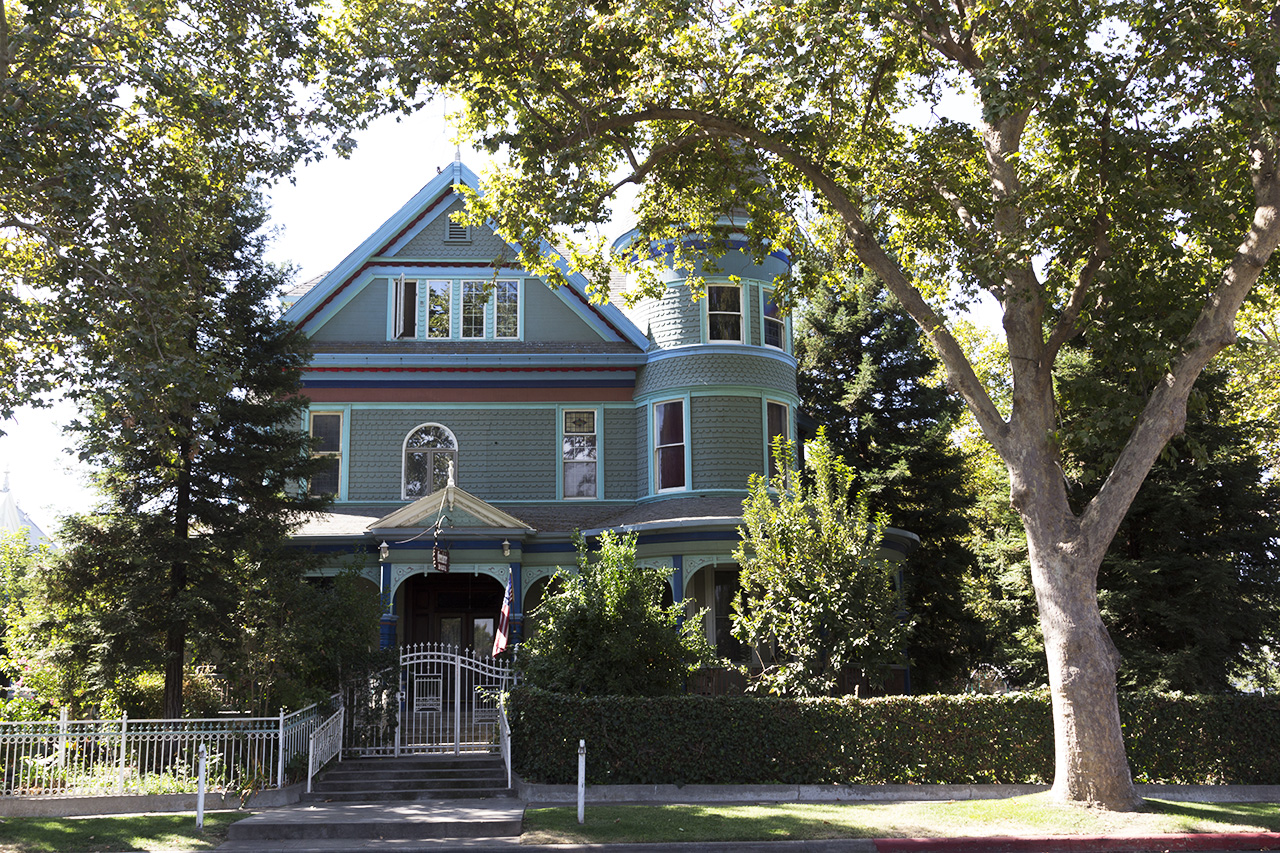
The Greenbrier: A Mayor's Mansion in Merced
The cylindrical tower is what you notice first. It rises from the corner of the house at 356 W. 21st Street in Merced, California, capped with a cone-shaped roof that looks lifted from a fairy tale illustration. Beneath it, a seven-sided bay juts from the west wall, and open porches wrap the front and back like arms welcoming visitors from the Central Valley heat. This is the Maj. George Beecher Cook House, considered one of the finest examples of Queen Anne architecture in Merced - a city that, in the late nineteenth century, was still shaking off the dust of its founding as a railroad stop on the Southern Pacific line. The house is all asymmetry and ambition, a Victorian-era declaration that its builder had arrived.
The Major and His Monument
George Beecher Cook held the rank of major - a title he carried for life - and served as both a local merchant and mayor of Merced. In the decades following the Civil War, men like Cook shaped small California towns through a combination of civic office and commercial enterprise, and the houses they built announced their standing more loudly than any newspaper notice. Cook's house was designed in the Queen Anne style, the most fashionable residential architecture in America during the 1880s and 1890s. The style favored complexity over restraint: mixed materials, irregular footprints, towers, bays, and rooflines that seemed to reinvent themselves from every angle. Cook's house delivered on all counts. Horizontal siding clads the first floor, while patterned shingles cover the upper stories. The main roof runs as a gable from front to back, but a pyramidal section rises in the center, a cross gable breaks the east side, hipped dormers push upward, and the tower wears its own conical cap. Cook lived in the house until his death in 1898.
From Sickbeds to Guest Rooms
After Cook's death, the house entered a long middle chapter common to grand Victorians in small towns. Families moved on, maintenance costs mounted, and the building was repurposed. For several decades it operated as a sanitarium - a residential treatment facility - and later as a boarding house, its spacious rooms subdivided to accommodate tenants rather than a single family. By 1943, the house might have seemed destined for the kind of slow decline that claimed so many Victorian mansions across the West. But that year, Alfred Green and his wife purchased the property and gave it a third life. They converted it into a guest house and named it "The Greenbrier," a name cleverly drawn from their surname, Green, and Mrs. Green's maiden name, Brier. Under their stewardship, the old major's home became a place of hospitality once more, its tower and porches greeting travelers instead of patients.
A Place on the Register
On September 15, 1983, the Maj. George Beecher Cook House was added to the National Register of Historic Places, formal recognition that the building possessed architectural significance worth preserving. The designation placed it among a select group of structures in Merced County deemed worthy of federal protection and public attention. Queen Anne houses survive in scattered numbers across California, but few exhibit the style's full vocabulary as completely as Cook's house does. The tower, the seven-sided bay, the layered rooflines, and the shift from clapboard to shingle between floors - each is a textbook element, and together they form an unusually cohesive example of the style in the Central Valley. The house stands as evidence that even in agricultural towns far from San Francisco's architectural showrooms, builders in the 1890s could produce work of real craft and confidence.
Standing on 21st Street
Merced today is a mid-sized city in the San Joaquin Valley, better known as the gateway to Yosemite than for its Victorian architecture. But 21st Street holds a reminder that the city once aspired to more than a waypoint. The Cook House sits in a residential neighborhood where the scale is modest and the shade trees are old. From above, it is a small footprint in a grid of streets and lots, easy to miss among the sprawl. On the ground, the tower and roofline are unmistakable. The house has outlived its builder by more than a century, has served as home, hospital, boarding house, and inn, and has earned a place on the national register. It is the kind of building that survives not because it is monumental but because someone, at each turning point, decided it was worth keeping.
From the Air
Located at 37.30N, 120.48W in Merced, California, in the San Joaquin Valley. The house is in a residential neighborhood and not individually visible from altitude, but Merced's street grid and the nearby Merced County Fairgrounds provide orientation. Elevation approximately 170 feet MSL. Merced Regional Airport (KMER) is nearby. Fresno Yosemite International (KFAT) is approximately 50nm southeast. Castle Airport (KMER) is just north of the city. Flat valley terrain with generally good visibility; summer haze common.