Majlis al Jinn
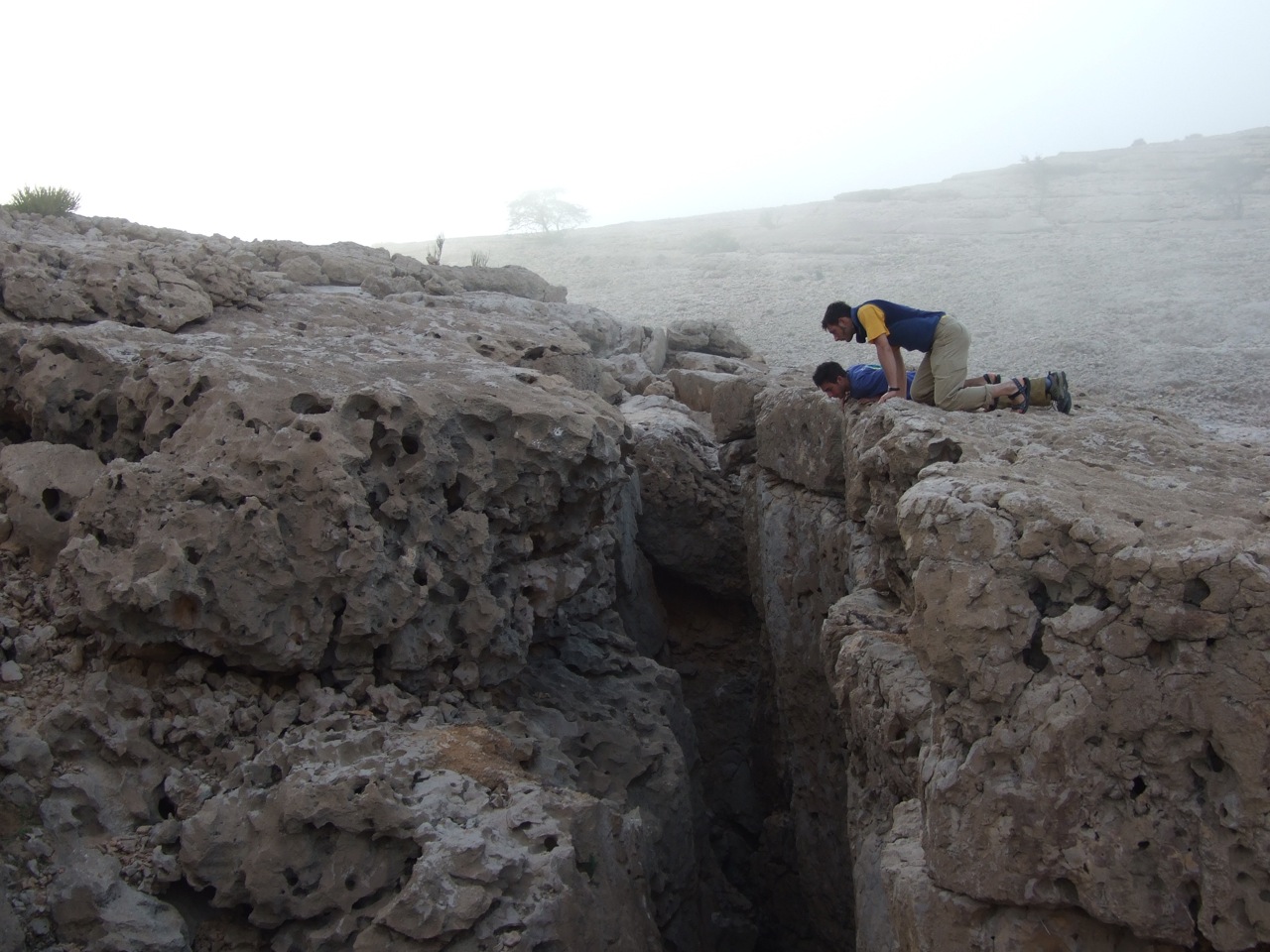
The ceiling is only forty meters thick. Stand on the Selma Plateau at 1,380 meters above sea level in eastern Oman, and beneath your feet lies a single cavern large enough to hold several football stadiums stacked on top of each other. Majlis al Jinn -- the Meeting Place of the Spirits -- measures 310 meters by 225 meters, with a domed ceiling soaring 120 meters overhead. Three holes in the roof are the only way in. There is no way out except back up.
Into the Dark
American hydrogeologist Don Davison discovered the entrances in June 1983 while working for the Omani government's Public Authority for Water Resources as part of a karst research program. The first descent came on June 23 of that year, when Davison rappelled 118 meters through what became known as the First Drop. His wife, Cheryl Jones, negotiated the second entrance on March 1, 1984 -- a 158-meter free rappel, the deepest into any known cave in Oman or the Arabian Peninsula. Davison completed the trilogy by descending the third entrance, called the Asterisk, on April 22, 1985. Three openings, three descents, each into the same vast darkness.
A Cathedral of Limestone
The cave formed in fossiliferous carbonate rocks of the Middle Eocene Dammam Formation. The Selma Plateau is a shallow syncline on the northeastern limb of the Jabal Bani Jabir anticline, and Majlis al Jinn is one of five vertical cave entrances on the plateau, but the only one with no lower exit. The volume of the chamber is approximately four million cubic meters. The floor area spans 58,000 square meters. When surveyed in 1985, it was the second-largest known cave chamber in the world by volume. More than fifteen larger chambers have been discovered since, but the scale remains staggering. The deepest point sits 178 meters below the top of the highest entrance. No visible passages lead from the chamber -- they have been blocked by debris accumulated on the floor over geological time.
Climbers in the Cathedral
In 2014, rock climbers Stefan Glowacz and Chris Sharma descended into Majlis al Jinn and attempted something that had never been done: climbing out. They chose a route up the interior of the dome, a steeply overhanging wall of limestone that curves outward as it rises. They claimed it as the world's largest unclimbed roof. The ascent required navigating holds on rock that had never been touched by human hands, with nothing below but 120 meters of empty air and a cavern floor lit by shafts of sunlight falling through the three roof openings. The beams of light that penetrate the cave create an effect that early visitors compared to a cathedral, an analogy the cave's Arabic name seems to anticipate: a meeting place not of humans but of spirits.
Between Tourism and Preservation
Oman's Ministry of Tourism began exploring plans to develop Majlis al Jinn as a show cave after their first show cave attracted 75,000 visitors in its inaugural year of 2007-2008. The tension between access and preservation is acute. The cave's remoteness has been its greatest protection -- reaching the Selma Plateau requires navigating rough terrain far from paved roads, and entering the cave requires technical rope skills. A show cave would bring electric lighting, walkways, and crowds to a space that has existed in near-total darkness for millions of years. The debate continues. For now, Majlis al Jinn remains what it has always been: a void in the earth, immense and indifferent, where sunlight falls through three narrow openings and illuminates nothing but the scale of what lies beneath.
From the Air
Coordinates: 22.88N, 59.11E, on the Selma Plateau in eastern Oman at approximately 1,380 m elevation. The three cave openings are not visible from normal cruising altitude but the plateau is identifiable as a flat limestone shelf. Best viewed at 3,000-5,000 ft AGL. The plateau sits about 100 km southeast of Muscat International (OOMS). Terrain is rugged and remote. Clear desert conditions typical.