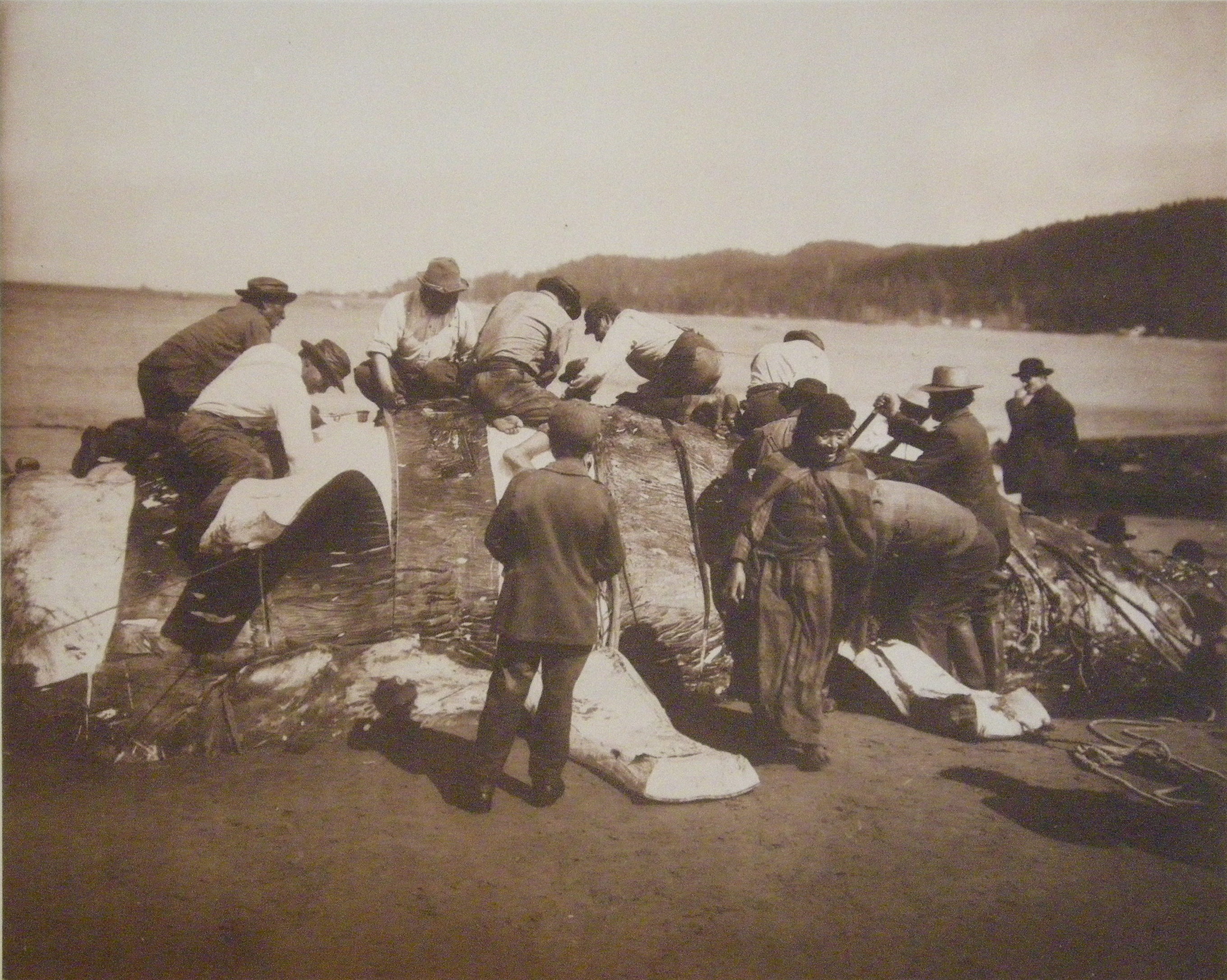
Makah
By counting a whale's exhalations, a Makah hunter determines when the animal is about to dive. He approaches from the left side. When the whale is three to four feet below the surface -- deep enough to avoid the lethal force of its tail -- he strikes with a harpoon of yew wood, sixteen to eighteen feet long, tipped historically with mussel shell and elk-horn barbs. The shaft comes loose. A line trails behind, attached to seal-skin floats that drag against the whale's movement, weakening it over hours, sometimes days. This is not history. On May 17, 1999, after more than seventy years without a hunt, the Makah successfully took a gray whale from cedar canoes in the Pacific Ocean off the northwestern tip of Washington state. The hunt was legal, sanctioned by the International Whaling Commission, and grounded in a treaty right that predates every other claim on that stretch of coast.
People of the Cape
The Makah -- qwidichchaatx in their own language, meaning roughly 'people who live by the rocks and seagulls' -- have inhabited the area around Neah Bay for more than 6,000 years. Their English name is borrowed from the S'Klallam language: Makah means 'generous with food.' They are the only members of the Wakashan linguistic family living within the boundaries of the United States. Their closest relatives, the Nuu-chah-nulth and Ditidaht peoples, live across the Strait of Juan de Fuca on the west coast of Vancouver Island. Traditionally, the Makah lived in villages of large longhouses built from western red cedar -- walls of cedar plank that could be tilted or removed for ventilation, bark woven into water-resistant clothing and hats, roots braided into baskets, entire trunks hollowed into canoes. Cedar was not a resource. It was an infrastructure.
The Ozette Time Capsule
Sometime in the early seventeenth century, a mudslide engulfed part of the Makah village near Lake Ozette. The oral history of the tribe remembers it as the 'great slide.' What the mud buried, it preserved -- longhouses collapsed but intact, their contents sealed from decay. The site lay hidden until February 1970, when a storm exposed hundreds of wooden artifacts on the beach. Richard Daugherty, who had excavated test pits at the site in 1966 and 1967, led a full excavation. University students worked alongside Makah community members, using pressurized water to wash mud from six buried longhouses over eleven years. They recovered more than 55,000 artifacts: whaling and sealing gear, fishing tools, toys, games, bows, arrows. Roughly 30,000 were made of wood -- extraordinary, given how quickly wood decomposes. The collection now fills the Makah Cultural and Research Center, which opened in 1979 under tribal chairman Edward Eugene Claplanhoo's leadership.
The Weight of a Treaty
On January 31, 1855, the Makah signed the Treaty of Neah Bay with the U.S. federal government, ceding 300,000 acres in exchange for a small reservation at Cape Flattery, a $30,000 annuity, and a clause that has no parallel in American law: 'The right of taking fish and of whaling or sealing at usual and accustomed grounds and stations is further secured to said Indians in common with all citizens of the United States.' No other treaty between the United States and a Native American tribe explicitly guarantees whaling rights. The treaty also banned slavery -- the Makah, like other Northwest Coast peoples, had practiced it. The negotiations were conducted not in the Makah language but in S'Klallam, and the government used the S'Klallam name for the tribe rather than the Makah endonym. Even so, the Makah secured the provision that would define their legal and cultural identity for the next two centuries.
The Hunt Returns
After the gray whale was removed from the Endangered Species List, the Makah reasserted their treaty rights. The 1999 hunt was conducted from cedar canoes, though hunters used a high-powered rifle after the harpoon strike to ensure a quicker kill. Traditional ceremonies and songs welcomed the whale's spirit onshore. The animal was divided according to custom: specific families owned specific cuts, the harpooner receiving the 'saddle piece' from the whale's back for a private ceremony. Meat and oil were distributed to the community and consumed at a potlatch. In 2007, five tribal members conducted an unauthorized hunt that the tribal council denounced, illustrating how deeply the question of whaling divides even within the tribe. The Makah today number more than 2,300 enrolled members. Many derive their income from fishing -- salmon, halibut, Pacific whiting -- making them particularly vulnerable to ocean acidification and warming waters. They are working with the Hoh, Quileute, and Quinault nations to monitor the Olympic Coast National Marine Sanctuary and build climate resilience plans rooted in traditional knowledge.
From the Air
The Makah homeland centers on Neah Bay at approximately 48.32°N, 124.63°W, at the extreme northwestern tip of the Olympic Peninsula. From altitude, the reservation is the triangular landmass bounded by the Strait of Juan de Fuca to the north and the Pacific Ocean to the west. Cape Flattery and Tatoosh Island are the northwesternmost landmarks. The coastline is rugged with sea stacks, and the interior is densely forested. Nearest airports: William R. Fairchild International (KCLM) in Port Angeles, approximately 65 nm east; Quillayute Airport (KUIL) near Forks, approximately 50 nm south. Marine weather is dominant -- overcast, rain-heavy, fog common in morning hours. Summer offers the best visibility, when whale-watching boats may be visible in the strait.