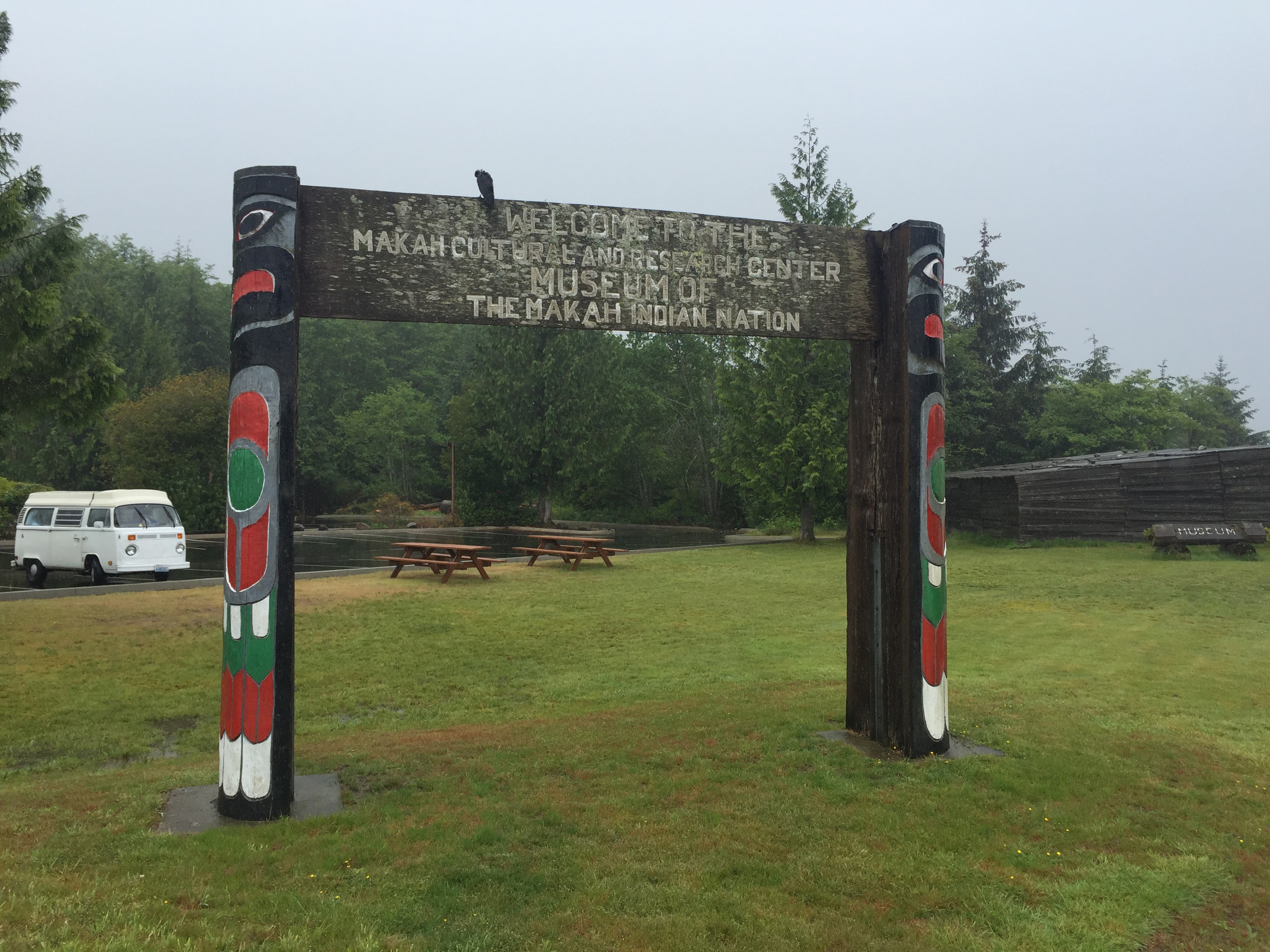
Makah Museum
Step inside the Makah Museum in Neah Bay and the first thing you encounter is a full-scale replica of a cedar longhouse. Duck through the entrance and you are standing in a space thirty feet wide and seventy feet long, divided into living quarters, a cooking fire at the center of each. The replica is based on the longhouses excavated at the Ozette archaeological site, fifteen miles to the south on the Pacific coast. But the replica is only the threshold. Beyond it lie thousands of artifacts recovered from that same site -- whaling harpoons, sealing clubs, fishing hooks, woven baskets, children's toys, decorative carvings -- objects made and used by Makah people centuries before any European set foot on this coast. The museum holds over 55,000 items. Roughly 30,000 of them are made of wood, a material so perishable that its survival for over four hundred years is itself the museum's most remarkable exhibit.
Claplanhoo's Vision
The museum opened in 1979 under the leadership of tribal chairman Edward Eugene Claplanhoo. The timing was not coincidental. The excavation at Ozette, which had begun in 1970 after a winter storm exposed the buried village, was producing artifacts at a rate that demanded a proper home. Claplanhoo understood that the artifacts belonged to the Makah, not to the university archaeologists who had helped recover them. He pushed for a facility that would be both a museum open to the public and a research center controlled by the tribe. The Makah Cultural and Research Center -- the museum's formal name -- fulfills both roles. It houses the artifacts, provides exhibition space for visitors, supports academic research, and serves as an archive for Makah history and oral traditions. The decision to build the museum on the reservation, in Neah Bay, rather than in a university or a city, was deliberate.
Before Contact
What makes the Ozette collection extraordinary is not just its size but its timing. The mudslide that buried the village occurred around 1560 -- decades before significant European contact on the Northwest Coast and well before the epidemics of smallpox and other diseases that would devastate Indigenous populations in the region. The artifacts represent a culture operating entirely on its own terms. There are no trade goods, no metal tools of European origin, no evidence of the disruptions that colonization would bring. The whaling gear tells the story of a people who hunted gray whales and humpbacks from cedar canoes in the open Pacific. The fishing equipment shows the sophistication of a marine economy built on salmon, halibut, and shellfish. The toys and games -- some small enough to fit in a child's hand -- remind visitors that this was not just a subsistence operation but a community with children, play, art, and leisure.
Cedar as Civilization
The museum's wooden artifacts are its crown jewels, and western red cedar is their common material. The Makah built their world from this single tree species. Trunks became longhouses and canoes. Bark was woven into water-resistant clothing and hats. Roots were braided into baskets so tightly woven they could hold water. Planks were fashioned into walls designed to be removed and transported when families moved with the seasons. The Ozette collection demonstrates the range of what cedar could become in skilled hands: from the massive structural beams of a longhouse to delicate carvings no larger than a finger. The anaerobic mud of the mudslide preserved these objects by sealing them from the oxygen that drives decomposition. Walk through the museum and you are looking at wood that was shaped by hands that lived four and a half centuries ago, still bearing the tool marks, still holding the form the maker intended.
Fifteen Miles from the Source
The drive from the Ozette trailhead to the museum in Neah Bay takes about forty minutes on narrow, winding roads through old-growth forest. The site and the museum are separated by fifteen miles of some of the most remote terrain on the Olympic Peninsula. For visitors, the museum offers what the archaeological site cannot: context. At Ozette, you see a beach, some eroding bluffs, and interpretive signs. At the museum, you see what the bluffs contained. Canoes that were paddled into Pacific swells. Harpoons that were driven into whales. Baskets that held food for a community. The museum charges an admission fee that helps support its operations -- a modest price for access to one of the most significant archaeological collections in North America, housed in a small building in a fishing village at the edge of a continent, controlled by the people whose ancestors made every object on display.
From the Air
The Makah Museum (Makah Cultural and Research Center) is located at 48.37°N, 124.60°W in Neah Bay, on the north shore of the Makah Reservation along the Strait of Juan de Fuca. From altitude, Neah Bay is the small harbor community visible at the northeastern edge of the reservation. The museum building is in the town center, not visible as a distinct landmark from high altitude but located near the harbor. Cape Flattery and Tatoosh Island are visible to the northwest. The Ozette archaeological site, source of the museum's collection, is approximately 15 miles to the south on the open Pacific coast. Nearest airports: William R. Fairchild International (KCLM) in Port Angeles, approximately 60 nm east; Quillayute Airport (KUIL) near Forks, approximately 50 nm south. Maritime weather dominates -- overcast with rain common year-round.