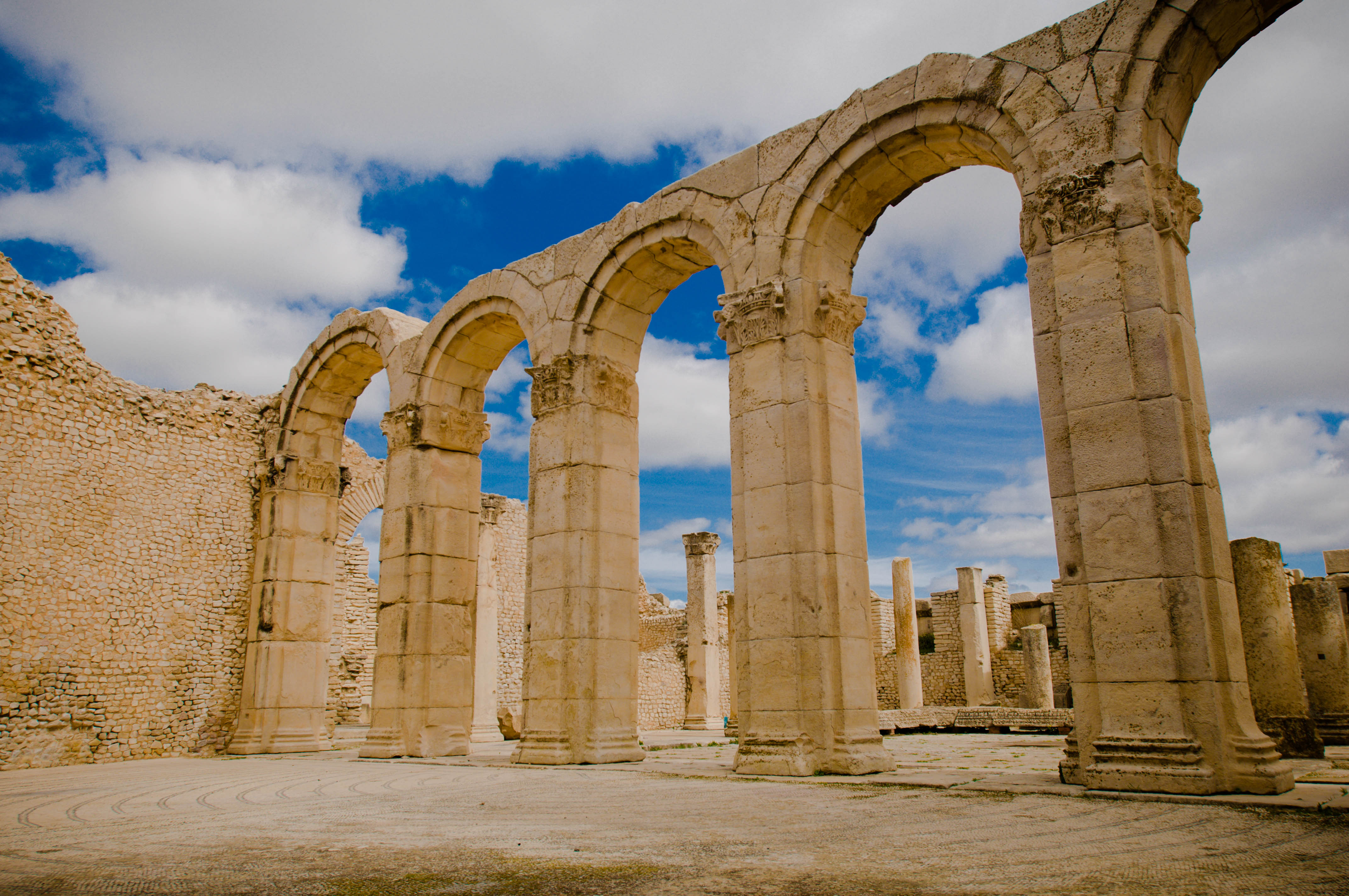
Makthar Archaeological Site
An epitaph preserved at the Louvre tells the story of a farm laborer in the ancient city of Mactaris who worked for 23 years, saved enough to meet the property requirement for his city's senate, and rose from harvest fields to political office. Carved between 260 and 270 AD, the "Harvester of Mactar" inscription is one of the most human documents to survive from Roman Africa. It came from this plateau in west-central Tunisia, 150 kilometers southwest of Carthage, where a city once stood that traced its origins to the 8th millennium BC.
Ten Thousand Years on a Plateau
The evidence of human presence at Mactaris begins with fossilized snails dating to the 8th millennium BC. The city proper was likely founded by Libyan populations, as indicated by its toponym MKTRM, later Latinized to Mactaris. Megalithic burial chambers on the site, excavated by archaeologist Mansour Ghaki, yielded ceramics ranging from the 3rd century BC to the 1st century AD -- collective tombs that served communities across centuries. By the time King Massinissa forged his alliance with Carthage in the 2nd century BC, Mactaris was already a significant Numidian city. When Carthage fell in 146 BC, refugees flooded in. A tophet dedicated to Baal Hammon, attested by stelae found at the Bab El Ain gate, speaks to the persistence of Punic religious practice long after Punic political power had vanished.
The Roman Zenith
Under Emperor Marcus Aurelius in the late 2nd century AD, Mactaris reached its peak, spreading over more than ten hectares of monumental construction. The forum, a remarkably well-preserved 1,500-square-meter square surrounded by porticos and enclosed by a triumphal arch, marks the intersection of the city's cardo and decumanus. The Grand South Thermal Baths are among the most important in Roman Africa, their walls preserved to a height of over twelve meters, still displaying a labyrinth mosaic on their floors. The main baths, inaugurated in 199 AD, covered approximately 4,400 square meters. The Schola Juvenes -- the headquarters of a youth association that performed night patrols and public order functions -- reveals a city sophisticated enough to organize its elite young men into civic colleges. It was precisely such a juvenile college that, at El Djem in 238 AD, led the revolt that brought Emperor Gordian I to power.
From Cathedral to Conquest
Christianity arrived in the 3rd century, establishing Mactaris as the seat of a bishopric. By the 5th century, the Donatist schism had split the community so thoroughly that the city maintained two cathedrals simultaneously. A Vandal-era basilica called Hildeguns, with three naves and Byzantine tombs, survives as one of the rare standing structures from that turbulent period. The decline accelerated in the 11th century with the arrival of the Hilalian tribes, and the city that had endured for millennia finally went silent. Excavations began in 1893 with the temple of Hathor Miskar, expanded under Gilbert Charles-Picard from 1944, and resumed after Tunisian independence in 1960. Much of the site remains unexcavated -- a situation archaeologists compare to Bulla Regia, another vast Tunisian site still yielding secrets.
Scattered Across the World's Museums
The artifacts of Mactaris have traveled far. The Harvester epitaph rests in the Louvre. The La Ghorfa stelae, unearthed near Makthar at the ancient site of Macota, are distributed across four countries: 22 at the British Museum, 12 at the Bardo National Museum in Tunis, three in Vienna's Art History Museum, two at the Louvre, and four -- the most recently discovered, in 1967 -- at the Makthar Museum itself. These stelae follow a distinctive three-register format: deities in the upper band, a dedicator before a temple pediment in the middle, and a sacrificial scene below. Together they illuminate the religious practices of a population undergoing Romanization while preserving deep Libyan-Punic roots. A limestone lion from the 1st century, discovered in 1952, stands as one of the finest examples of pre-Roman Numido-Punic statuary.
From the Air
Located at 35.86°N, 9.21°E on a plateau at 900 meters elevation in west-central Tunisia, between the Ouzafa and Saboun wadi valleys. The archaeological park is visible from altitude as a cluster of ruins on the plateau edge. Recommended viewing altitude: 4,000-6,000 feet AGL. Nearest major airport: Tunis-Carthage International (DTTA) approximately 150 km northeast. Expect turbulence near the plateau edges due to thermal updrafts.