Makthar Museum
The building was meant to be a cafe. Constructed on the site of a marabout's shrine at the entrance to one of Tunisia's most important archaeological parks, it was converted in 1967 into a three-room museum that would come to hold artifacts spanning from the Punic era to the Byzantine twilight. The Makthar Museum is small, but what it contains -- carved stelae, painted mosaics, sculptured heads of emperors and gods -- amounts to a compressed history of ancient North Africa displayed steps from where the objects were unearthed.
Voices in Stone and Clay
The museum's Punic and Neo-Punic collections date not from the height of Carthaginian power but from after its destruction in the Third Punic War -- evidence that Punic civilization persisted in these inland cities long after the mother city fell. Ex-votos and funerary stelae bearing inscriptions in both Libyco-Punic and Neo-Punic characters fill the displays. Alongside them, statue bases and altars document the rituals of a population transitioning between cultural identities. A showcase of oil lamps traces daily life across centuries, from simple clay vessels to elaborate Roman designs. Ancient coins chart the economic networks that connected this plateau town to the wider Mediterranean. The collection of glassware, fragile survivors of nearly two millennia, demonstrates the sophistication of trade reaching even this relatively remote settlement.
Mosaics of Light and Shadow
Two mosaics stand out from the pagan collection. The first is a large panel crowded with animal motifs -- birds and game leaping across the surface -- representing a theme widespread in African mosaics of the period. The second depicts Venus bathing: the goddess leans against a tree while undressing, flanked by two cherubs bringing flowers. The work is notable for its play of light and shadow, achieving a three-dimensionality unusual for floor mosaics. Fragments of sculpted heads, showing the wear of centuries, include portraits of emperors and deities. A 1st-century lion sculpture belonging to the older Numido-Punic artistic tradition demonstrates the continuity of local craft alongside imported Roman styles -- though a better-preserved version of the same tradition sits in the Bardo National Museum in Tunis.
The Last Four of the Ghorfa Series
The museum's most significant holdings may be its four Ghorfa stelae, discovered in 1967 at nearby Maghrawa, the ancient Macota. They are the final additions to a series first found in the mid-19th century, whose origin remained mysterious until scholar Ahmed M'Charek traced them to this location. The stelae follow a stereotyped three-register format that has proved invaluable for understanding religious life in Roman Africa. The upper register depicts deities -- Saturn or Tanit -- in human form. The central register shows a dedicator standing beside an altar within a temple pediment. The lower register portrays a sacrificial scene, complete with the sacrificial animal and sometimes the sacrificer. The series is now scattered: 22 stelae in the British Museum, 12 in the Bardo, three in Vienna, two in the Louvre. These four in Makthar are the youngest siblings of a dispersed family.
Where Christianity Took Root
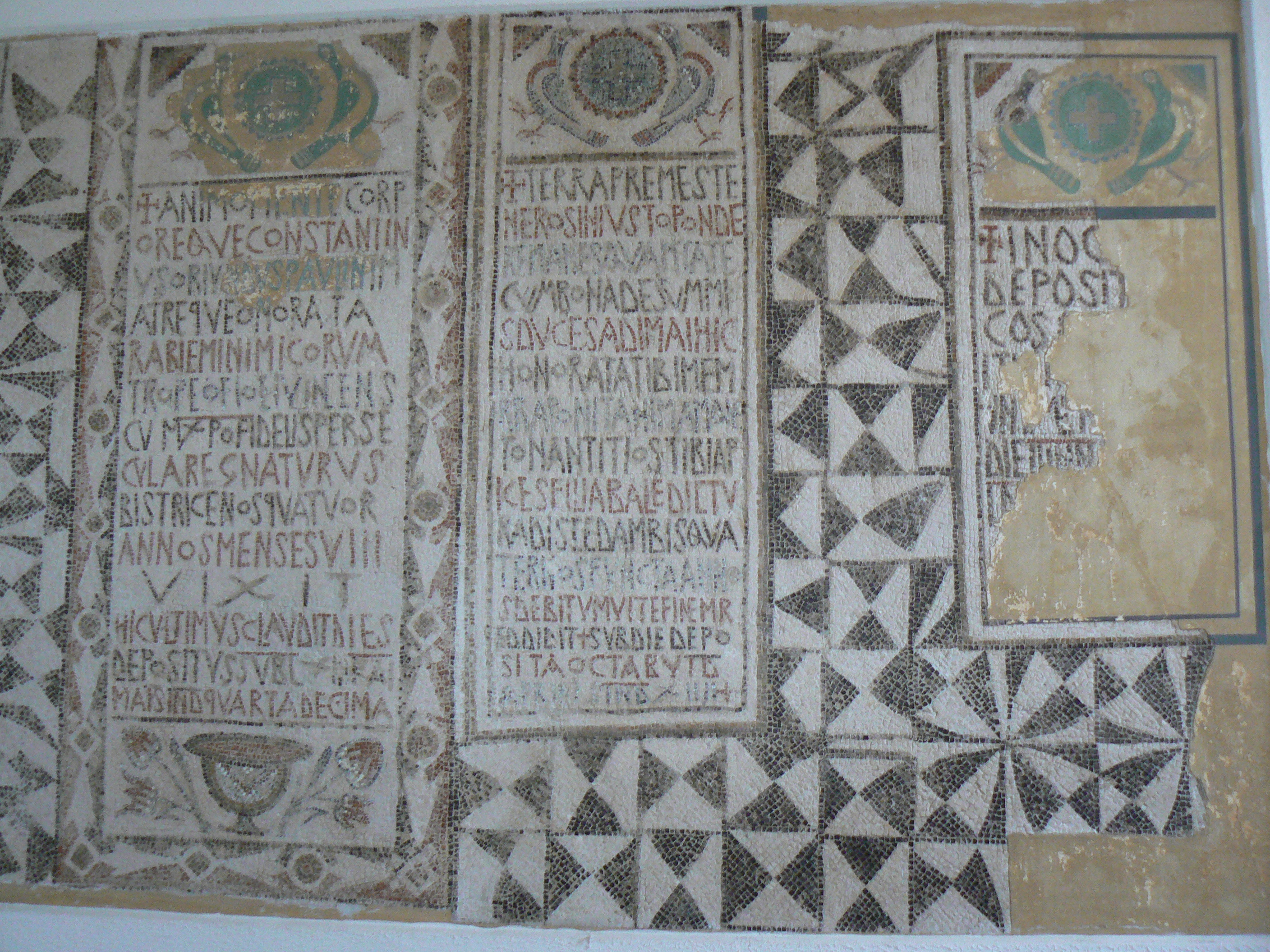
Behind the museum stand the remains of the Rutilius basilica, built over a sanctuary once dedicated to Saturn -- a layering of faiths that encapsulates the site's religious history. The Paleochristian and Byzantine department displays marble fragments from Christian gravestones, some bearing delicate incised decorations. Funerary mosaics feature the Chi-Rho symbol, the early Christian monogram that marked the faith's arrival in these hills. Some mosaics adorned double tombs, suggesting family burials in a community where Christianity had put down deep roots. Scholar Noel Duval studied the Rutilius basilica extensively, concluding it may have served as the city's cathedral. The building suffered from 19th-century excavation methods, but enough remains to convey the scale of Christian worship in a city that once maintained two cathedrals during the Donatist schism.
From the Air
Located at 35.86°N, 9.21°E at the entrance to the Makthar archaeological park in west-central Tunisia, at approximately 900 meters elevation. The museum building is small and not independently visible from altitude, but the surrounding archaeological site is identifiable as ruins on the plateau edge. Recommended viewing altitude: 3,000-5,000 feet AGL. Nearest major airport: Tunis-Carthage International (DTTA) approximately 150 km northeast.