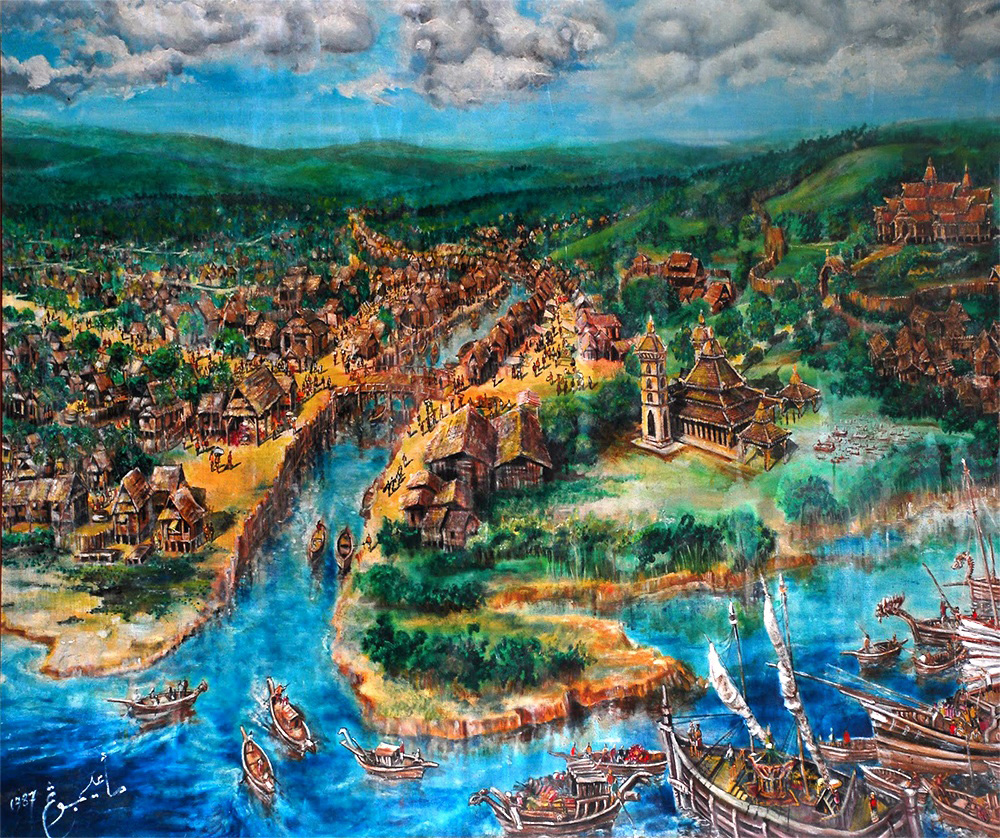
Malacca Sultanate
According to legend, the fugitive prince Parameswara was resting beneath a tree when he witnessed something that changed the course of Southeast Asian history. A mouse deer, cornered by his hunting dog, kicked the animal into the river. "This place is excellent," he declared. "Even the mouse deer is formidable." The tree was a Malacca tree, the place a fishing village at the mouth of the Bertam River, and the kingdom Parameswara founded there around 1400 would become the wealthiest and most powerful sultanate in the Malay world. Today, the mouse deer still appears on Malacca's coat of arms.
A Prince Without a Kingdom
Parameswara arrived in Malacca as a man running out of options. He had been king of Singapura, the flourishing trading post at the southern tip of the Malay Peninsula, until it was sacked -- by either Ayutthaya or Majapahit, sources disagree -- around 1398. He fled north through Muar, Ujong Tanah, and Biawak Busuk, searching for a place to rebuild. The fishing village he found at the Bertam River was already cosmopolitan in its way, populated by Orang Laut seafarers who had been left alone by the Majapahit forces that swept through the region. Buddhists from the north, Hindus from Palembang, and Muslims from Pasai had already taken refuge there. Parameswara set about transforming this accidental gathering of refugees into a proper port, deploying the Orang Laut to patrol the surrounding waters, repel pirates, and channel passing traders into his harbor.
The Dragon's Shield
Malacca's early survival depended on a shrewd diplomatic gamble. In 1405, the Yongle Emperor of China's Ming dynasty sent an envoy to the new settlement, and two years later Admiral Zheng He made the first of six visits. Parameswara traveled to China with the admiral, a journey that secured something far more valuable than trade goods: imperial protection. In exchange for regular tribute, China offered to shield Malacca from the Siamese kingdom of Ayutthaya, which had been expanding aggressively southward. When Ayutthaya's threat grew acute, Malacca's ruler sailed to China in 1418 to raise the alarm. The Yongle Emperor responded by sending envoys to warn the Siamese directly. Chinese merchants began establishing permanent trading bases, and Arab, Indian, and Persian traders followed, raising Malacca's population to around 2,000 in its earliest decades. The city was growing under the umbrella of the most powerful navy the world had ever seen.
Faith and Law on the Waterfront
Sometime around the 1430s, the third ruler, Raja Tengah, adopted the Muslim name Muhammad Shah and began reshaping Malacca's administration along Islamic principles. Customs, royal protocols, bureaucracy, and commerce were reformed to conform with Islamic law. The Undang-Undang Laut Melaka, the Maritime Laws of Malacca, codified the rules of trade that made the port function so effectively. Four Shahbandars -- harbor masters -- were appointed to oversee different merchant communities, and foreign traders received their own designated enclaves within the city. As an international trading center, Malacca became a hub for Islamic learning, and Classical Malay emerged as the lingua franca of Maritime Southeast Asia. The Jawi script became the primary medium for cultural and intellectual exchange across the archipelago. These developments laid the foundation for what historians recognize as the golden age of Malay civilization.
Empire of Two Hundred Ships
Under Sultan Mansur Shah, who reigned from roughly 1456 to 1477, Malacca reached its territorial peak. The sultan dispatched a fleet of two hundred ships under the legendary Bendahara Tun Perak to conquer Pahang, a vast territory rich in gold on the eastern coast of the peninsula. The Pahangite forces were decisively defeated, and the entire royal court was captured. Mansur Shah later added Kampar and Siak in Sumatra to his realm, turning numerous states across the archipelago into tributaries. Rulers who had been overthrown came to Malacca to request the sultan's help in reclaiming their thrones -- as did Sultan Zainal Abidin of Pasai, whose restoration by Malaccan forces demonstrated the sultanate's reach and prestige. Earlier, during the reign of Sultan Muzaffar Shah, Tun Perak had twice repelled Siamese invasions, the second time pursuing the Ayutthayan fleet all the way to Singapura. These victories gave Malacca the confidence and reputation of a genuine regional power.
The Portuguese at the Gate
By 1511, Malacca controlled much of the Malay Peninsula, the Riau Islands, and stretches of Sumatra's central eastern coast. Its harbor thronged with ships from China, India, Arabia, and the Indonesian archipelago. It was precisely this wealth that drew Afonso de Albuquerque and his Portuguese armada. The Portuguese intended to sever Malacca's Islamic and Venetian trade networks and seize control of the spice routes. When Malacca fell, the last sultan, Mahmud Shah, retreated south, where his descendants established the successor sultanates of Johor and Perak. The city itself passed into European hands and would not be ruled by Malay sovereigns again. But the sultanate's legacy proved more durable than its walls. The systems of trade, diplomacy, and governance it built persisted for centuries. The concept of daulat -- a distinctly Malay notion of royal sovereignty -- still shapes the understanding of kingship in Malaysia today.
From the Air
Located at 2.19N, 102.38E on the western coast of peninsular Malaysia, at the narrowing of the Strait of Malacca. The old sultanate's core occupied the area around the mouth of the Malacca River, visible along the waterfront. Malacca International Airport (WMKA) is approximately 10 km north. St. Paul's Hill, where the Portuguese later built their fort, marks the original hilltop center. Best viewed at 3,000-5,000 ft AGL. The strait stretches to the horizon in both directions, still one of the world's busiest shipping lanes.