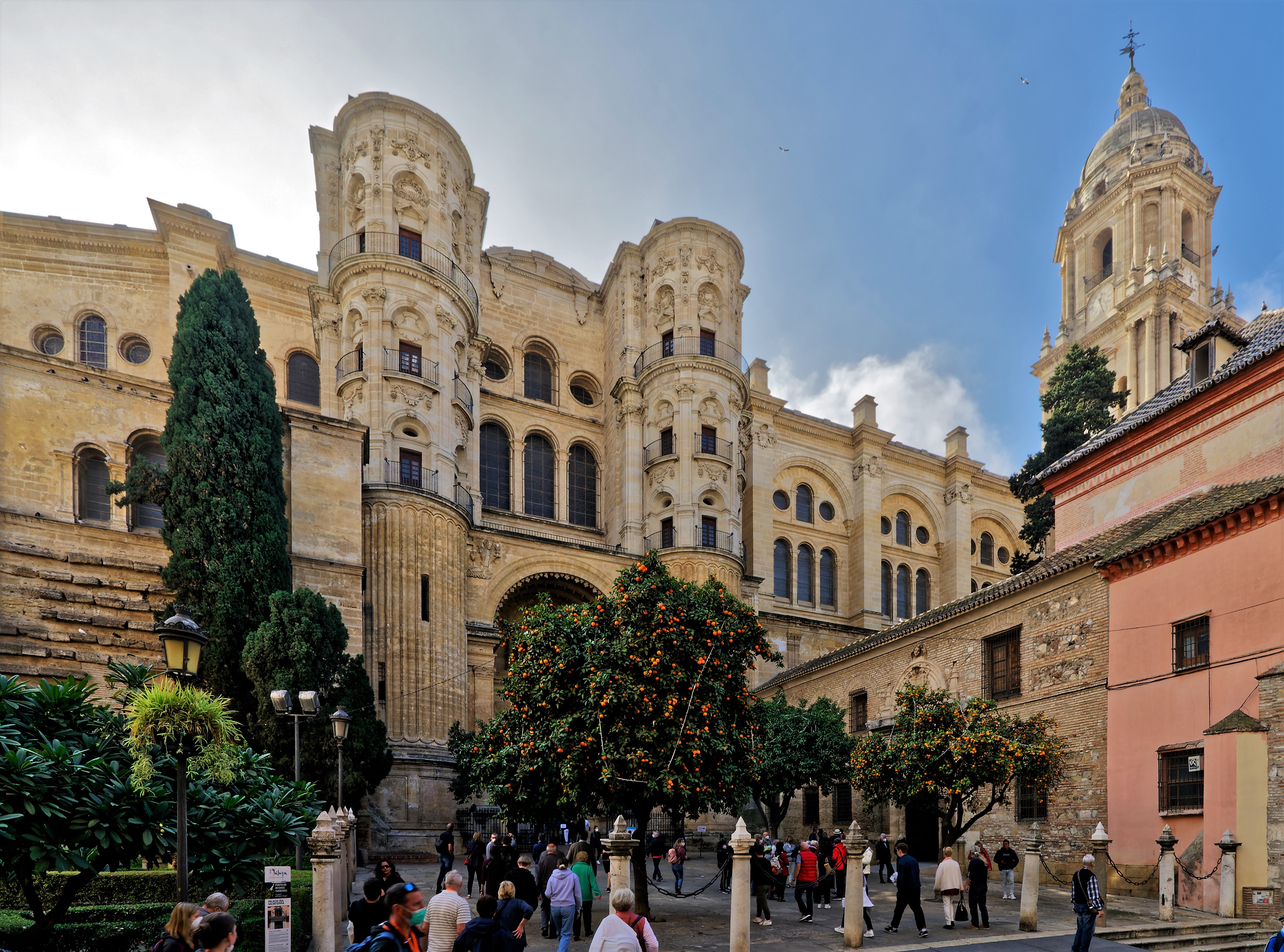
Malaga Cathedral
Malaga Cathedral has only one tower. The north tower rises 84 meters, making it the second-tallest cathedral in Andalusia after the Giralda in Seville. The south tower is a stump, capped at roughly half height and never finished. A plaque at the base explains why: the funds raised to complete it were redirected to support the American colonies in their war of independence against Great Britain. Whether this is entirely true remains a matter of historical debate, but the nickname stuck. Locals call their cathedral La Manquita, the One-Armed Lady.
Two Centuries of Construction
Construction began in 1528, following plans drawn by the architect Diego de Siloe, within the footprint of the medieval Moorish walls that still surround the nearby Alcazaba and Castle of Gibralfaro. Building continued for 254 years, finally concluding in 1782. The interior follows Renaissance principles of proportion and light, with a nave and two aisles of equal height, an unusual design that gives the space a grandeur beyond its rectangular plan. The choir stalls, carved by the sculptor Pedro de Mena, are among the finest in southern Spain. But the exterior tells a different architectural story: the facade is Baroque, divided into two levels with three arched portals separated by marble columns. Stone medallions above the lateral doors depict the patron saints of Malaga, Saint Cyriacus and Saint Paula, while the central medallion represents the Annunciation.
The Money That Built a Nation
After the War of Spanish Succession, the Crown imposed a tax on ships calling at Malaga's port to finance the cathedral's completion. By 1776, when trade with the Americas began to liberalize, construction accelerated. Then the funds ran out. King Carlos III redirected the remaining budget through a chain of intermediaries, including the canon Tomas de Unzaga Amezaga and his brother Luis de Unzaga y Amezaga, the governor of Louisiana and brother-in-law of Bernardo de Galvez, to support the Americans fighting for independence from England. Examination of parish registers suggests the money may have actually been spent on more prosaic local improvements: renovating the road to Antequera, building the San Telmo aqueduct to bring water to Malaga, and beginning a road to Colmenar. Either way, the south tower was never completed. The cathedral's asymmetry became its most distinctive feature.
Art in the Sanctuary
The interior compensates for what the exterior lacks. A Gothic altarpiece in the Chapel of Santa Barbara dates from the earliest period of construction. The Chapel of San Francisco contains 16th-century tombs. The Chapel of the Incarnation holds a neoclassical altarpiece designed in 1785 by the sculptor Juan de Villanueva and carved by Antonio Ramos and Aldehuela, featuring figures of the Annunciation and sculptures of Saints Ciriaco and Paula carved by Juan Salazar Palomino. Among the most striking works is The Beheading of Saint Paul, painted by Enrique Simonet in 1887 during his stay in Rome, a dramatic canvas that captures the moment of martyrdom with unflinching realism. In 2023, restoration work uncovered the cathedral crypt, revealing tombs of the Count and Countess of Buenavista and the Count and Countess of Villalcazar de Sirga.
Music in Stone
The cathedral's musical tradition runs as deep as its foundations. Notable maestros de capilla include Cristobal de Morales, one of the greatest Spanish Renaissance composers, who served here during his final years from 1551 to 1554. Esteban de Brito, the Portuguese-born composer known in Spain as Estevao de Brito, held the post next. In the late Baroque period, Juan Frances de Iribarren served as choirmaster after the sudden death of his predecessor, Manuel Martinez Delgado, who died before he could take up the position. The cathedral's acoustics, shaped by its equal-height nave and aisles, transform polyphony into something architectural, the sound filling the space the way light fills it through the high windows. In a building defined by what was never finished, the music has always been complete.
From the Air
Located at 36.72N, 4.42W in the historic center of Malaga, near the Alcazaba and the port. The cathedral's distinctive asymmetrical profile, with one tall tower and one stump, is visible from altitude at 2,000-3,000 feet. Nearest airport: Malaga-Costa del Sol (LEMG), approximately 8 km southwest.