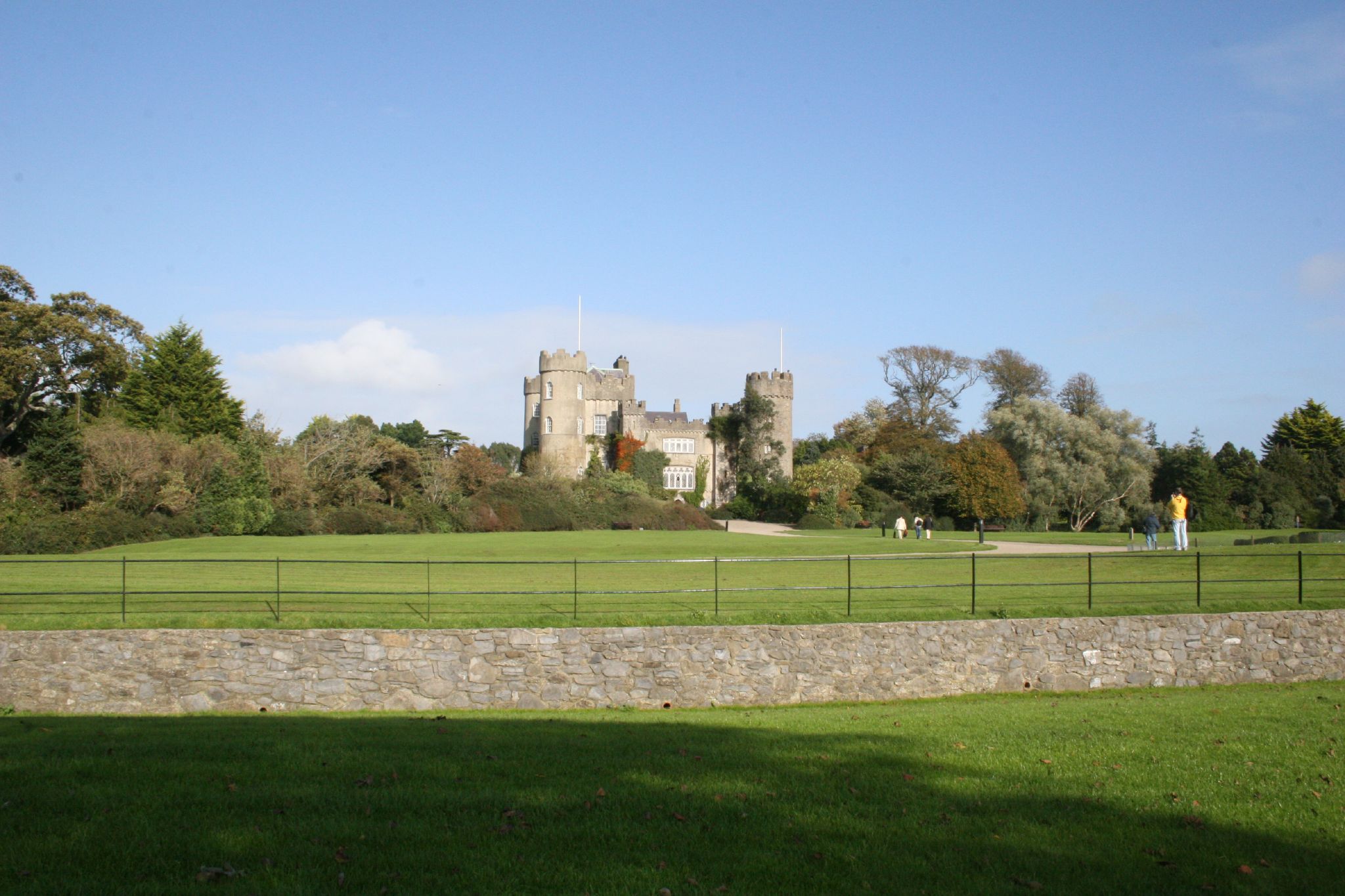
Malahide Castle
On the morning of July 1, 1690, fourteen members of the Talbot family sat down to breakfast together in the Great Hall of Malahide Castle. By evening, all fourteen were dead, killed at the Battle of the Boyne. The castle survived. It had already outlasted centuries of upheaval and would endure centuries more -- 791 years in total under a single family, a record of continuous occupation almost unmatched in Ireland.
A Knight's Grant, a Family's Fortress
The story begins in 1185, when Richard Talbot, a knight who had accompanied Henry II to Ireland, was granted the 'lands and harbour of Malahide.' The oldest surviving parts of the castle date to the twelfth century, making it one of the earliest Norman fortifications still standing near Dublin. The Talbots held it through every convulsion of Irish history, with one interruption: from 1649 to 1660, Oliver Cromwell seized the property and gave it to Miles Corbet, one of the regicides who had signed Charles I's death warrant. When the monarchy was restored, Corbet was hanged and the castle returned to the Talbots. They remained Roman Catholic through the penal laws -- an act of quiet defiance that could have cost them everything.
Boswell's Papers and Wartime Airships
The castle's history contains surprises that have nothing to do with medieval warfare. In the 1920s, the private papers of James Boswell -- the celebrated biographer of Samuel Johnson -- were discovered hidden within the castle. Boswell's great-great-grandson, Lord Talbot de Malahide, sold the papers to American collector Ralph Isham, and they eventually passed to Yale University, which published scholarly editions of the journals and correspondence. A second cache was found soon after. During World War I, the castle grounds served a different purpose entirely: the British Navy established an airship mooring base there in 1918, with blimps from RNAS Anglesey in Wales conducting anti-submarine patrols over the Irish Sea.
The End of an Era
The 7th Baron Talbot de Malahide wanted to donate the castle to the Irish state, but he died in 1973 before arrangements could be completed. The property passed to his sister Rose, who had served as caretaker in the 1950s. Facing substantial death duties that the government refused to offset by accepting valuables, Rose was forced to sell many of the castle's furnishings -- a loss that provoked public controversy. In 1975, she ceded the castle to the Irish state. Some furnishings were later recovered through private and government efforts, but the sale marked the bittersweet end of nearly eight centuries of Talbot ownership.
Parkland, Gardens, and Summer Stages
Today, Malahide Castle sits within 267 acres of parkland just fourteen kilometers north of Dublin's center. The Talbot Botanic Gardens behind the castle reflect the plant-collecting passion of the 7th Baron, who gathered specimens from Chile, Australia, and the southern hemisphere. Seven glasshouses, including a Victorian conservatory, shelter plants that have no business thriving at this latitude. The demesne itself is one of the few surviving examples of an eighteenth-century landscaped park, with cricket pitches, golf courses, and woodland walks threading through its protective belt of trees. Since 2007, the castle grounds have doubled as a concert venue, hosting acts from Radiohead and Prince to Depeche Mode, with crowds of up to twenty thousand gathering on the lawns where Talbots once rode.
From the Air
Malahide Castle sits at 53.44N, 6.17W, about 14 km north of Dublin city center on the coast. The castle and its extensive parkland are visible from the air, bordered by Malahide village and the estuary. Dublin Airport (EIDW) is approximately 5 nm to the southwest. Best viewed below 3,000 ft AGL.