Where the Water Village Remembers
The village that Antonio Pigafetta called the "Venice of the East" in 1521 had no need for Venice's stone. Its palaces floated on wooden stilts above the Brunei River, its mosques rose from the water, and its craftspeople forged gold and wove textiles while the tide shifted beneath their floors. Kampong Ayer -- the water village at the heart of Brunei's capital -- once housed an entire empire. Today much of that knowledge survives in an unlikely container: a Shell-funded museum on a hillside overlooking the very river where it all began.
Oil Money Meets Ancient Craft
The Malay Technology Museum owes its existence to an improbable patron. Royal Dutch Shell, the company that transformed Brunei from a fading sultanate into one of the world's wealthiest nations per capita, funded the museum's construction at a cost of roughly B$7 million. Building took place between 1985 and 1987 on a 15-hectare stretch of land along the Brunei River at Kota Batu, and Sultan Hassanal Bolkiah formally opened its doors on 29 February 1988 -- a leap day, as if the past needed an extra moment to settle into the present. The site sits among royal tombs: the resting places of Sultan Sharif Ali, the third sultan, and Sultan Bolkiah, the fifth, who reigned during Brunei's golden age. Nearby stand the Brunei Museum and the Brunei Darussalam Maritime Museum, forming a complex that maps the sultanate's history from multiple angles. But it is the Technology Museum that gets closest to daily life.
Houses That Read Like a Social Register
The museum's first gallery reconstructs the architecture of Kampong Ayer as it stood in the late 19th and early 20th centuries, and the houses tell you everything about who lived in them. Six scale models, built from traditional materials -- nipah palm leaves called daun apong, woven kajang mats, and bamboo -- represent distinct social ranks. A commoner's home was a Rumah Belah Bubung, modest and functional. The nobility built the Rumah Tungkup and the Rumah Loteng, elevated in both altitude and ambition. Later designs introduced zinc roofing: the Rumah Potong Lima and the collided-roof Rumah Belanggar marked the point where imported materials began reshaping a building tradition that had held for centuries. Walking through these models is less like visiting an architecture exhibit and more like reading a census -- each house declaring its owner's place in a floating society.
The Trades That Named the Neighborhoods
In the second gallery, the museum turns from structures to the hands that built them. Textile weaving, goldsmithing, silversmithing, boat-building, and roof construction are all represented through dioramas, tools, and finished pieces -- brass trays, ancient pots, bolts of woven fabric. The exhibit makes a point that often escapes casual visitors: Kampong Ayer was not a fishing village that happened to float. It was an industrial center. Village names still carry the proof. Kampong Pandai Besi -- literally "Village of the Skilled Ironworker" -- tells you what its residents did for generations. The crafts on display were not hobbies or heritage performances. They were livelihoods, refined over centuries and passed from parent to child with the seriousness that any professional guild would recognize.
Inland Roots
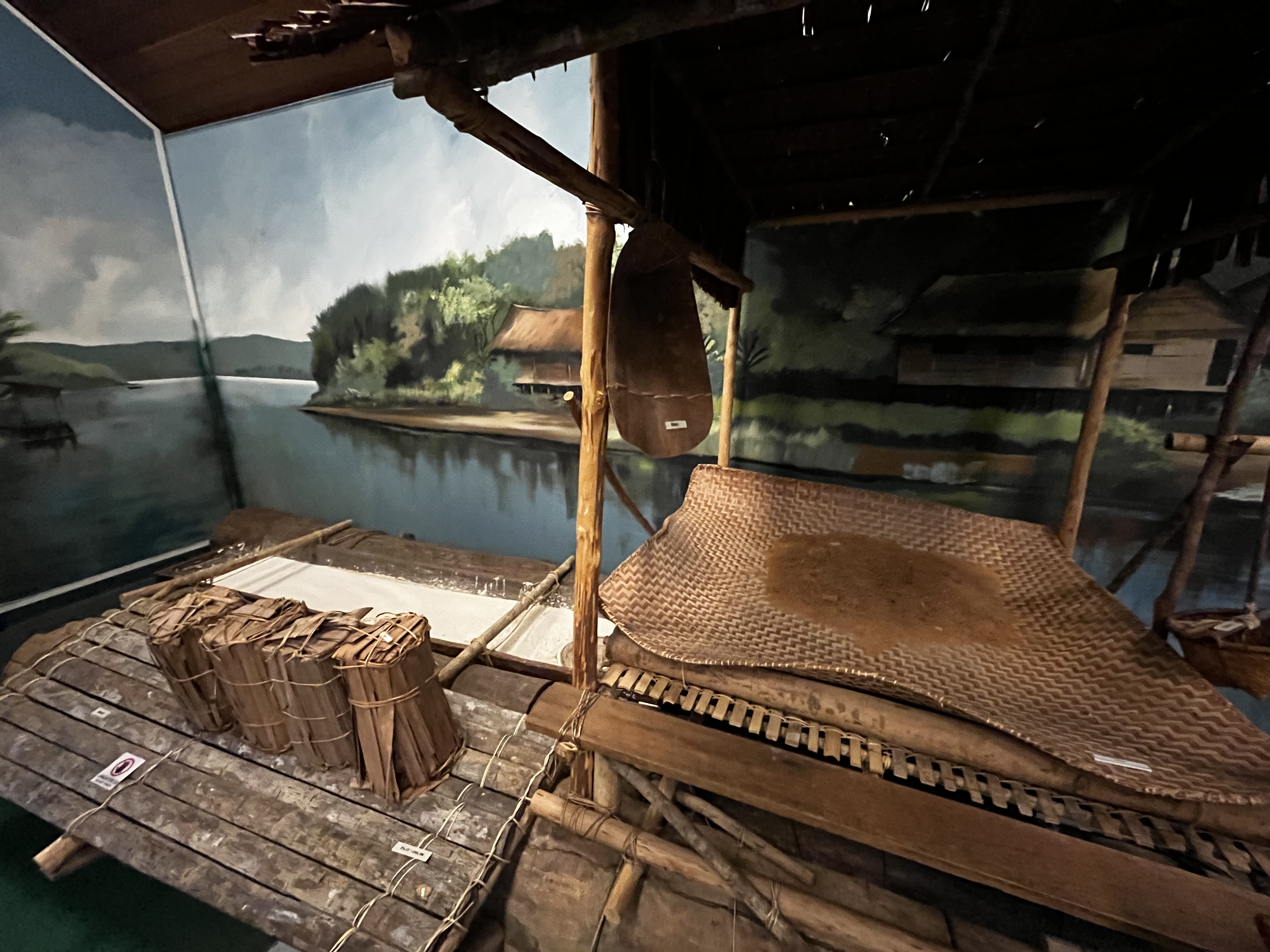
The third gallery steps away from the river entirely and into the interior, where Brunei's indigenous communities -- the Kedayan, the Dusun, and the Murut -- developed technologies shaped by forest and hill rather than tide and current. Tools for processing sago (ambulong), arrowroot starch (tapa garut), and palm sugar (gulanau) share space with rafts, musical instruments, and sugar cane presses. Replicas of traditional houses reveal how architecture encoded social structure even on dry land. The Kedayan longhouse accommodated extended families under one roof. Dusun houses arranged bedrooms to reflect family hierarchy, with elders nearest the center. The Murut house included a communal gathering area and a Barukai ceremonial space, where ritual and daily life met without pretending to be separate. These inland cultures lived within earshot of the water village but developed wholly distinct material traditions -- a reminder that Brunei's geography, however small, contained multitudes.
A Monument You Almost Miss
Among the museum's quieter exhibits stands the original front gate of the General Hospital, inaugurated on 7 September 1929. When the hospital was replaced in 1984 by the Raja Isteri Pengiran Anak Saleha Hospital, the gate was preserved as a historical monument -- an artifact from the colonial period wedged into a museum about indigenous technology. It is an odd fit, and perhaps a deliberate one. The gate marks the moment when outside institutions began arriving on Bruneian soil, carrying their own technologies and assumptions. The rest of the museum shows what was already here. Outside, ASEAN Youth Sculptures and an interactive area with traditional games soften the academic tone. But the real draw remains those three galleries, where a civilization that built its world on water left behind enough evidence to prove that simplicity and sophistication are not opposites.
From the Air
Located at 4.88°N, 114.97°E on the banks of the Brunei River in Kota Batu, Bandar Seri Begawan. Best viewed at 2,000-3,000 feet, where the museum complex is visible alongside the Brunei River and the sprawling stilt houses of Kampong Ayer downstream. Nearest airport is Brunei International Airport (WBSB), approximately 10 km to the northeast. The Brunei River and its distinctive water village settlements serve as primary visual landmarks for navigation.