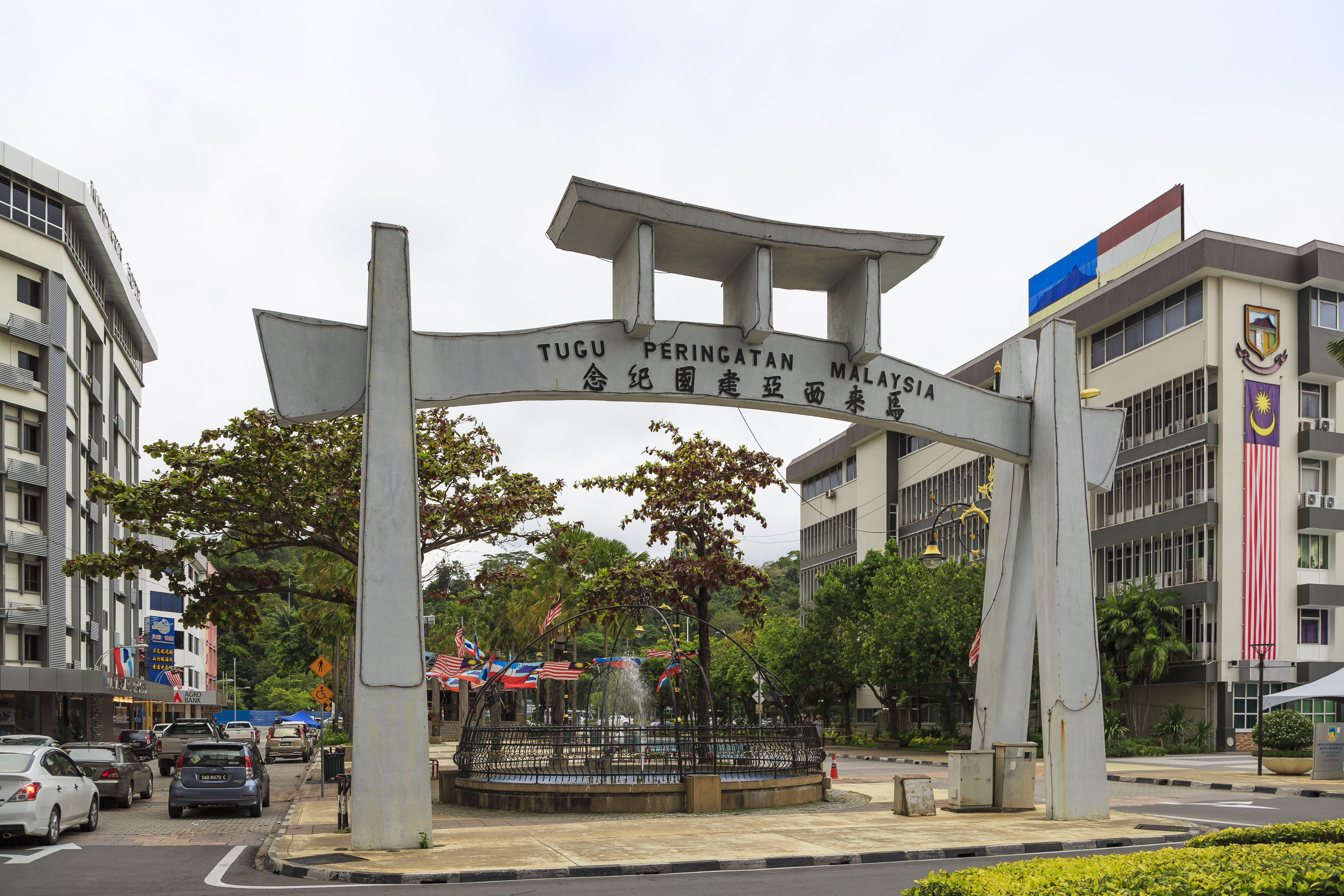
Malaysia Monument
Twenty days. That is how long the Chinese community of Jesselton had to design, fund, and erect a monument to commemorate the most consequential political decision in their city's history. On 16 September 1963, the territory known as North Borneo would join the Federation of Malaya to form a new nation called Malaysia. The community had debated several proposals for marking the occasion, but by the time they reached consensus, the calendar was nearly out of pages. What they built -- quickly, with conviction -- still stands in Deasoka Square near the Kota Kinabalu City Hall. It cost $11,000. Its plaque, inscribed in Chinese, English, and Malay, reads: "This Monument Is Built By The People Of Jesselton To The Founding of Malaysia on 16th September 1963."
When Borneo Became Malaysian
The Malaysia Agreement of 1963 redrew the political map of Southeast Asia. North Borneo -- a territory administered by the British since the late nineteenth century -- joined Malaya, Singapore, and Sarawak to form the Federation of Malaysia. For the residents of Jesselton, the North Borneo capital that would later be renamed Kota Kinabalu, the agreement carried enormous weight. It meant the end of colonial administration and the beginning of a new national identity. The Chinese community, one of the most commercially active groups in the city, saw the formation of Malaysia as a moment worth marking permanently. Their decision to sponsor a monument was both civic and personal: a declaration that they belonged to this new nation and had a stake in its future. The inscription credits both the North Borneo Chinese Association and the Jesselton Chinese Chamber of Commerce as sponsors.
Three Languages, One Pillar
The monument reflects the multicultural reality of Sabah through its trilingual inscriptions in Chinese, English, and Malay. Its design incorporates Chinese aesthetic elements -- a deliberate choice by its sponsors that distinguishes it from the colonial monuments elsewhere in the city. Initially erected near the Keng Chew Association, the monument now occupies Deasoka Square, a busy area adjacent to City Hall and close to the Sunday market on Gaya Street. The square gives the monument a public stage: it is surrounded by foot traffic, market stalls, and the daily commerce of a modern Malaysian city. A small fountain sits in front of the structure, adding a touch of civic formality to what is otherwise a modest memorial. The monument's simplicity is part of its power. It was not built by a government or an empire. It was built by a community, in haste, out of genuine feeling.
Malaysia Day Lives Here
Every 16 September, Malaysia Day celebrations return to the monument. The date, which marks the formation of the federation, holds particular significance in Sabah and Sarawak -- the Bornean states that joined Malaya to create the nation. For decades, Malaysia Day was overshadowed by Merdeka Day on 31 August, which commemorates Malaya's independence from Britain in 1957. It was not until 2010 that Malaysia Day became a national public holiday, a long-sought recognition that the country was formed not in 1957 but in 1963, and not by Malaya alone. The monument in Deasoka Square had been making that argument silently for nearly half a century. There are now proposals to designate it as a cultural heritage site, a formal acknowledgment of what the Chinese community of Jesselton understood from the start: that some moments deserve stone.
From the Air
Located at approximately 5.982°N, 116.076°E in central Kota Kinabalu, near City Hall and Gaya Street. The monument itself is small and not visible from altitude, but the Deasoka Square area is identifiable in the dense urban grid of downtown KK. Kota Kinabalu International Airport (WBKK) is approximately 7 km to the southwest. Best combined with a low pass over the KK waterfront.