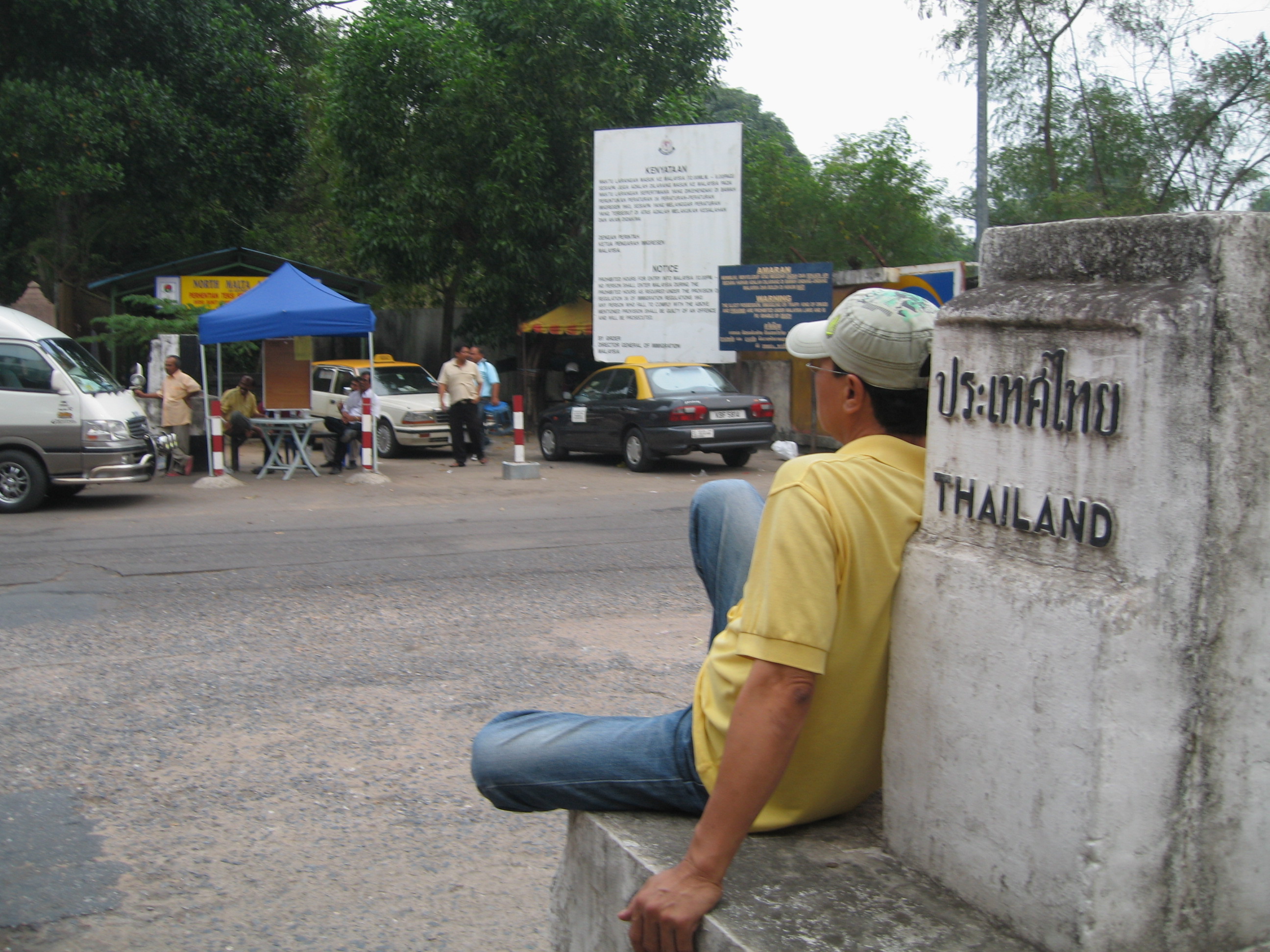
Malaysia–Thailand Border
On a 1909 map drawn in Bangkok, British and Siamese diplomats traced a line that would sever communities, split sultanates, and create a border still disputed in places more than a century later. The Malaysia–Thailand border runs 595 kilometers across the spine of the Malay Peninsula, from the mangrove-fringed estuary of the Perlis River in the west to the muddy mouth of the Golok River in the east. It is a border defined not by any single natural feature but by an accumulation of treaties, mountain watersheds, river channels, and the competing ambitions of two empires that carved up a peninsula already home to ancient Malay sultanates.
The Treaty That Drew the Line
Before 1909, the Malay Peninsula's political geography was fluid. Sultanates like Kedah, Kelantan, Pattani, and Terengganu operated under varying degrees of Siamese suzerainty, while the British steadily expanded their influence northward from the Straits Settlements. The pivot came on 10 March 1909 with the Anglo-Siamese Treaty, signed in Bangkok and ratified on 9 July 1909. Siam ceded authority over Kedah, Kelantan, Perlis, and Terengganu to Britain; Pattani remained Siamese. The treaty's annexes described a border following mountain ridgelines and river watersheds — features that seemed permanent on paper but proved contentious on the ground. An earlier agreement, the Bangkok Treaty of 1869, had already given Britain the territory opposite Penang, creating Province Wellesley. But the 1909 treaty was the decisive act, the one that drew the modern boundary and left Malay-speaking communities on both sides of a line they had no part in negotiating.
Mountains, Rivers, and a Disputed Hill
The land border traces 552 kilometers along mountain watersheds before following the Golok River for its final 95 kilometers to the sea. From the Sayun Range in the west, it climbs through the Kedah-Singgora mountains, crosses the Main Range — the Banjaran Titiwangsa — and descends to the Golok's headwaters at Bukit Jeli. That hill is where the border becomes uncertain. An 8.5-kilometer stretch near Bukit Jeli remains disputed, a 42-hectare territory claimed by both nations. The problem is almost absurdly literal: the geographical features described in the 1909 treaty have changed over the past century, and the two countries cannot agree on which ridgeline the diplomats meant. Survey and demarcation work that began in 1973 was completed by 1985 everywhere except this stubborn gap. Negotiations through a joint subcommittee continue, though neither side has ever threatened force over the matter.
Where the Sea Becomes Contested
The dispute extends underwater. In the Gulf of Thailand, Malaysia and Thailand disagree over how to calculate their continental shelf boundary. Thailand uses Ko Losin, a tiny rocky islet barely breaking the surface, as a baseline point; Malaysia considers it invalid and draws its equidistant line from the shore instead. The result is an overlapping wedge of seabed rich enough in mineral resources to demand a practical solution. In 1979, both countries signed a memorandum of understanding, and by 1990 they had established a 7,250-square-kilometer joint development area where revenues from oil and gas exploration are shared equally. Vietnam, which claims a small slice of the overlapping zone, joined a trilateral agreement in 1999. The arrangements are explicitly temporary — each country preserves its sovereignty claim — but they have kept the peace for decades, turning a potential flashpoint into a model of pragmatic resource sharing.
A Border That Breathes
This is not a static line. During World War II, Japan handed Kedah, Kelantan, and Terengganu back to Thailand, shifting the border southward for the duration of the occupation. After the war, the states returned to British control, and the 1909 boundary reasserted itself. Today, the border touches four Malaysian states — Kedah, Kelantan, Perak, and Perlis — and four Thai provinces: Narathiwat, Satun, Songkhla, and Yala. On the western end, the Straits of Malacca separate Langkawi from Tarutao, with the 1909 treaty specifying that islands south of the mid-channel are Malaysian and those north are Thai. A concrete boundary wall near Padang Besar, built to curb smuggling and respond to the South Thailand insurgency, gives the border a harder edge than its colonial architects intended. Yet the crossing points remain busy, the airline connections numerous, and the Malay communities on both sides still share language, food, and family ties that no treaty has been able to divide.
From the Air
The border runs at approximately 5.95°N, 98.03°E at the western end of the Perlis River estuary, crossing the peninsula to the Golok River mouth in the east. From cruising altitude, the Banjaran Titiwangsa mountain range is visible as the central spine of the peninsula. Langkawi Island and Tarutao Island mark the maritime border in the Straits of Malacca. Nearby airports include Sultan Abdul Halim Airport in Alor Setar (WMKA), Langkawi International Airport (WMKL), and Hat Yai International Airport (VTSS) on the Thai side. Best viewed at 15,000–25,000 feet where the peninsula's narrow waist and the border's mountain-to-river trajectory become clear.