Malkastenpark
In 1855, the general director of the Dusseldorf gasworks took possession of a Baroque garden in the heart of the city and announced that he intended to sell it as building lots. The garden had hosted Johann Wolfgang von Goethe and Wilhelm von Humboldt as guests of the philosopher Friedrich Heinrich Jacobi. It had been one of the earliest English landscape gardens in the Rhineland. To the artists, philosophers, and writers of Dusseldorf, the prospect of seeing it carved into housing plots was unbearable. So they tried something extraordinary. They organized a worldwide lottery of paintings, asking artists across Europe and beyond to donate works, and used the proceeds to buy the garden for themselves. On 17 September 1857, the landscape painter Andreas Achenbach and a wealthy industrial lobbyist signed the deed: eleven acres, 117 Ruthen, twenty-two thousand Thaler. The Malkastenpark belongs to its artists' association to this day.
The Paint Box
The name Malkasten means 'paint box.' It belongs to the Kunstlerverein Malkasten, an association of Dusseldorf artists founded in 1848, the year Europe burned with revolution. While other revolutionaries built barricades, the Malkasten members built a club, partly social, partly political, mostly an excuse to drink together and complain about the academy. The name was chosen for its very ordinariness: a paint box is what every artist owns, the most democratic of artistic tools. When the Jacobi garden came up for sale seven years later, the Malkasten was the natural buyer, although as a private association it lacked the legal right to hold property. A sympathetic notary named Joseph Euler, himself a founding member, and the district president had to push through a special 'Corporationsrecht,' a right of incorporation, before the artists could legally own anything at all.
Jacobi's Garden
Before the Malkasten arrived, the garden belonged to the Jacobi family. The philosopher Friedrich Heinrich Jacobi inherited it from his father, a merchant and councilor of commerce who had acquired the estate in 1742 and laid it out as a French formal garden with parterre and avenue. In the 1770s, Friedrich Heinrich transformed it into an English landscape garden, one of the first in the Dusseldorf area, preserving the central avenue and pond but adding winding paths, orchards, and small bridges over the Dussel stream. Jacobi and his wife Betty, born von Clermont, made the house and garden a salon for European intellectual life. Goethe came. Wilhelm von Humboldt came. The conversations that happened beside the central pond in the 1780s are the kind of thing literary scholars still write theses about.
The Kaiserfest of 1877
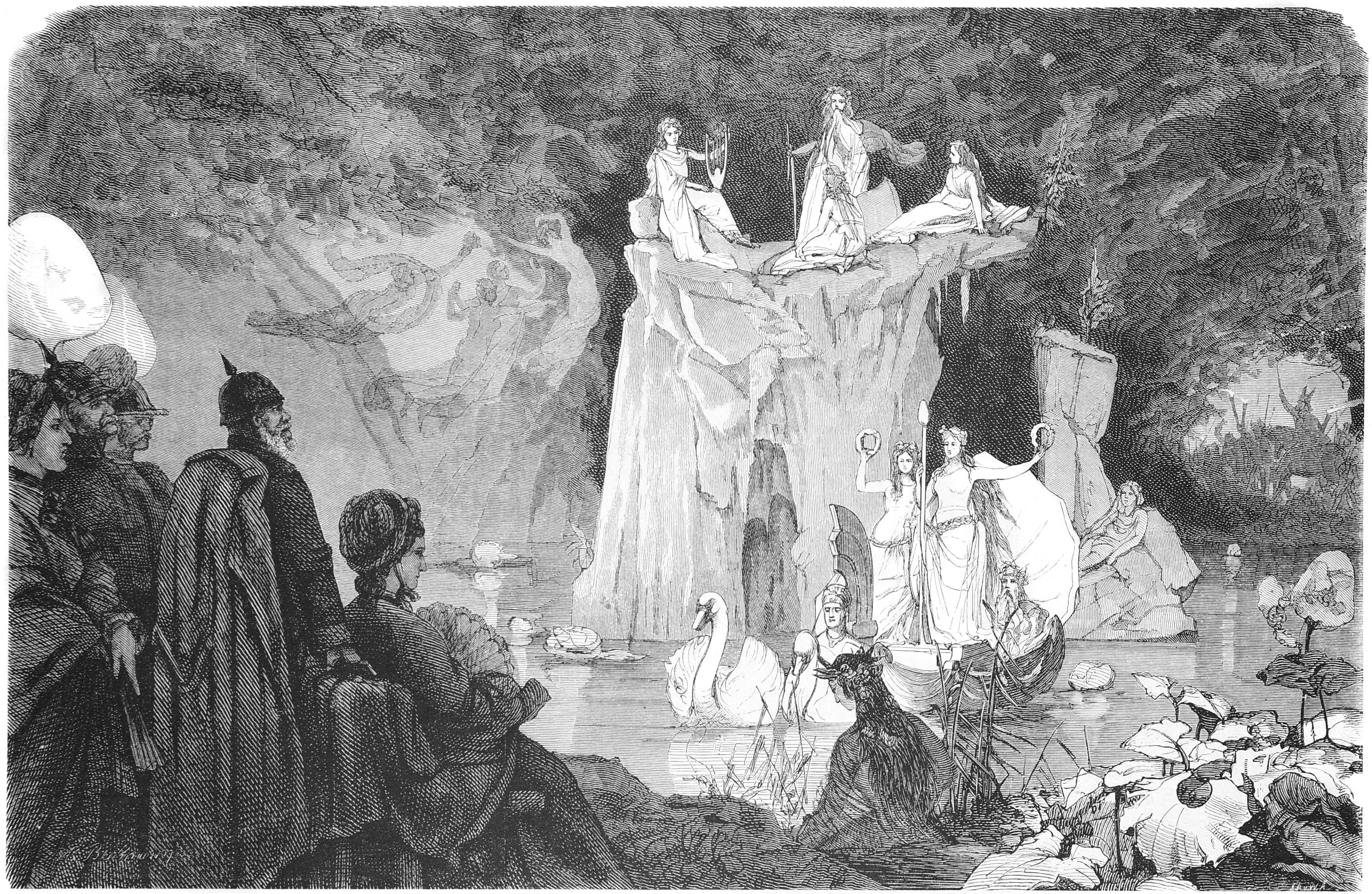
Once the artists owned the garden, they immediately began using it for the kind of festivals you can only really stage when you do not have to ask permission. The royal garden director redesigned the landscape, the Dusselbach stream was reshaped, the Venus Pond was given its central sculpture, and the Malkasten formally moved in on 14 July 1860. The most famous of the parties was the Kaiserfest in 1877, held in honor of Emperor Wilhelm I and Empress Augusta. The event combined theatrical tableaux, music, parades, and the kind of elaborate stagecraft that nineteenth-century artists adored. It set a tradition. For decades afterward, Malkasten festivals were renowned far beyond Dusseldorf, with painters competing to outdo each other in scenic design for a single night of revelry by the pond.
Storm Ela
On 9 June 2014, the Pentecost weekend, a violent line of storms swept across western Germany. Storm Ela tore through Dusseldorf with hurricane-force gusts, knocking down 50,000 trees across the city in a single afternoon. The Malkastenpark lost 40 of its mature trees outright and saw another 200 damaged. Walls cracked, sculptures fell from their pedestals, the careful background of tulip and magnolia trees behind the Venus Pond was wiped out. Restoration, led by landscape architect Achim Rothig, took three years and required donations from the city's gardens, culture, monuments, and finance departments as well as private sponsors. The park reopened in September 2015. Some scars are still visible. Some of the felled tulip trees were a century and a half old, planted in the early years of Malkasten ownership, and cannot be replaced within any human lifetime.
Sculpture by Stream
Today the park is a working open-air sculpture garden, with around three hectares of paths threading past works that span 140 years. A bust of Goethe by Gustav Rutz, erected in 1899, watches the central avenue. The limestone Dusselnixe, also by Rutz, has stood by the stream since 1897. A bronze Laozi by Yungang Chen, a 2015 gift from the China National Academy of Painting, sits among older pieces in a deliberate cross-century conversation. A fragment of one of the baroque lions from Jagerhof Palace rests on a pedestal at the end of the kitchen garden. The entrance fee is two euros, modest by any standard, and goes back into maintenance. The Malkasten still owns it. The paint box, 178 years on, has not been put away.
From the Air
Malkastenpark sits at 51.23 north, 6.79 east, in the Pempelfort district just north of central Dusseldorf, less than 1 km north of the Hofgarten and 500 m east of Schloss Jagerhof. The nearest major airport is Dusseldorf International (EDDL), about 6 km north. From the air, the park appears as a small green pocket within the dense city grid, just under three hectares, framed by Pempelforter Strasse to the east and Jacobistrasse to the south. Look for the dark pond near its center, the Venusteich.