Mallows Bay-Potomac River National Marine Sanctuary
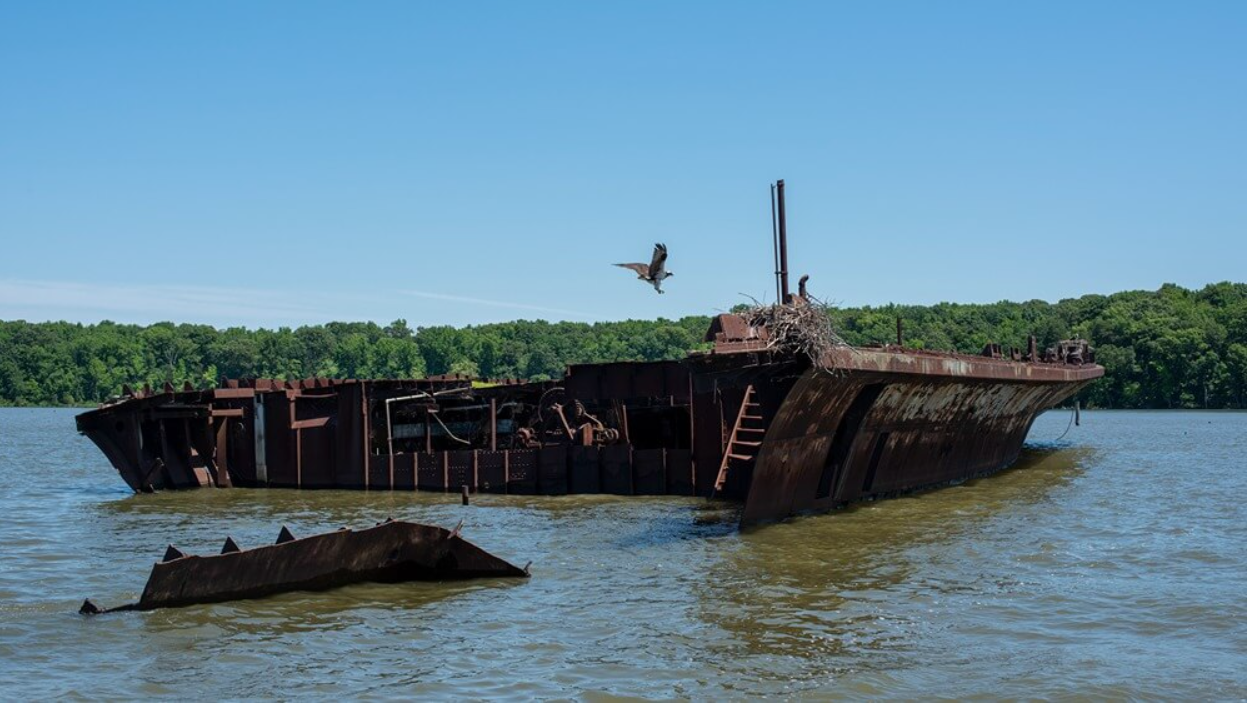
Trees grow from the decks of dead ships here. In a sheltered bend of the Potomac River in Charles County, Maryland, the rotting ribs of more than 200 vessels break the surface of the water, their wooden hulls colonized by marsh grasses, wildflowers, and even full-grown trees. Osprey nest on rusted iron. Beaver lodges sit atop sunken steamships. This is Mallows Bay, home to the largest collection of shipwrecks in the Western Hemisphere and the centerpiece of the 14th National Marine Sanctuary, the first ever designated in the Chesapeake Bay watershed.
The Ghost Fleet
The heart of the sanctuary is a fleet of 118 wooden-hulled steamships that never saw the war they were built for. Between 1917 and 1919, the U.S. Shipping Board's Emergency Fleet Corporation rushed to build nearly 300 ships at more than 40 shipyards across 17 states, racing to replace merchant vessels sunk by German U-boats during World War I. The war ended before most of them could be deployed. Obsolete and unwanted, dozens were towed to this stretch of the Potomac and scuttled. By 1929, ships like the Afrania, the Benzonia, the Boone, and the Yawah had settled into the mud of Mallows Bay, beginning their transformation from instruments of war into something stranger and more beautiful: an accidental nature preserve.
Centuries of Wreckage
The World War I fleet is only the most visible layer. Archaeological surveys have identified shipwrecks in the sanctuary dating back to the American Revolutionary War and the Civil War, along with historical artifacts spanning 12,000 years of human presence along the Potomac. The sanctuary stretches along the Charles County shoreline from Sandy Point south past Mallows Bay and Wades Bay to Smith Point, then across to the Virginia border near the mouth of Aquia Creek in Stafford County. Its waters are mostly fresh, with salinity levels so low that the environment more closely resembles a river than the salt marshes of the Chesapeake Bay downstream.
Where Rust Becomes Refuge
Nature has done what salvage crews could not: reclaimed the fleet entirely. The decomposing hulls create sheltered habitats for fish, birds, and aquatic plants. Osprey hunt above the wrecks while bass and other species shelter below. The shallow, warm waters around the wooden skeletons support submerged aquatic vegetation that feeds the broader Potomac ecosystem. Researchers from the Smithsonian Environmental Research Center use acoustic telemetry to track fish migration patterns through the sanctuary, attaching tags to passing fish and recording their movements with receivers mounted on water quality buoys. At least one beaver lodge has been documented on a wreck, proof that these century-old ships have been fully absorbed into the living landscape.
From Forgotten to Protected
For decades, the Ghost Fleet was an obscure local curiosity. That changed on September 16, 2014, when Maryland Governor Martin O'Malley nominated the area for national sanctuary status on behalf of the state, Charles County, and a coalition of community groups. NOAA officially designated the Mallows Bay-Potomac River National Marine Sanctuary on July 8, 2019, making it the first sanctuary in the Chesapeake Bay watershed. The designation protects not only the shipwrecks but also sites related to African-American history dating to the 17th century and the ecologically rich shoreline habitat. Kayakers now paddle among the wrecks, weaving between rusted ribs and tree-topped hulls in what has become one of Maryland's most unusual ecotourism destinations.
Paddling Through History
The sanctuary is best experienced at water level, where the scale of the wreckage becomes personal. From a kayak, the curved ribs of a steamship rise overhead like the bones of a whale. Marsh grasses wave from what were once cargo holds. The Benzonia's wreck caught fire as recently as 2013, a reminder that even after a century of submersion, these vessels still hold surprises. Citizen scientists from the National Marine Sanctuary Foundation and the Potomac Riverkeeper Network monitor water quality, while students from area schools visit to study the intersection of maritime history, ecology, and preservation. From the air, the dark outlines of hulls are clearly visible against the lighter riverbed, a fleet that went nowhere and, in doing so, became something irreplaceable.
From the Air
Located at 38.47°N, 77.27°W in the Potomac River along the Charles County, Maryland shoreline, approximately 30nm south of Washington, D.C. The Ghost Fleet shipwrecks in Mallows Bay are visible from moderate altitude as dark rectangular outlines clustered in the shallow water near the eastern shore. The Potomac River is wide here, with the Virginia shoreline visible to the west. Nearest airports: Stafford Regional Airport (KRMN) approximately 15nm southwest, Potomac Airfield (VKX) approximately 15nm north, Joint Base Andrews (KADW) approximately 25nm north-northeast. The sanctuary stretches south along the Maryland shore from Sandy Point to Smith Point.