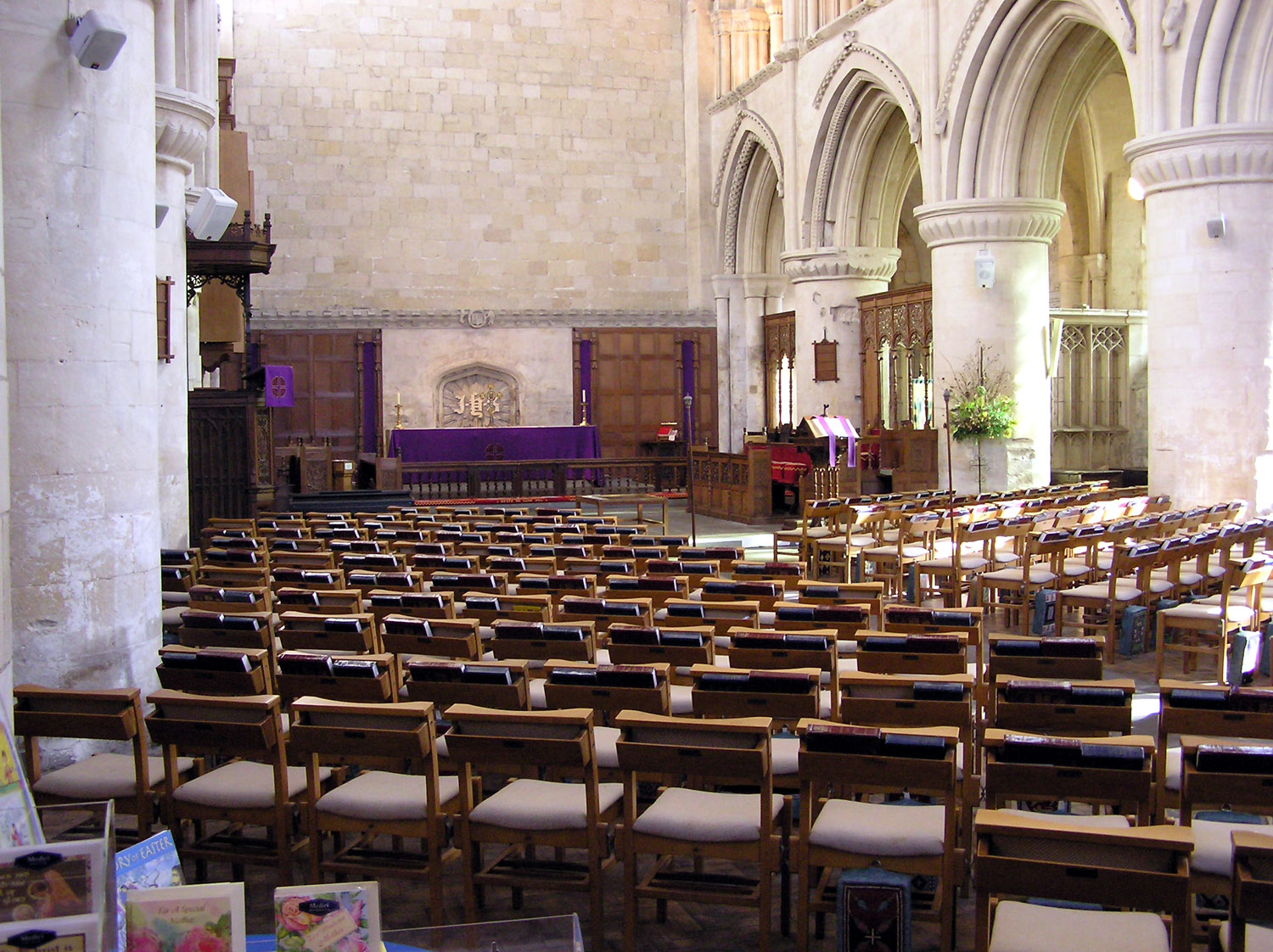
Malmesbury Abbey
In the year 1010 or thereabouts, a Benedictine monk named Eilmer strapped wings to his hands and feet, climbed to the top of Malmesbury Abbey's tower, and jumped. He glided for about 200 metres before crash-landing and breaking both legs. He walked with a limp for the rest of his life and blamed his failure on forgetting to attach a tail. The story, recorded by the twelfth-century historian William of Malmesbury, captures something essential about this abbey: it has always attracted people who thought bigger than their circumstances allowed.
The Irish Hermit's Legacy
Malmesbury Abbey traces its origins to Mael Dub, an Irish monk who established a hermitage in the later seventh century, teaching local children in what was then a frontier between Saxon and Celtic Britain. Around 676, the scholar-poet Aldhelm, a nephew of King Ine of Wessex, founded a Benedictine monastery on the site. Aldhelm was the first writer of Old English descent to produce significant works in Latin, and his intellectual ambitions set the tone for an institution that would become one of England's great centres of learning. Under Alfred the Great, Malmesbury was fortified as a burh against Viking attack, and a mint was established. King Athelstan, Alfred's grandson and the first king to unite all of England, is buried here -- or was, until the Normans allegedly moved his remains to avoid desecration.
Half a Church, Twice the Character
The abbey that stands today is less than half of the original building. The west tower collapsed around 1550, destroying the three westernmost bays of the nave. A spire or tower at the crossing had already fallen. The result is a truncated church that feels both grand and wounded -- monumental architecture with a visible scar. The surviving Norman nave is magnificent, its round-arched arcades and carved porch among the finest Romanesque work in England. The south porch, in particular, features an extraordinary programme of sculpture depicting biblical scenes in a style that mixes Norman severity with an almost Byzantine fluidity. During the English Civil War, Malmesbury suffered further damage: hundreds of musket ball pock-marks still pepper the south, west, and east walls.
Tigers, Poets, and the Dissolution
When Henry VIII dissolved the monasteries in 1539, Malmesbury Abbey -- which by then owned 23,000 acres across twenty parishes -- was sold to William Stumpe, a wealthy cloth merchant. Stumpe returned the abbey church to the town for continuing use as a parish church and installed up to twenty looms in the monastic buildings. It was a practical arrangement that saved the church from the fate of so many dissolved abbeys. Among the notable burials in the churchyard is Hannah Twynnoy, supposedly the first person killed by a tiger in England. She died on 23 October 1703 after taunting a tiger kept in a travelling menagerie stabled at the White Lion pub where she worked. Her gravestone is inscribed with a poem.
Where Beowulf May Have Been Written
In 2009, historian Michael Wood speculated that Malmesbury Abbey's scriptorium was the place where the Anglo-Saxon epic poem Beowulf was transcribed. The abbey's scriptorium was one of the most active in medieval England, and the Anglo-Saxon charters of Malmesbury -- though extended by later forgeries -- provide valuable source material for the history of Wessex. Today the abbey is in full use as the parish church of Malmesbury, in the Diocese of Bristol. Its parvise, the room above the porch, still holds examples of books from the medieval library. Historic England placed the abbey on its Heritage at Risk Register in 2022, noting that the nave and aisle roofs are leaking. The building has survived Vikings, Normans, civil war, and dissolution. A leaky roof seems manageable.
From the Air
Located at 51.585N, 2.098W in the hilltop town of Malmesbury, Wiltshire. The abbey's truncated nave and tower are visible on the town's highest point. Nearest airports: Kemble/Cotswold Airport (EGBP) approximately 10nm east, Bristol (EGGD) approximately 25nm southwest. Best viewed from 2,000-3,000ft.