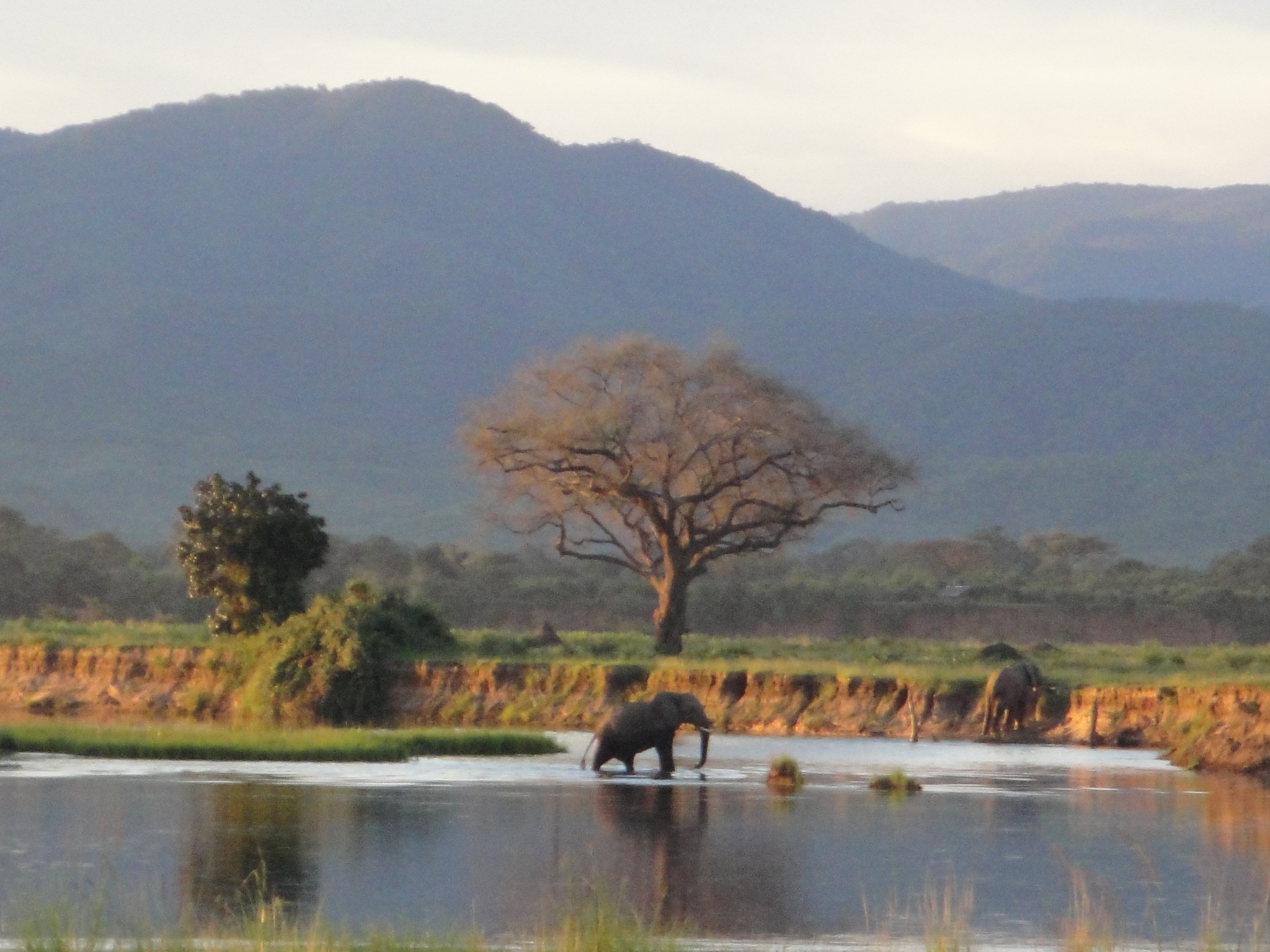
Mana Pools National Park
The word mana means "four" in Shona, and it refers to the four large permanent pools that form when the middle Zambezi meanders across its floodplain in northern Zimbabwe. Each rainy season, the river spills outward, turning low ground into a broad expanse of temporary lakes. As the dry season advances and these waters recede, they concentrate into shrinking pools that draw elephants, buffalo, zebra, and predators from across the region. This annual contraction -- water pulling life toward itself like a slow gravitational field -- makes Mana Pools one of Africa's most extraordinary places to witness wildlife at close range.
The Pools and Their Forest
Mana Pools National Park covers 2,196 square kilometers along the Zambezi's south bank. Its river frontage is flanked by forests of mahogany, wild figs, ebonies, and baobabs -- tall canopy trees whose shade and fruit sustain animals through the hottest months. The park holds Zimbabwe's largest concentrations of hippopotami and Nile crocodiles. During the dry season, large herds of elephant and Cape buffalo gather near the remaining water, joined by zebra, lion, cheetah, leopard, brown hyena, and the endangered Cape wild dog. Over 350 bird species have been recorded. Together with the adjacent Sapi Safari Area and Chewore Safari Area, the park forms part of a UNESCO World Heritage Site totaling 6,766 square kilometers, inscribed in 1984 for its wilderness value. It remains one of the least developed national parks in southern Africa -- there are few roads, no fences, and visitors walk among the animals on foot.
Five Hundred Rhinos, Then Ten
When UNESCO inscribed Mana Pools in 1984, the park was one of Africa's most important refuges for the eastern black rhinoceros. Approximately 500 animals roamed the area. Within a decade, poaching had reduced that number to ten. By 1994, the surviving rhinos were removed to another location for their protection. The collapse was swift and devastating -- a population that had taken centuries to establish was functionally eliminated in roughly ten years. The story of Mana Pools' rhinos is not unique in southern Africa, but its speed and scale made it one of the starkest examples of how quickly poaching can destroy a species' foothold in even a protected landscape. The park's remoteness, which makes it attractive to wildlife, also made enforcement difficult across thousands of square kilometers of bush.
Dams and What They Take
The ecology of Mana Pools depends on the Zambezi's natural flood cycle, and that cycle is no longer entirely natural. Upstream, the Kariba Dam controls 90 percent of the river's total runoff, regulating when and how much water reaches the floodplain. The pools still form, the animals still gather, but the rhythm has been altered. Twice the park has faced the threat of being flooded entirely by proposed hydroelectric schemes. In the early 1980s, a dam planned for the Mupata Gorge downstream would have submerged much of the park. The project was shelved. It resurfaced years later, but the Batoka Dam was chosen as an alternative site. Environmental organizations and the Zimbabwean government have so far kept Mana Pools above water, though the pressure of southern Africa's energy demands ensures the question is never fully settled.
Walking with Elephants
Mana Pools is one of the few national parks in Africa where visitors are permitted -- even encouraged -- to explore on foot without a guide in certain areas. This is not recklessness but a reflection of the park's character: the terrain is open woodland, visibility is reasonable, and the animals, accustomed to a small number of quiet human visitors, are generally tolerant. Walking here puts you at eye level with elephants feeding in the canopy, stripping bark or reaching for seed pods in the upper branches of albida trees. Across the Zambezi, Zambia's Lower Zambezi National Park mirrors Mana Pools on the opposite bank, creating a continuous wildlife corridor along one of Africa's great rivers. From the park's river frontage, the Zambezi Escarpment rises on the Zambian side, a wall of green cliffs that frames the northern horizon. The landscape feels vast, unhurried, and ancient -- which, given how much has changed around it, is perhaps the most remarkable thing about it.
From the Air
Mana Pools National Park is centered around 15.75°S, 29.33°E along the Zambezi River in northern Zimbabwe. From 5,000-10,000 feet AGL, the Zambezi floodplain and its network of pools, oxbow lakes, and river channels are clearly visible, bordered by dark green mopane and riverine forest. The Zambezi Escarpment on the Zambian side provides a dramatic backdrop. There are no commercial airports nearby; the closest significant field is Kariba Airport (FVKB) to the west. The park contains several bush airstrips for charter flights. Dry season (May-October) offers best visibility and wildlife concentrations.