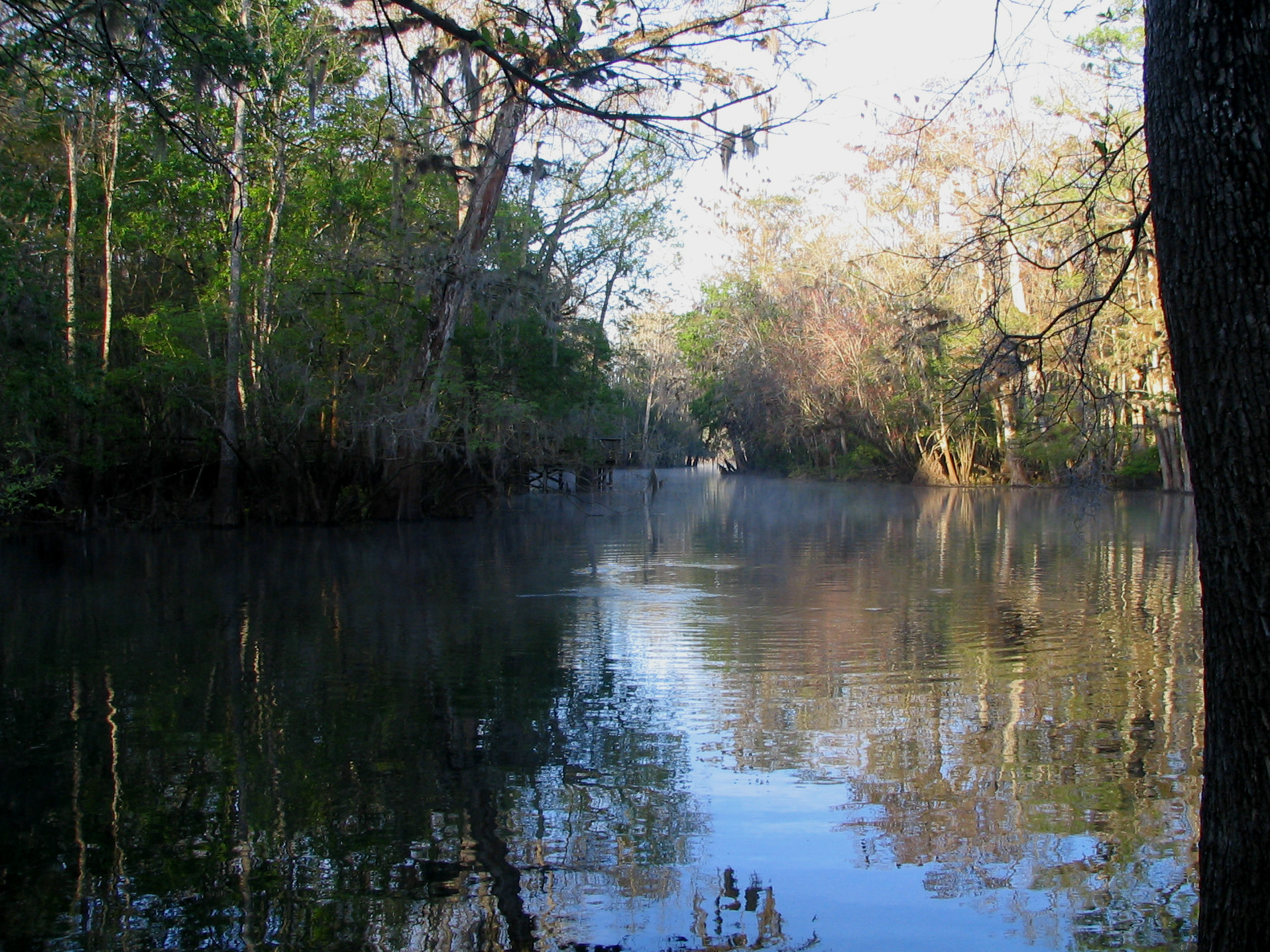
Manatee Springs State Park
Naturalist William Bartram arrived at this spring in 1774 and found a dead manatee on the shoreline. He named the place "Manate Springs" on the spot, and the name stuck for a quarter of a millennium. But the spring itself had been drawing life to its banks for far longer than any European explorer could have guessed. Timucuan people settled here at least 9,000 years ago, choosing the spot for its clear, constant water and its connection to the Suwannee River, which carried them all the way to the Gulf of Mexico. Today, Manatee Springs State Park preserves that same pull of clean water in a landscape that feels both ancient and startlingly alive -- a place where the ground itself is riddled with passages, and the river surface darkens with tannic acid while the spring beneath it runs crystal clear.
Nine Thousand Years at the Water's Edge
Excavations at Manatee Springs have revealed layer upon layer of human presence stretching back millennia. The picnic area that visitors use today was once a Timucuan village, its inhabitants drawn by the same forces that draw people now: fresh water, abundant fish, and a river route to the coast. Archaeologists have uncovered pottery fragments, bone awls, and arrowheads from the Weeden Island period, along with sea turtle remains and saltwater shells -- evidence that these inland villagers traded with or traveled to the Gulf. The arrival of Spanish colonists in the 1500s disrupted the culture that had thrived here for thousands of years. Then came the Seminole Wars in the 1830s and 1840s, which cleared much of the region's indigenous population. Settlers moved in to harvest timber, grow cotton and corn, and raise livestock along the Suwannee. On January 23, 1968, the springs became Florida's first spring to achieve state park status.
The Catfish Hotel and the World Below
Ninety feet below the surface of a sinkhole near the main spring lies the entrance to one of the most extensive underwater cave systems in Florida. Divers call it the Catfish Hotel, named for the bottom-dwelling fish that congregate at the opening. The system includes four main entry points -- Headspring, Catfish Hotel, Sue Sink, and Friedman's Sink -- and divers have explored and mapped over five miles of submerged passages branching through the limestone karst. Sue Sink is designated as an emergency exit only, because entering or leaving it is hazardous and causes soil erosion. Friedman Sink, the furthest upstream entrance, is reserved for certified cave divers. At the Catfish Hotel itself, the siphon side produces an immense flow that demands respect even from experienced cavern divers. A layer of duckweed floats on the surface above, making the pool look deceptively unremarkable from the bank.
The Manatees' Warm Refuge
The West Indian manatees for which the spring was named still travel here, swimming twenty-three miles upriver from the Gulf to reach water that holds at a constant 72 degrees Fahrenheit year-round. The Suwannee River itself runs dark with tannic acid leached from decaying vegetation, which stunts the growth of aquatic plants in most of its length. But the spring's clear outflow creates a pocket of clean, warm water where manatees can feed and rest. They appear most often in fall and winter, when the river cools and the spring becomes a thermal refuge -- a place to calve and shelter through harsh cold snaps. Around one hundred manatee sightings are recorded at the park each year. The spring run closes to boat traffic during peak manatee season, a measure that has helped the population stabilize and allowed visitors to observe the animals undisturbed from the boardwalk above.
A Gothic Canopy
The spring attracts another wintering visitor that gives the landscape a strikingly different character. Large numbers of American black vultures roost in the moss-draped cypress trees that line the spring run, their dark silhouettes perched among the Spanish moss in numbers that visitors often find startling. The birds are not afraid of humans but are not aggressive either, creating an atmosphere that feels more like a scene from a Southern Gothic novel than a state park brochure. Below the vultures, the spring run flows through swamps and hardwood wetlands of cypress, sweetgum, maple, and ash on its way to the Suwannee -- the longest spring run feeding the river. Largemouth bass, speckled perch, catfish, bream, and longnose gar move through these waters. White-tailed deer browse the uplands. The whole park hums with the layered life that a first-magnitude spring, pumping tens of millions of gallons per day, makes possible.
From the Air
Located at 29.49N, 82.98W, six miles west of Chiefland, Florida, in Levy County. The spring run is visible as a corridor of clear water flowing into the dark-stained Suwannee River -- the contrast is dramatic from the air. The park's sinkhole ponds and wetlands are visible at lower altitudes. Nearest airport is Chiefland Sky Ranch (51FL), a small private strip. Gainesville Regional Airport (KGNV) is approximately 45 miles to the northeast. George T. Lewis Airport (KCDK) near Cedar Key is about 30 miles to the southwest. The Suwannee River's winding path to the Gulf is a distinctive navigation feature. Best viewed at 1,000-2,000 feet AGL to spot the spring run and sinkholes.