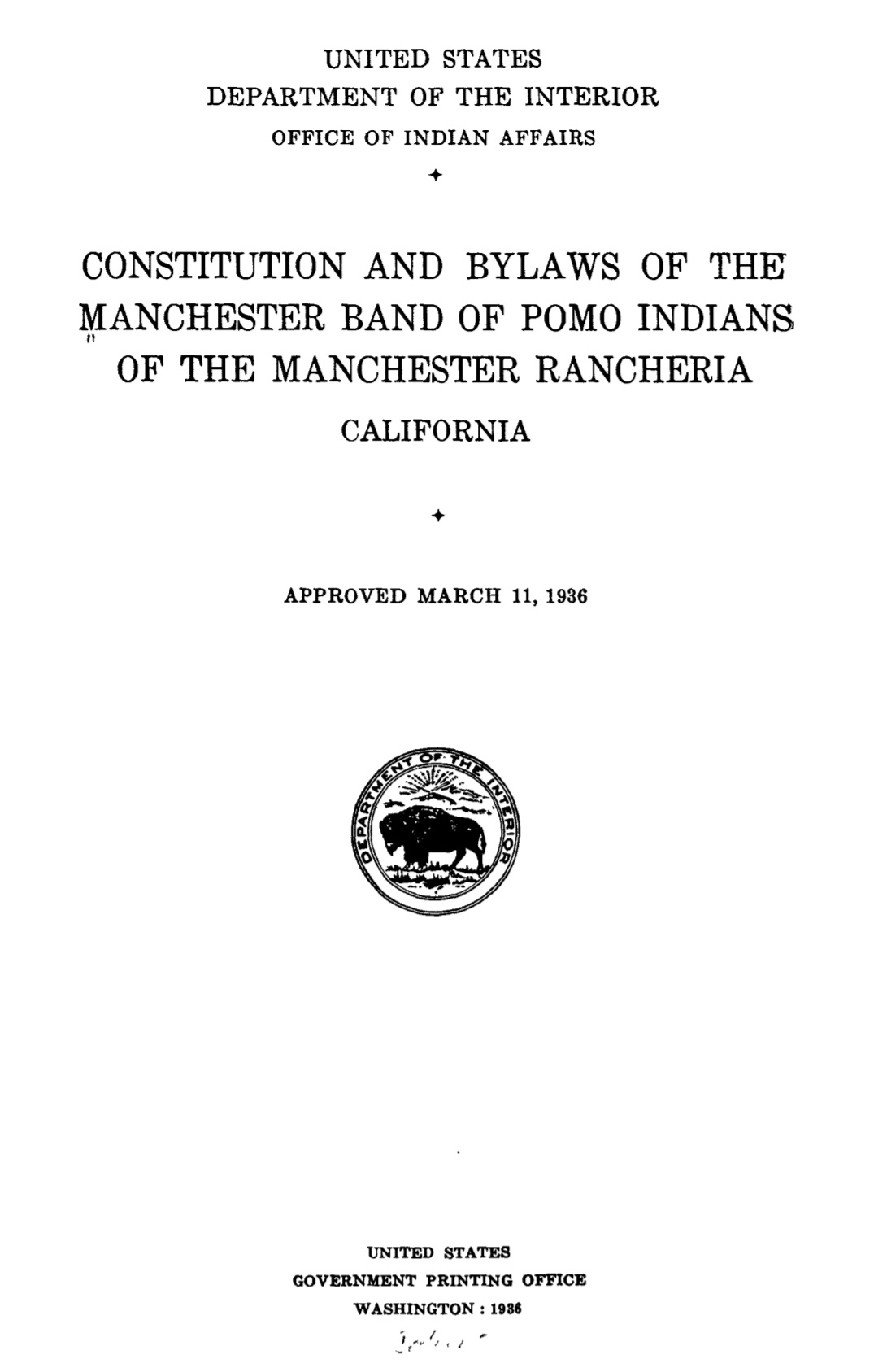
Manchester Band of Pomo Indians
In 1968, the Manchester Band of Pomo Indians sued the United States of America. The charge: improper handling of tribal funds. After the government failed to comply with court orders, the court found the charges to be true. It was not the first time the federal government had broken faith with these people, and it would not be the last time they fought back. The Manchester Band -- descendants of the Bokeya, once the largest Pomo tribelet by territorial area in what is now Mendocino County -- have spent the better part of a century using the legal and political tools of the nation that displaced them to protect what remains of their homeland.
The Bokeya and Their Coast
The Pomo people have lived along the northern California coast and its inland valleys for thousands of years, and the Bokeya were among the most prominent of the Pomo tribelets. Their territory in what is now Mendocino County was the largest of any Pomo group, stretching across a landscape where the Coast Range meets the Pacific. They were self-sufficient people who drew their livelihood from the ocean, the rivers, and the forests. Hunting, fishing, and healing were prestigious professions. Shamans treated not only individual illness but the health of the community as a whole. The Bokeya had a sophisticated system of exchange and trade with neighboring groups, governed by strict protocols -- outsiders could share resources, but only through proper channels. When the Bokeya had abundance beyond their needs, they organized feasts among their trade allies, turning surplus into social bonds.
Ghost Ceremonies and Secret Societies
Each Bokeya kin-group maintained a men's assembly house, and within these structures the community performed what were known as ghost ceremonies. These rituals were tied to a society whose practices were kept from outsiders -- what anthropologists have labeled a 'secret society,' though the Bokeya themselves understood it as something more fundamental than secrecy for its own sake. The ceremonies served social integration, binding families and kin-groups into a cohesive whole. The Pomo people broadly shared these cultural practices, but the Bokeya enacted them within the particular context of their coastal territory, where the rhythms of ocean, river, and forest shaped every aspect of communal life. These were not performances or entertainments. They were the mechanisms by which a people maintained their identity across generations.
A Constitution of Their Own
When Congress passed the Indian Reorganization Act in 1934, the Manchester Band of Pomo Indians seized the opportunity. The Bokeya framed a constitution and by-laws, ratified in 1936, that established a legal rancheria organization and secured the privileges and powers the IRA offered to tribal nations. A corporate charter followed in 1937, aimed at furthering the band's economic development. The Manchester Band became one of the few Native American groups to make their constitution publicly available -- a document that asserted jurisdiction over their rancheria land in the language of the system that had taken most of it. Today the reservation is split between Manchester and Point Arena lands, totaling 364 acres. It is a fraction of the territory the Bokeya once roamed, but it is sovereign ground, governed by the band's own laws.
Fighting for What Was Owed
The 1968 lawsuit against the United States was not a symbolic gesture. The Manchester Band filed a class action suit against 'the United States of America and certain officers of the Interior and Treasury Departments' for mishandling tribal funds. The case dragged through the courts -- efforts to convene a three-judge panel failed, and the case was reassigned in early 1972. When the defendants refused to comply with the court's discovery orders, the judge took the extraordinary step of establishing the charges as true by default. It was a vindication, though a bitter one: the tribe had to go to federal court to prove that the government entrusted with protecting their interests had failed to do so.
The Rancheria Today
The Manchester Band operates the Garcia River Casino on the Point Arena Rancheria -- a modest operation, mostly slots, with a single blackjack table run by an electronic host. The tribal-state gaming compact was signed on October 8, 1999. Healthcare comes through a satellite clinic of the Sonoma County Indian Health Project, which provides not only medical services but education on prevention of injuries, HIV/AIDS, teen pregnancy, and suicide. The rancheria sits at roughly 38.94 degrees north, 123.68 degrees west, on a stretch of the Mendocino Coast where the hills roll down to meet the Pacific. It is a small place with a long memory, where a people who once governed the largest Pomo territory continue to govern themselves on 364 acres of it.
From the Air
The Manchester Rancheria is located at approximately 38.94°N, 123.68°W on California's Mendocino Coast, split between Manchester and Point Arena lands. The rancheria is near the town of Point Arena, visible along Highway 1. The Point Arena Lighthouse, one of the coast's most recognizable landmarks, is a few miles to the southwest. The Garcia River, which gives its name to the tribal casino, runs nearby. The closest public airport is Point Arena Airport (not ICAO-coded), a small strip near the coast. Charles M. Schulz-Sonoma County Airport (KSTS) is approximately 50 nm to the southeast. The terrain is rolling coastal hills with dense vegetation.