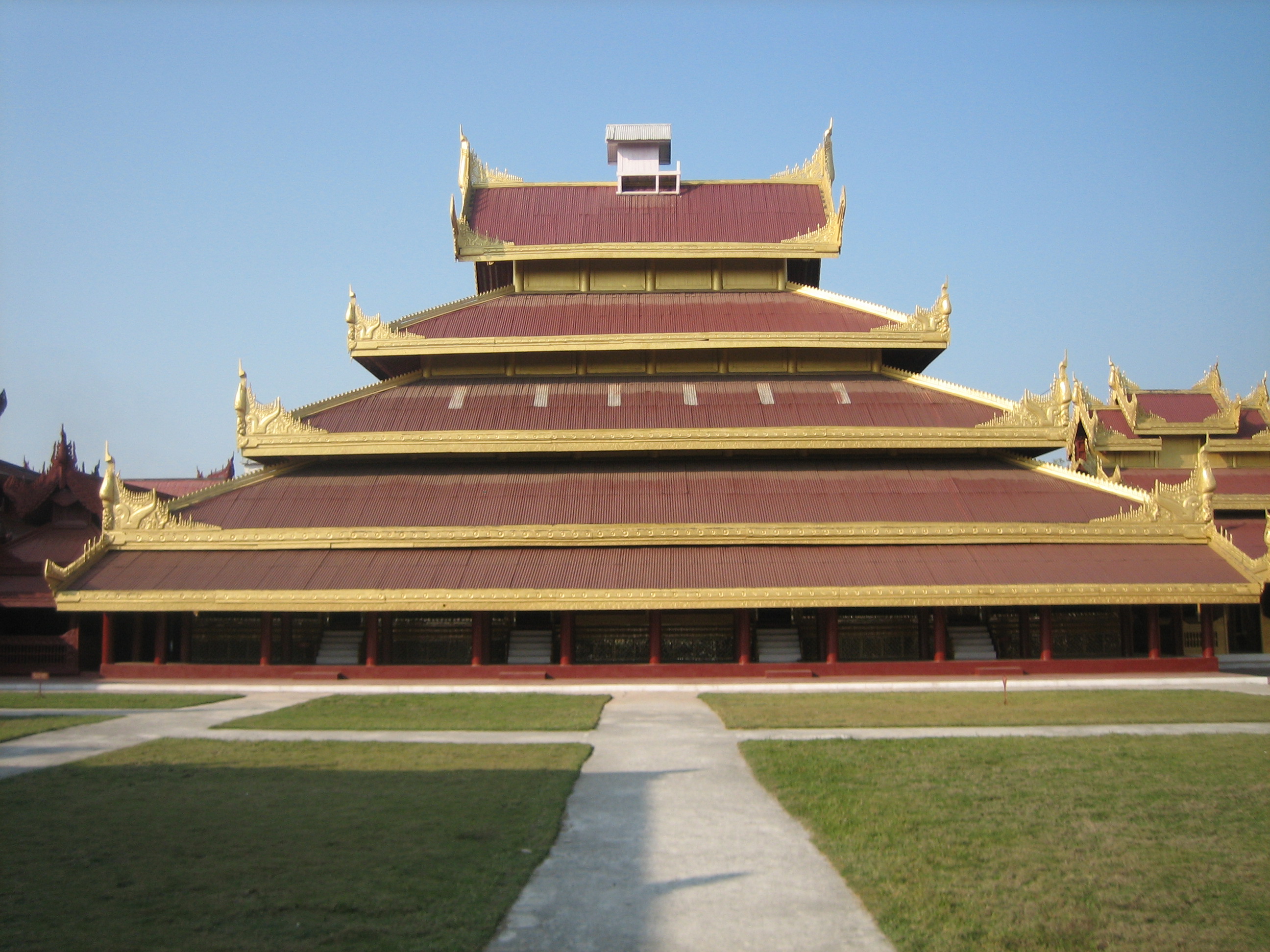
Mandalay Palace
Queen Supayalat stood on the watchtower in November 1885 and watched the British column march through her gates. It was the last time a Burmese royal would look out from this palace as its sovereign. Built barely three decades earlier by King Mindon as the centerpiece of his new capital, the Mandalay Palace was designed to project permanence -- a walled city within a city, its golden spires counting off the hierarchy of power in ascending tiers. Within a generation, the monarchy it housed would be abolished, its timbers repurposed as a colonial garrison. The palace's story is one of grandeur, loss, and the stubborn insistence on reconstruction that runs through Myanmar's relationship with its past.
A Kingdom, Relocated
In February 1857, King Mindon ordered his capital moved from Amarapura to the foot of Mandalay Hill. Large sections of the old Amarapura Palace were physically dismantled and carried to the new site, where they were reassembled within a master plan of remarkable ambition: a 144-block grid city anchored by a 16-block royal compound at its center. The compound's four walls, each stretching two kilometers, enclosed 413 hectares and were surrounded by a moat 64 meters wide and nearly five meters deep. Forty-eight bastions crowned with gold-tipped pyatthat spires punctuated the walls at intervals of 169 meters. Twelve gates -- three on each side -- bore the signs of the zodiac. Every measurement was deliberate, every detail calibrated to express cosmic order made tangible in brick and teak.
Eight Thrones and a Glass Palace
At the heart of the compound, raised on an earthen platform over 300 meters long, stood the palace buildings -- all single-storey, their importance legible in the number of spires overhead. The Lion Throne, greatest of the palace's eight royal seats, rested on a double-lotus pedestal flanked by carved lions, accessible only through a hidden stairway behind a gilt iron lattice. Anyone who dared sit on it uninvited was committing high treason -- or, as the Burmese saw it, declaring themselves king. The Hmannan, or Glass Palace, served as the monarch's private quarters. Its west room was so restricted that even princesses and minor queens had to leave their slippers and golden umbrellas at the door. When King Mindon died in 1878, his body was laid out in the east room beneath the Bee Throne, its pedestal adorned with tiny carved bees in their niches.
Fort Dufferin and the Fire
After the Third Anglo-Burmese War ended the Konbaung dynasty in 1885, the British renamed the compound Fort Dufferin and billeted troops where courtiers had once prostrated. The palace's ornate wooden buildings survived this indignity intact -- only to meet a more destructive fate during World War II. The Japanese military commandeered the citadel as a supply depot, making it a legitimate military target. Allied bombing in 1945 burned the palace to the ground. Of all those gilded halls, carved peacock finials, and lotus-band eaves, only two structures survived: the royal mint and the watchtower from which Supayalat had witnessed her kingdom's end sixty years earlier. The Lion Throne itself was spared only because the British had shipped it to India in 1885; it was later returned and now sits in the National Museum of Myanmar in Yangon.
Rebuilt from Memory
Reconstruction began in 1989, led by the Department of Archaeology with funding from the State Law and Order Restoration Council. The rebuilt structures follow historical plans and photographs, recreating the Great Audience Hall's carved and gilded rooflines, the zodiac gates, and the tiered pyatthat spires. The palace compound today sits within the still-intact original walls and moat, the brick fortifications having proven more durable than the teak splendor they once protected. But the reconstructed palace carries a complicated legacy -- funded by an authoritarian government, built atop contested ground, and serving simultaneously as historical monument, national symbol, and active military base.
The Ground Shifts Again
On March 28, 2025, a powerful earthquake struck Myanmar's Sagaing Region, damaging sections of the palace once more. The destruction raised fresh concerns about the site's structural integrity, compounding anxieties already heightened by the country's political turmoil since 2021. The moat still reflects the watchtower and the rebuilt spires. Visitors still enter through zodiac gates. But the palace's meaning continues to shift with each generation that claims or contests it -- a structure that has been royal seat, colonial barracks, wartime target, reconstruction project, and earthquake casualty, each layer adding to a story that refuses to settle into a single telling.
From the Air
Located at 21.993N, 96.096E in central Mandalay. The palace compound is unmistakable from altitude -- a perfect square of walls and moat measuring roughly 2 km per side, centered at the base of Mandalay Hill. Nearest airport is Mandalay International (VYMD), approximately 35 km south. The moat reflects sunlight prominently in morning and late-afternoon passes. Recommended viewing altitude: 3,000-5,000 feet for the full geometric layout.