Mandarin Oriental, Bangkok
Six people once bought this hotel for fifteen hundred dollars. That was in 1945, at the end of World War II, when the building on the Chao Phraya River was badly run down from wartime use. Each partner contributed US$250 to acquire what would become one of the most celebrated hotels in the world. The group included Germaine Krull, a German-born photographer known for her avant-garde work in 1920s Paris; Jim Thompson, an American OSS operative who would later build Thailand's silk industry before his mysterious disappearance in Malaysia; and Prince Bhanu, Thai royalty. From this unlikely consortium, the hotel that had opened as The Oriental in 1876 -- Thailand's first -- began its second life.
When Siam Opened Its Doors
The hotel's origins trace to the aftermath of the Bowring Treaty, which opened Siam to foreign trade in the mid-19th century. Ships began arriving in Bangkok, and their crews needed a place to stay. An American named Captain Dyers and his partner J.E. Barnes opened the first Oriental Hotel to meet that demand, but it burned down in 1865. A partnership of Danish sea captains replaced it, and the board later settled on 1876 -- the year the River Wing opened -- as the hotel's official founding date. In 1881, a 29-year-old Danish businessman named Hans Niels Andersen purchased the property. Encouraged by Prince Prisdang Jumsai, Andersen partnered with Peter Andersen and Frederick Kinch to build something Siam had never seen: a luxury hotel. Italian architects Cardu and Rossi designed a building with 40 rooms and features that, outside a royal palace, were unknown in the country -- a second floor, carpeted hallways, a billiard room, and a bar seating 50. The owners even lured the chef and butler from the French Consulate to ensure the kitchen met European standards.
Royalty at the Table
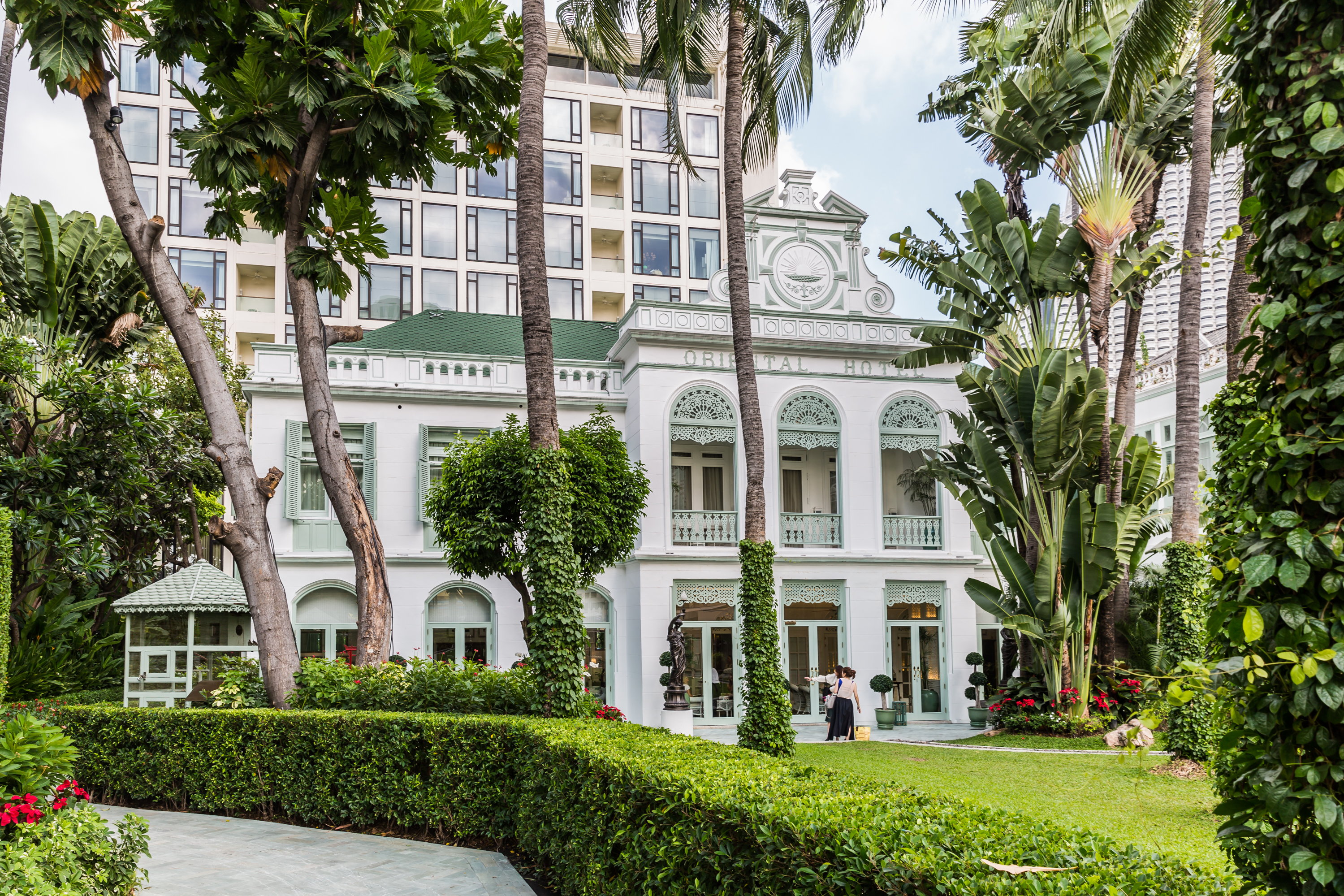
The hotel's first grand event was a banquet on 24 May 1888, celebrating the Golden Jubilee of Queen Victoria. That occasion put the Oriental on the map for visiting dignitaries, but the decisive endorsement came in December 1890, when King Chulalongkorn personally inspected the premises. Satisfied that the hotel met the standard required for royal guests, the king gave his approval. The payoff arrived in April 1891, when the entourage of Crown Prince Nicholas of Russia -- the future Tsar Nicholas II -- stayed at the hotel. A procession of writers, diplomats, and heads of state would follow across the decades. The hotel cultivated these connections carefully, eventually naming suites after its most famous literary guests and creating an Authors' Wing that remains one of its signature features. The 19th-century building that houses it is the oldest surviving structure in the hotel complex.
The Photographer Who Became a Hotelier
Germaine Krull had no hotel experience when she took over as manager in 1947. What she had was resourcefulness honed by an extraordinary life -- born in Germany in 1897, she became a celebrated photographer in Paris, then served as a war correspondent for Agence France-Presse in the Pacific. When the six-person partnership acquired the war-damaged Oriental, Krull volunteered to run it. She turned out to be a natural. Under her management, the hotel regained its reputation as Bangkok's premier accommodation. Jim Thompson contributed his architectural and artistic sensibilities to the restoration before departing the partnership over disagreements about a planned new wing. To compete with popular local nightspots, including a bar called Chez Eve, Krull established the Bamboo Bar, which became one of Bangkok's most storied drinking establishments. In 1958, the ten-story Garden Wing opened with the city's first elevator and a French restaurant, Le Normandie, that would earn its own decades of acclaim.
Two Flagships, One Name
The hotel's modern corporate identity formed through a merger of legacies. In 1974, the Mandarin Hotel in Hong Kong acquired a 49 percent interest in The Oriental, Bangkok, creating the unusual situation of a hotel group with two flagship properties. For years, both operated under their own names. In 1985, the company rationalized by uniting them as Mandarin Oriental Hotel Group. The Bangkok property formally became Mandarin Oriental, Bangkok in September 2008, retiring the name that had identified it for over 130 years. The awards continued to accumulate: ranked the best hotel in the world by the Telegraph in 2024, rated second globally by Hotels Digest in early 2026, and a perennial fixture on Conde Nast and Travel + Leisure best-of lists. The hotel sits today where it has always been, on the east bank of the Chao Phraya, its original 1887 structure still standing -- a place where a $250 investment once bought a share of what became a legend.
From the Air
Located at 13.72N, 100.51E on the east bank of the Chao Phraya River in Bangkok's Bang Rak District. The hotel complex is visible along the riverbank, with the historic Authors' Wing distinguishable among newer towers. Best viewed at 1,500-2,500 feet following the river. Nearest airports: Don Mueang (VTBD) approximately 16 nm north, Suvarnabhumi (VTBS) approximately 18 nm east-southeast.