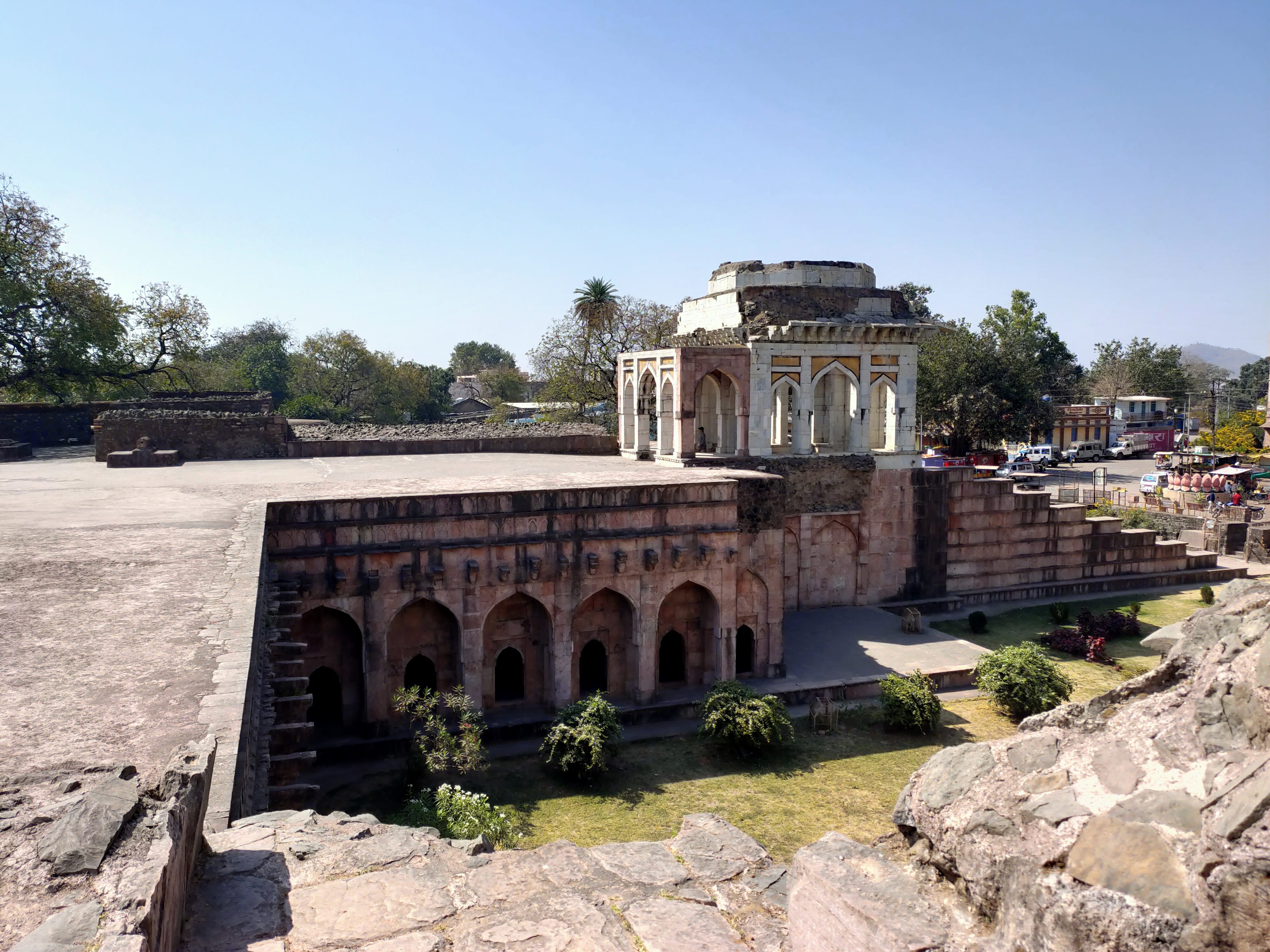
Mandu
Between two artificial lakes on a windswept plateau, a palace appears to float on water. The Jahaz Mahal -- the Ship Palace -- is the signature ruin of Mandu, a fortress city perched 633 meters above the plains of central India on the Vindhya Range. For over six centuries, sultans, emperors, and conquerors fought to hold this 13-kilometer-long hilltop stronghold, each leaving behind monuments that together form one of the subcontinent's richest architectural collections. Today Mandu is largely deserted, its palaces crumbling into the monsoon forests, its lakes silting up, its twelve great gates standing watch over empty roads. The ruins are more eloquent for the silence.
A Capital Born of Necessity
Mandu's story begins with retreat. In the 10th and 11th centuries, the Paramara dynasty ruled the Malwa plateau from their capital at Dhara, down in the plains. But as the Delhi Sultanate pressed from the north and the Yadavas of Devgiri threatened from the south, the Paramaras needed higher ground. They found it at Mandapa-Durga -- Mandu -- where steep ravines and the Vindhya cliffs formed natural defenses on every side. The Narmada River valley lay to the south, the Malwa plateau to the north, and only a narrow neck of land connected the fortress to the surrounding hills. It was a position designed by geology for war. In 1305, the Delhi Sultan Alauddin Khalji ended the Paramara reign when his forces, guided by a spy, found a secret way into the fort. King Mahalakadeva died trying to flee on November 24 of that year.
The Ship That Never Sailed
When Timur sacked Delhi in 1401, the governor of Malwa seized his chance at independence. His son Hoshang Shah shifted the capital from Dhar to Mandu and began a building campaign that would transform a military stronghold into a city of extraordinary beauty. The Jahaz Mahal, built by Sultan Ghiyas-ud-din Khalji later in the 15th century, stretches between Munj Talao and Kapur Talao, its long profile reflected in both lakes so that it genuinely resembles a ship at anchor. The palace served as the sultan's harem -- an intimate pleasure palace rather than a seat of power. Nearby, Hoshang Shah's own tomb stands as India's first marble structure, with a proportioned dome, intricate lattice work, and porticoed courts that reportedly served as inspiration for the builders of the Taj Mahal two centuries later.
Walls That Lean and Gates That Multiply
The Hindola Mahal -- the Swing Palace -- takes its name from walls that slope dramatically inward, creating the impression that the entire building is swaying. Constructed around 1425, it may have served as an audience hall, and its massive buttressed walls give it a solidity that belies its whimsical name. The Jami Masjid, inspired by the Great Mosque of Damascus, anchors the religious quarter with vast courtyards and grand proportions. Twelve major darwazas -- gates -- pierce the fortification walls, each defended by smaller subsidiary gates, creating a layered defense that invaders had to breach one barrier at a time. The entire wall circuit runs some 37 kilometers, enclosing what was once a self-contained world of palaces, mosques, tombs, and lakes.
The Last Sultan's Song
Mandu's most romantic chapter belongs to its last independent ruler. Baz Bahadur, who came to power in the mid-16th century, was renowned not as a warrior but as a musician and poet. His love for the Hindu singer Rani Rupmati became the stuff of legend -- her pavilion still crowns the southernmost point of the plateau, its arched windows framing views down to the Narmada valley where she could see her beloved river. When the Mughal general Adham Khan conquered Mandu in 1561, Rupmati reportedly poisoned herself rather than be captured. Baz Bahadur fled, spent years as a fugitive, and finally surrendered to Emperor Akbar at Nagaur in 1570, joining Mughal service. His palace and Rupmati's pavilion stand just close enough to suggest the connection, just far enough apart to hint at the tragedy.
Monsoon Ghosts
Today Mandu comes alive during the monsoon, when the plateau's lakes fill and the ruins disappear into curtains of rain and mist. The annual Mandu Festival brings music, lights, and adventure activities to the Jahaz Mahal. But for much of the year, the fortress city belongs to the langurs that clamber over Hoshang Shah's tomb and the peacocks that strut through the Hindola Mahal. Indore, the nearest major city, lies about 100 kilometers to the southeast, yet the plateau feels far more remote than that distance suggests. The Songarh citadel, separated from the main hill by a narrow land bridge and surrounded by ravines, stands in spectacular ruin -- an impregnable keep inside an impregnable fort, now open to nothing but weather and time.
From the Air
Located at 22.34°N, 75.42°E on the Vindhya Range in Madhya Pradesh, India. From altitude, Mandu appears as a long, narrow plateau extending roughly 13 km, with the ruins of palaces, mosques, and fortification walls visible amid green forest cover. The Jahaz Mahal is identifiable as a long rectangular structure between two lakes. The Narmada River valley lies to the south, and the flat Malwa plateau extends to the north. The nearest airport is Devi Ahilya Bai Holkar Airport (VAID) at Indore, approximately 100 km southeast. The Satpura Range and Vindhya Range create the surrounding terrain. Best viewed in clear conditions at moderate altitude.