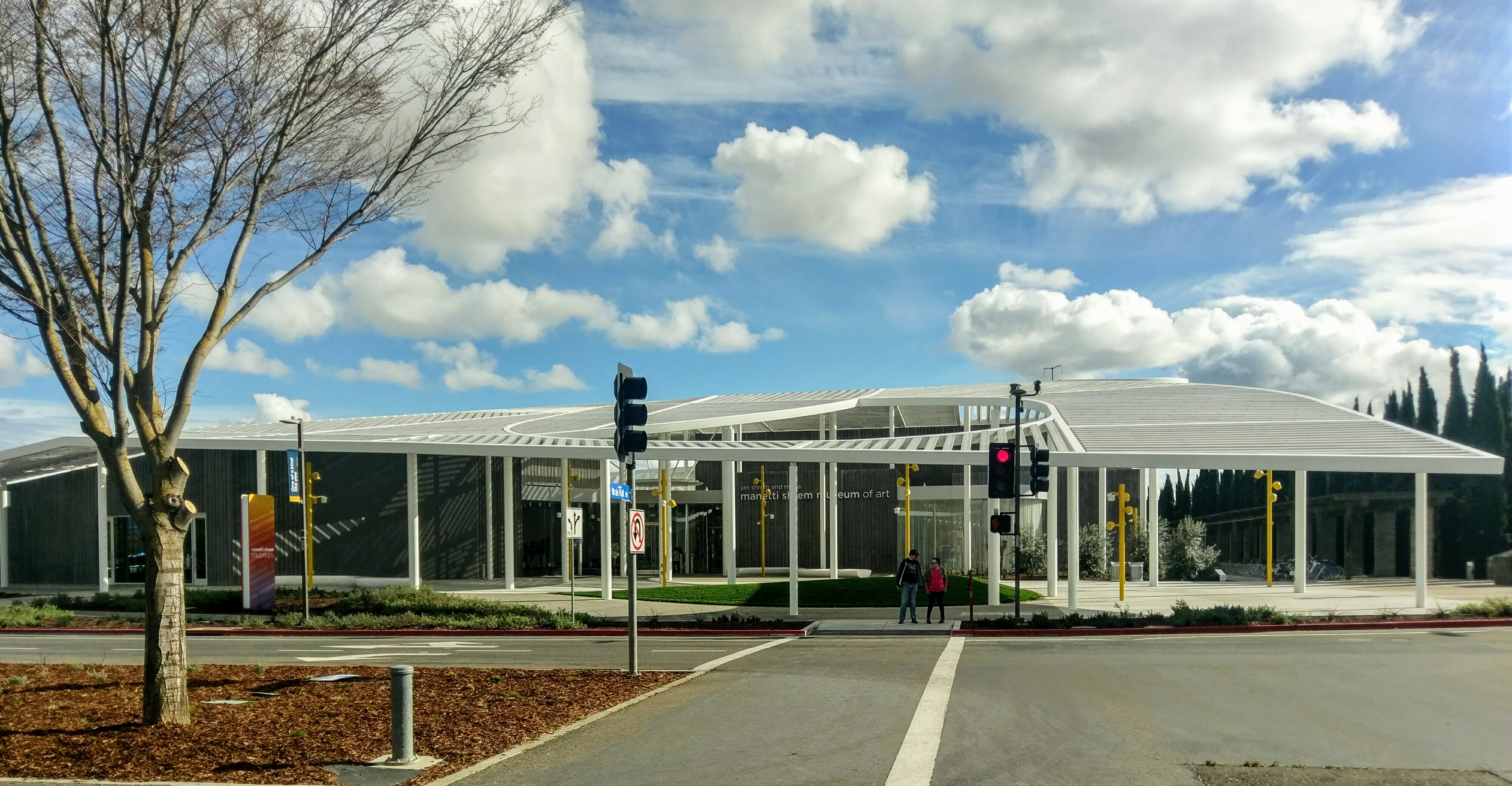
Canopy of Light: The Manetti Shrem Museum of Art
For nearly sixty years, the artists who taught at UC Davis had no proper museum to show what they had made. Wayne Thiebaud painted his luminous cakes and pies. Robert Arneson fired irreverent ceramic self-portraits. William T. Wiley and Roy De Forest pushed into territory so playful and strange that critics eventually gave it a name: Funk art. All of this happened at a university surrounded by tomato fields and almond orchards, and the art stayed largely invisible beyond the campus. Then, in November 2016, a building opened that finally matched the ambition of what had been created inside those studios. The Jan Shrem and Maria Manetti Shrem Museum of Art does not hide behind walls. Its defining feature is a grand canopy, a sweeping lattice of perforated aluminum and steel that floats above the grounds, casting shifting patterns of light and shadow across the paths below. The geometry of that canopy was drawn from the very fields that surround Davis, farm rows translated into architecture.
The Faculty That Changed American Art
Richard L. Nelson founded the art department at UC Davis in the early 1960s, and the faculty he recruited reads like a roster of postwar California art's most restless minds. Thiebaud brought painterly precision to everyday objects. Arneson turned ceramics into confrontation. Manuel Neri sculpted raw, expressive human figures. Roland Petersen layered color into landscapes. De Forest filled canvases with fantastical creatures and dense psychedelic narratives. Several of these artists became associated with Funk art, a Bay Area movement that rejected the seriousness of Abstract Expressionism in favor of humor, irreverence, and the handmade. The New York Times would later describe the museum's holdings as representing "trailblazing contributions by the school's renowned art faculty, which contributed to innovations in conceptual, performance and video art in the 1960s and 70s." The art was always there. What was missing, for decades, was a place worthy of displaying it.
Architecture as Invitation
The architects Florian Idenburg and Jing Liu of the Brooklyn firm SO-IL, partnering with Bohlin Cywinski Jackson, designed a building that refuses to separate indoors from out. A lobby with polished concrete floors curves behind floor-to-ceiling glass. Galleries of varying sizes and heights are topped with aluminum mesh ceilings that leave mechanical systems visible rather than concealed. But the true architectural statement is the canopy: a perforated aluminum and steel roof that extends beyond the building itself, creating textured light and shadows across the surrounding grounds. Architecture critic Christopher Hawthorne, writing in the Los Angeles Times, recognized it as a building that hints at fresh directions for American architecture. The canopy does not provide shade so much as it transforms light, filtering the Central Valley sun into something dappled and shifting, a quality that changes by the hour and the season.
From Napa Valley to the Quad
The museum exists because of Jan Shrem and Maria Manetti Shrem, whose generosity turned a faculty dream into concrete and aluminum. Jan Shrem, a winemaker best known for founding Clos Pegase winery in Napa Valley, did not simply write checks. He donated works from his personal art collection, including sculptures that now anchor the museum's holdings. The collection today encompasses nearly 6,000 objects, among them significant works by Bruce Nauman, who earned his MFA from UC Davis in 1966 and went on to become one of the most influential artists of the late twentieth century. Nauman's early experiments with neon, video, and performance owe something to the atmosphere Davis cultivated during those years, a place where artistic categories were treated as suggestions rather than rules.
A Campus Finally Complete
What the Manetti Shrem achieved was not merely institutional. It completed something emotional. For decades, the art made at UC Davis had been scattered across inadequate galleries and faculty offices, its influence felt more in New York and Los Angeles than on the campus where it was created. The museum gathered all of that energy under one roof, or rather under one extraordinary canopy, and gave it a permanent address. Walk beneath the latticed steel at midday and the ground is covered in shifting geometric shadows that recall the ordered rows of the agricultural fields visible from the campus edge. The building does not compete with the art inside it. Instead, it extends the same idea outward: that creativity at Davis has always been rooted in the landscape, drawing from the practical and the earthy even as it reached for something stranger and more ambitious.
From the Air
Located at 38.5335N, 121.7478W on the UC Davis campus in the Sacramento Valley. The museum's distinctive perforated aluminum canopy is visible from low altitude as a geometric metallic structure on the southeast edge of campus. University Airport (KEDU) is less than 2 miles to the west. Sacramento Executive Airport (KSAC) lies approximately 15 miles east. The flat Central Valley farmland surrounding Davis makes the campus easy to identify from altitude, and the museum's canopy catches sunlight distinctively.